
具体描述
Review
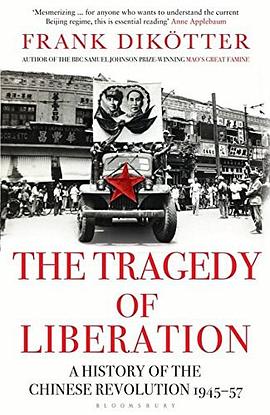
An excellent, angry book about Mao’s so-called “productive years” ... He has written a brilliant and powerful account of the formation of that society. This is an angry book, but its fury is always contained within a framework of impressive research and elegant prose ... The effect is fascinating: it brings to the fore a variety of actors at a local level who sought to implement the dictates of the new state, often without scruple or wisdom. One of the book’s many merits is that it gives full weight to the Chinese countryside, drawing on previously closed local archives ... He does an excellent job of showing how the new order gradually took shape ... Even if the book is likely to spark debates about the nature of the socio-economic crisis stimulated by the PRC’s policies, few will be able to deny the human suffering brought about in the name of the new society and described by the author with brutal clarity ... Nobody who reads about the cost of the establishment of the PRC in Dikotter’s humane and lucid prose will find much sympathy for the authoritarian case. This excellent book is horrific but essential reading for all who want to understand the darkness that lies at the heart of one of the world’s most important revolutions (Guardian)
Frank Dikötter, now well into his stride as a meticulous chronicler of China’s greatest miseries ... The Tragedy of Liberation is a tightly-written narrative of the twelve most pivotal years in modern Chinese history ... The book is also a dispassionate study of the way nations can pervert optimism and descend into lunacy by steady increments ... The Tragedy of Liberation is more unsettling. For what it tells us about the foundations of the modern Communist Party, and the backstory to so many decisions and statements made in Beijing today, it is essential reading (The Times)
Frank Dikötter’s powerful new book is a bold and startling attempt to rectify this apparent neglect. In a cool, dispassionate narrative, Dikötter recounts the orgy of violence which the communists set loose ... The Tragedy of Liberation demonstrates why he has established himself as a leading historian of modern China. He is a rare scholar, adept in both Russian and Chinese ... Dikötter has a writer’s gift in the use of English ... Dikötter must be admired for the manner in which he puts a human scale on the enormous barbarities of the communist takeover of China. We cannot begin to understand modern China without being aware of the blood-drenched tale Dikötter so ably relates (Kwasi Kwarteng, Evening Standard)
A mesmerizing account of the communist revolution in China, and the subsequent transformation of hundreds of millions of lives through violence, coercion and broken promises. The Chinese themselves suppress this history, but for anyone who wants to understand the current Beijing regime, this is essential background reading (Anne Applebaum)
This follow up to Dikötter’s award-winning Mao’s Great Famine examines the early bloodstained years of Communist China (The Times, Critics’ Choices)
One-party states take control of the past as they take control of societies. Usually they must end for serious historical discussion to begin. A great intellectual challenge of our century is to historicize the People’s Republic even as it continues to exist. Dikötter performs here a tremendous service by making legible the hugely controversial origins of the present Chinese political order (Tim Snyder)
Dikotter’s third volume in the series will treat the larger-scale violence of the Cultural Revolution, so unlimited access might slow him up somewhat. But if I know Frank Dikotter, it will not stop him (Independent)
A history of early Maoist China puts paid to any notion of a “golden age” ... In The Tragedy of Liberation ... Frank Dikotter convincingly demolishes this rosy assessment of the early People’s Republic ... The book is a remarkable work of archival research. Dikotter rarely, if ever, allows the story of central government to dominate by merely reporting a top-down directive. Instead, he tracks down the grassroots impact of Communist policies – on farmers, factory workers, industrialists, students, monks – by mining archives and libraries for reports, surveys, speeches and memoirs. In so doing, he uncovers astonishing stories of party-led inhumanity and also popular resistance ... Dikotter sustains a strong human dimension to the story by skilfully weaving individual voices through the length of the book (Financial Times)
This groundbreaking book examines the bloodstained reality behind the word and reveals how it brought tragedy to millions. Frank Dikotter is already the author of a revelatory book about China’s great famine of 1958-62, and in this prequel – unsparing in its detail, relentless in its research, unforgiving in its judgments – he deals in the same way with the Chinese revolution from 1945 to 1957 ... This exhaustive trawl through Chinese archives charts the full cost of those early years of change ... Dikotter’s achievement in this book is remarkable. He has mastered a mass of original source material, and has done so by mining local archives in China, which have yielded up a host of treasures. (Significantly, scholars are now reporting the steady closure of official records, as local bureaucrats revert to old habits of secrecy and isolation. This may be the last work of its kind for a while.) ... Staggering amount of detail ... For many years, histories of China have treated the 1950s as if the decade was an interlude of reason. That belief does not survive contact with this book ... It is clear to this reviewer, at least, that mainstream academic scholarship must also be revised in the light of Dikotter’s work. In particular, volume 14 of the Cambridge History of China, which covers the period of this book, will have to be rewritten (Sunday Times)
Path-breaking ... Some of what Dikotter describes has been known in general terms, but what he has done here – as when he was writing about the later famine – is take advantage of the opening of archives in which firsthand official reports and accounts of death in all its forms, together with the myriad other forms of Maoist horror, can now be read unedited. It will be increasingly difficult for Western China specialists to write with authority based only on previous Western publications or on Chinese public statements. We remain in Frank Dikotter’s debt (Literary Review)
With a mixture of passion and ruthlessness, he marshals the facts, many of them recently unearthed in party archives. Out of these, Mr Dikotter constructs a devastating case for how extreme violence, not a moral mandate, was at the heart of how the party got to power, and of how it then governed ... He was ready to lead the country into the giant experiment of the Great Leap Forward. Mr Dikotter has already written about that in “Mao’s Great Famine”, which this book only betters. The final volume of his planned trilogy will be on the Cultural Revolution, bringing the curtain down on a truly disastrous period (Economist)
Frank Dikotter’s powerful new book is a bold and startling attempt to rectify this apparent neglect. In a cool, dispassionate narrative, Dikotter recounts the orgy of violence which the communists set loose ... The Tragedy of Liberation demonstrates why he has established himself as a leading historian of modern China. He is a rare scholar, adept in both Russian and Chinese ... Combined with this linguistic skill, Dikotter has a writer’s gift in the use of English. The narrative of The Tragedy of Liberation is always clear and simple ... Dikotter ... Must be admired for the manner in which he puts a human scale on the enormous barbarities of the communist takeover of China. We cannot begin to understand modern China without being aware of the blood-drenched tale Dikotter so ably relates (Scotsman)
Unsparing reappraisal of China’s communist revolution (Sunday Times Must Reads)
Frank Dikotter, Professor of Humanities at the University of Hong Kong, is establishing himself as the chronicler of what happened to the most populous nation on Earth during Mao’s 27-year reign ... Dikotter’s great achievement is to have melded together the big picture of Mao with the smaller one of what was happening to millions of victims of his policies. In doing so he’s produced a book that’s as authoritative as it is gripping (Mail on Sunday)
Much of what Dikötter describes has been known in outline; but Chinese history will have to be revised in light of his detailed revelations (The Week)
The historian of China Frank Dikötter has taken a sledgehammer to demolish perhaps the last remaining shibboleth of modern Chinese history ... What emerges from the archives with new clarity is just how ruinous Mao’s policies were (Spectator)
A meticulous reappraisal of the formative years of Maoist rule ... This is the first study to make sense in detail of events central to the Mao era, of which only the broad outlines have been known before now. It deserves to become fundamental to a better understanding of the forces that have shaped China today (Sunday Telegraph)
Startling ... Dikötter’s work has aimed to demolish almost every claim to truth or virtue the Chinese Communist party ever made. He combines a vivid eye for detail with a Historuan’s diligence in the archives. Powerful ... Dikötter is unsparing in his account of the effects of the communist rule (Observer)
作者简介
Frank Dikötter is Chair Professor of Humanities at the University of Hong Kong. Before moving to Asia in 2006, he was Professor of the Modern History of China at the School of Oriental and African Studies, University of London. He has published nine books about the history of China, including Mao’s Great Famine, which won the BBC Samuel Johnson Prize for Non-fiction in 2011.
http://www.frankdikotter.com/
目录信息
读后感
用户评价
这本书的后劲实在太大了。它不是那种读完就束之高阁的娱乐读物,而是一部会住进你心里的作品。故事中的人物们所经历的痛苦、他们为了心中的信念付出的巨大牺牲,在合上书本很久之后,仍然会以一种潜移默化的方式影响你对现实世界的看法。我开始重新审视身边那些看似理所当然的“安定”与“秩序”,思考它们背后的代价和维护成本。它成功地制造了一种强烈的共鸣感,让你仿佛身临其境地感受到了历史的脉搏和呼吸。这种深刻的情感投射和对现实的反思,远远超出了一个普通故事所能提供的范畴,更像是一次精神上的洗礼,让人在敬畏之余,对未来抱持着一种审慎而坚定的希望。
这本书简直是令人震撼的史诗巨作,它以一种近乎残酷的坦诚,剖析了人类历史进程中那些最核心的矛盾与挣扎。作者的笔触细腻入微,仿佛能穿透时间的迷雾,直抵事件发生的瞬间。我尤其欣赏它对复杂人性深度的挖掘,书中描绘的那些人物,没有绝对的善恶之分,他们的每一个抉择都充满了沉重的代价和无可奈何的挣扎。那种在宏大历史背景下,个体命运的渺小与不屈,被刻画得淋漓尽致。阅读过程中,我数次停下来,深思那些关于自由、牺牲与代价的哲学命题。它不仅仅是一本记录历史的书,更像是一面映照我们内心深处恐惧与希望的镜子。那种情绪的张力,从开篇的压抑到高潮部分的爆发,再到最后的余韵悠长,构建了一个极其完整且令人难忘的阅读体验。读完之后,那种意犹未尽的感觉久久不能散去,迫使我不断回味那些深刻的场景和精妙的对话。
坦白说,初读此书时我感到有些气馁,因为它需要读者投入极大的专注力去理解其中复杂的历史背景和哲学术语。但一旦跨过了最初的门槛,你会发现作者对细节的考究达到了令人发指的程度。每一个地名、每一个历史事件的引用,都经过了严谨的考证,这使得整部作品具有极高的学术价值,绝非泛泛之谈。作者似乎拥有将冷峻的史实与鲜活的生命力熔铸于一炉的魔力。它强迫我走出舒适区,去查阅大量的背景资料,这种主动学习的过程,极大地拓宽了我的视野。对于那些不满足于肤浅故事的读者来说,这本书绝对是一份无价的知识宝库,值得反复研读,每一次重读都会有新的领悟浮现。
如果用一个词来形容这本书带给我的感受,那就是“沉重而美丽”。它的文字本身就具有一种古典的韵律感和极强的画面感。作者对于环境和氛围的描摹达到了近乎诗意的境界,即使是描绘最黑暗、最悲惨的场景,字里行间依然流淌着一种令人心碎的美感。我特别喜欢它在描写自然景象时所蕴含的象征意义,那些风暴、荒原或是黎明的微光,无不呼应着人物内心的挣扎与转变。这种美学上的追求,使得即便是面对严肃甚至令人不适的主题时,阅读体验也不会沦为单纯的苦涩,反而升华成了一种对生命力的赞颂。它提醒我们,即使在最绝望的境地里,人性的光辉和对美的感知依然存在,并能成为支撑下去的力量。
这是一部在叙事结构上极具野心和创意的作品。作者似乎毫不费力地在不同时空维度间穿梭,却始终保持着令人惊叹的清晰度。情节的推进并非线性,而是采用了多线程交织的方式,像一张巨大的蛛网,将无数看似无关的线索巧妙地编织在一起,直到最后才猛然收紧,揭示出隐藏在表象之下的宏大图景。这种叙事技巧极大地增强了阅读的沉浸感和智力上的挑战性。每一章的结尾都设计得极其巧妙,总能留下一个引人入胜的悬念,让人忍不住想立刻翻到下一页,去探寻真相的另一角。不同角色的视角切换处理得非常成熟,使得整个故事的世界观饱满立体,避免了单一视角的局限性。它考验读者的耐心,但给予的回报是巨大的知识和情感上的满足感。
读的联经中文版。每一页都是黑料,每一个黑料都是血染的,此书更像是黑料汇编。相当一部分陶、邓的黑料。还有经常性引用李志绥和张戎的问题已经有人说了,鉴于冯客的立场,我觉得这些问题倒不大,把有问题的史料忽略便好。这本书的真正价值在于其中大多数黑料的来源都是“内部参考”以及来往电报。
可以看出这是一本毫不客气的历史作品,观点犀利,冯客的目标是将此前广泛理解的建国后10年的所谓黄金岁月,抨击到一无是处,为此从农业、军事、经济、政治、思想和文化等各个方面举证论述,每一个方面都从实际影响人群出发并落脚,同时给出了非常具体的死亡人数,最终的矛头都指向了一个人,也是三部曲中后两部的序曲和完美铺垫。这本书的纪实性很强,如同记者撰写的深度调查报告,然而一页又一页不断更换花样记述的恐怖行为,会令人厌烦和压抑。 该书最独到也最讽刺的地方在于,虽然众所周知知识分子群体在50年代的各种运动中遭受极其恶劣的对待,但是却非当时各种斗争下的最大受害者,农村地区所遭受的损害和苦难要更超乎想象。
引用了大量的一手资料,尤其是档案资料,这些档案目前已经很难看到。对于那段历史,做了很好的勾勒,其切入的角度,也很有新意。其中很多史实,还是挺让人惊异的。
怎么又被删了……
五星级黑材料