
具体描述
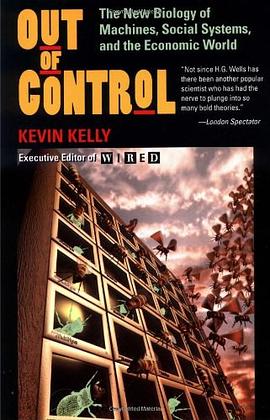
Out of Control is a summary of what we know about self-sustaining systems, both living ones such as a tropical wetland, or an artificial one, such as a computer simulation of our planet. The last chapter of the book, "The Nine Laws of God," is a distillation of the nine common principles that all life-like systems share. The major themes of the book are:
As we make our machines and institutions more complex, we have to make them more biological in order to manage them.
The most potent force in technology will be artificial evolution. We are already evolving software and drugs instead of engineering them.
Organic life is the ultimate technology, and all technology will improve towards biology.
The main thing computers are good for is creating little worlds so that we can try out the Great Questions. Online communities let us ask the question "what is a democracy; what do you need for it?" by trying to wire a democracy up, and re-wire it if it doesn't work. Virtual reality lets us ask "what is reality?" by trying to synthesize it. And computers give us room to ask "what is life?" by providing a universe in which to create computer viruses and artificial creatures of increasing complexity. Philosophers sitting in academies used to ask the Great Questions; now they are asked by experimentalists creating worlds.
As we shape technology, it shapes us. We are connecting everything to everything, and so our entire culture is migrating to a "network culture" and a new network economics.
In order to harvest the power of organic machines, we have to instill in them guidelines and self-governance, and relinquish some of our total control.
作者简介
Kevin Kelly is Senior Maverick at Wired magazine. He co-founded Wired in 1993, and served as its Executive Editor from its inception until 1999. He has just completed a book for Viking/Penguin publishers called "What Technology Wants," due out in the Fall 2010. He is also editor and publisher of the Cool Tools website, which gets half a million unique visitors per month. From 1984-1990 Kelly was publisher and editor of the Whole Earth Review, a journal of unorthodox technical news. He co-founded the ongoing Hackers' Conference, and was involved with the launch of the WELL, a pioneering online service started in 1985. He authored the best-selling New Rules for the New Economy and the classic book on decentralized emergent systems, Out of Control.
目录信息
Neo-biological civilization
The triumph of the bio-logic
Learning to surrender our creations
Chapter 2: HIVE MIND
Bees do it: distributed governance
The collective intelligence of a mob
Asymmetrical invisible hands
Decentralized remembering as an act of perception
More is more than more, it's different
Advantages and disadvantages of swarms
The network is the icon of the 21st century
Chapter 3: MACHINES WITH AN ATTITUDE
Entertaining machines with bodies
Fast, cheap and out of control
Getting smart from dumb things
The virtues of nested hierarchies
Using the real world to communicate
No intelligence without bodies
Mind/body black patch psychosis
Chapter 4: ASSEMBLING COMPLEXITY
Biology: the future of machines
Restoring a prairie with fire and oozy seeds
Random paths to a stable ecosystem
How to do everything at once
The Humpty Dumpty challenge
Chapter 5: COEVOLUTION
What color is a chameleon on a mirror?
The unreasonable point of life
Poised in the persistent state of almost falling
Rocks are slow life
Cooperation without friendship or foresight
Chapter 6: THE NATURAL FLUX
Equilibrium is death
What came first, stability or diversity?
Ecosystems: between a superorganism and an identity workshop
The origins of variation
Life immortal, ineradicable
Negentropy
The fourth discontinuity: the circle of becoming
Chapter 7: EMERGENCE OF CONTROL
In ancient Greece the first artificial self
Maturing of mechanical selfhood
The toilet: archetype of tautology
Self-causing agencies
Chapter 8: CLOSED SYSTEMS
Bottled life, sealed with clasp
Mail-order Gaia
Man breathes into algae, algae breathes into man
The very big ecotechnic terrarium
An experiment in sustained chaos
Another synthetic ecosystem, like California
Chapter 9: POP GOES THE BIOSPHERE
Co-pilots of the 100 million dollar glass ark
Migrating to urban weed
The deployment of intentional seasons
A cyclotron for the life sciences
The ultimate technology
Chapter 10: INDUSTRIAL ECOLOGY
Pervasive round-the-clock plug in
Invisible intelligence
Bad-dog rooms vs. nice-dog rooms
Programming a commonwealth
Closed-loop manufacturing
Technologies of adaptation
Chapter 11: NETWORK ECONOMICS
Having your everything amputated
Instead of crunching, connecting
Factories of information
Your job: managing error
Connecting everything to everything
Chapter 12: E-MONEY
Crypto-anarchy: encryption always wins
The fax effect and the law of increasing returns
Superdistribution
Anything holding an electric charge w ill hold a fiscal charge
Peer-to-peer finance with nanobucks
Fear of underwire economies
Chapter 13: GOD GAMES
Electronic godhood
Theories with an interface
A god descends into his polygonal creation
The transmission of simulacra
Memorex warfare
Seamless distributed armies
A 10,000 piece hyperreality
The consensual ascii superorganism
Letting go to win
Chapter 14: IN THE LIBRARY OF FORM
An outing to the universal library
The space of all possible pictures
Travels in biomorph land
Harnessing the mutator
Sex in the library
Breeding art masterpieces in three easy steps
Tunnelling through randomness
Chapter 15: ARTIFICIAL EVOLUTION
Tom Ray's electric-powered evolution machine
What you can't engineer, evolution can
Mindless acts performed in parallel
Computational arms race
Taming wild evolution
Stupid scientists evolving smart molecules
Death is the best teacher
The algorithmic genius of ants
The end of engineering's hegemony
Chapter 16: THE FUTURE OF CONTROL
Cartoon physics in toy worlds
Birthing a synthespian
Robots without hard bodies
The agents of ethnological architecture
Imposing destiny upon free will
Mickey Mouse rebooted after clobbering Donald
Searching for co-control
Chapter 17: AN OPEN UNIVERSE
To enlarge the space of being
Primitives of visual possibilities
How to program happy accidents
All survive by hacking the rules
The handy-dandy tool of evolution
Hang-gliding into the game of life
Life verbs
Homesteading hyperlife territory
Chapter 18: THE STRUCTURE OF ORGANIZED CHANGE
The revolution of daily evolution
Bypassing the central dogma
The difference, if any, between learning and evololution
The evolution of evolution
The explanation of everything
Chapter 19: POSTDARWINISM
The incompleteness of Darwinian theory
Natural selection is not enough
Intersecting lines on the tree of life
The premise of non-random mutations
Even monsters follow rules
When the abstract is embodied
The essential clustering of life
DNA can't code for everything
An uncertain density of biological search space
Mathematics of natural selection
Chapter 20: THE BUTTERFLY SLEEPS
Order for free
Net math: a counter-intuitive style of math
Lap games, jets, and auto-catalytic sets
A question worth asking
Self-tuning vivisystems
Chapter 21: RISING FLOW
A 4 billion year ponzi scheme
What evolution wants
Seven trends of hyper-evolution
Coyote trickster self-evolver
Chapter 22: PREDICTION MACHINERY
Brains that catch baseballs
The flip side of chaos
Positive myopia
Making a fortune from the pockets of predictability
Operation Internal Look, Ahead
Varieties of prediction
Change in the service of non-change
Telling the future is what the systems are for
The many problems with global models
We are all steering
Chapter 23: WHOLES, HOLES, AND SPACES
What ever happened to cybernetics?
The holes in the web of scientific knowledge
To be astonished by the trivial
Hypertext: the end of authority
A new thinking space
Chapter 24: THE NINE LAWS OF GOD
How to make something from nothing
Hijacking the universe
ANNOTATED BIBLIOGRAPHY
A to L
M to Z
· · · · · · (收起)
读后感
书名《失控》,英文《Out of Control: The New Biology of Machines, Social Systems, and the Economic World》,听起来挺唬人,再加上黑黄色的封面,让人以为又是一本写于90年代的末日论著作。 实际上这是一本充满浪漫主义情怀的书。它描述了随着逐步放弃对机器的精确控制,...
书名《失控》,英文《Out of Control: The New Biology of Machines, Social Systems, and the Economic World》,听起来挺唬人,再加上黑黄色的封面,让人以为又是一本写于90年代的末日论著作。 实际上这是一本充满浪漫主义情怀的书。它描述了随着逐步放弃对机器的精确控制,...
研读《失控》,就如同一次冒险之旅,你会发现自己正身处一个不断拓展的可能性之库,一个开放的大千世界,甚至分不清是真实还是梦境。 原链接:http://dongxi.net/b04XW 技术超验主义者的生命之书 ——评凯文·凯利《失控》 梭罗这人有脑子 月亮照着他的鼻子 …… 梭罗这人有脑...
很幸运年终前能读到两本出版已久的好书:查理芒格《穷查理宝典》及KK的《失控》。 查理在前书中指出,一般人只要能掌握几门基础学科——如数学、物理、生物学、心理学等——的十几种基本模式,就正确认识和分析生活中相当多的问题。而KK在《失控》中也不断重复,指要在基本基...
《失控》第八章:控制的兴趣,共6小节,分别为:密封的瓶装生命、邮购盖亚、人与绿藻息息相关、巨大的生态技术玻璃球、在持久的混沌中进行的实验和另外一种合成生态系统 在第六节另外一种生态系统中有这样一句话:“在封闭系统中,共同进化的多样性得到了集中体现。把虾倒进一...
用户评价
我对于那些能够让我从头到尾都保持好奇心的书,总是格外喜爱。《Out of Control》就是这样一本。它就像一位技艺精湛的魔术师,一次又一次地变出令人惊叹的花样,让我目不暇接。我迫不及待地想知道接下来会发生什么,这种期待感贯穿了整个阅读过程。
阅读《Out of Control》的过程,就像是在解开一个复杂的谜题。我常常会在脑海中勾勒出各种可能的结局,但每一次都被作者出人意料的转折所打败。这种惊喜感是我最看重的阅读体验之一,而这本书恰好满足了我的需求。它不像一些故弄玄虚的作品,让你觉得作者在故意吊胃口,而是用一种自然而然的方式,将故事推向一个又一个高潮。
从文学的角度来说,这本书的语言也是值得称赞的。作者的文字功底很扎实,能够用简洁而有力的语言描绘出复杂的场景和情感。我特别喜欢其中一些段落的描写,仿佛一幅幅画面在我眼前展开,让我心生敬佩。
这本书的节奏感掌握得非常好,时而紧张激烈,时而又会舒缓下来,给读者留出思考的空间。我喜欢作者在制造悬念的同时,又不会让故事变得晦涩难懂。每一个情节的推进都恰到好处,让你既能理解当下的情境,又能对未来的发展充满期待。书中的对话也很有意思,看似平淡无奇,实则暗流涌动,每一个字都可能隐藏着更深层的含义,需要你仔细品味。
一本能够让我真正投入其中,甚至在深夜也忍不住翻开下一页的书,绝对是值得推荐的。这本《Out of Control》正是这样的一本。从我拿到它开始,就仿佛被一种无形的力量吸引,无法自拔。书中的叙事手法非常巧妙,作者似乎懂得如何一点点地剥开真相的层层外衣,让读者在猜测和惊讶中不断前行。我尤其喜欢它对于人物内心世界的刻画,那些细腻的情感波动,那些不为人知的挣扎,都被描绘得淋漓尽致,仿佛我就是其中的一个角色,亲身经历着这一切。
我不得不说,这本书真的颠覆了我对某种主题的认知。在阅读之前,我从未想过事情会以这样的方式展开,也从未意识到一个简单的选择会引发如此连锁的反应。作者的想象力简直是天马行空,但又不像是一些纯粹的幻想小说那样脱离现实。相反,它巧妙地将那些惊人的想法植根于现实的土壤中,让你在读的时候,不禁会思考“如果是我,会怎么做?”这种代入感非常强,让你不仅仅是在阅读一个故事,更是在参与一场思想的盛宴。
这本书带给我的惊喜不仅仅是情节上的,还有它所传达出的某种价值观。它让我思考了关于选择、责任以及命运的意义。作者并没有给出一个简单的答案,而是留给了读者广阔的思考空间。这种开放式的结局,反而让我觉得更加深刻。
这本书带给我一种深刻的思考。它不仅仅是一个精彩的故事,更像是一面镜子,照出了人性中复杂的一面。我能够从中看到自己的影子,也能够反思一些自己过去的想法和行为。作者并没有简单地将人物划分为好人和坏人,而是展现了他们在特定情境下的选择和挣扎,这使得人物形象更加立体和丰满。
我喜欢这本书带来的那种“余味”。读完之后,故事并没有立刻在我脑海中消失,而是久久萦绕,让我不断地回味其中的情节和人物。我甚至会和朋友们讨论这本书,分享各自的理解和感受。这种能够引发持续讨论的书,绝对是值得一读的。
我尤其欣赏这本书在细节上的处理。作者仿佛拥有敏锐的观察力,能够捕捉到生活中那些容易被忽略的瞬间,并将它们巧妙地融入到故事之中,让整个故事更加真实可信。例如,书中对某个场景的描写,我甚至能想象出那里的气味和光线,这种沉浸式的体验是很多书都难以给予的。
无比经典
终于读完这一本,是很好的书。
If scientists debunk truth like this, sooner or later we are going to believe in nothing. This book completely smashed my faith in intelligence, the origin of life, and pretty much everything else. I guess secretly, I am just another anthropocentric narcissist.
http://www.yeeyan.com/groups/show/out%20_of_control
http://www.kk.org/outofcontrol/contents.php