
具体描述
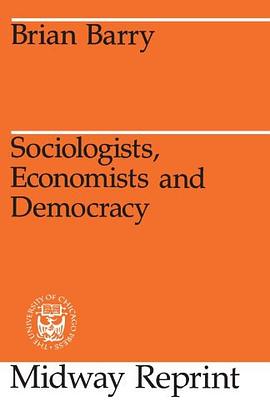
"Rationalist theories of political behavior have recently risen in status to that of a new--or, more accurately, rediscovered--paradigm in the systematic study of politics. Brian Barry's short, provocative book played no small part in the debate that precipitated this shift. . . . Without reservation, Barry's treatise is the most lucid and most influential critique of two important, competing perspectives in political analysis: the 'sociological' school of Talcott Parsons, Gabriel Almond, and other so-called functionalists; and the 'economic' school of Anthony Downs and Mancur Olson, among others."--Dennis J. Encarnation, "American Journal of Sociology
"
作者简介
目录信息
1. The State of Political Theory
2. The Two Approaches Outlined
3. Ideological Origins: Sociological Approach
4. Ideological Origins: Economic Approach
5. Subjects to be Covered
Chapter II - Political Participation as Rational Action
1. The Decision to Vote: Downs and Riker
2. The Decision to Vote: Limits of the Economic Approach
3. The Basic Logic of Olson's Theory
4. Application of Olson's Theory
5. Participation in Collective Action: Some Explanations
6. Selective Incentives as Explanations
7. Leadership and Collective Action
8. Conditions of Economic Rationality
Chapter III - Values and Stable Democracy: Three Theories
1. Introduction
2. Almond and Verba
3. Eckstein
4. Lipset
Chapter IV - Values and Democratic Stability: the Setting and the Problems
1. Introduction
2. Parsons on the 'Hobbesian Problem'
3. Parsons on Norms and Values
4. Values and Social Order
5. Values as Explanations
6. The Problem of Causal Inference
7. How Important are Values?
Chapter V - The Economic Theory of Democracy
1. The Downsian Model Introduced
2. Information Costs and Strategic Abstention
3. Multi-Party Systems
Chapter VI - Testing Theories of Democracy (1)
1. Issues and Voting Decisions: U.S. Data
2. Issues and Voting Decisions: Non-U.S. Data
3. The Problems of Dimensions
4. What is an Issue?
Chapter VII - Testing Theories of Democracy (2)
1. The Aims of Political Parties
2. The Effects of Party Competition
3. Some Sociological Explanations
4. Justifications of Democracy
Chapter VIII - Conclusion
1. Conceptions of 'Theory'
2. Conceptions of 'System' and 'Equilibrium'
3. Underlying Values
4. Implicit Assumptions
5. Relationship of the Two Approaches
Bibliography (with a Postscript 1978)
Subject Index
· · · · · · (收起)
读后感
用户评价
这本书的书名《Sociologists, Economists, and Democracy》一上来就抓住了我的眼球,让我非常好奇。它似乎在暗示着一个非常宏大且重要的议题:不同学科的视角如何交织,共同塑造我们对民主的理解。我脑海中立刻浮现出各种各样的画面,比如社会学家如何分析社会结构、阶层分化对民主参与的影响,他们可能会深入探讨公民社会的活力、社会运动的兴起,以及不同群体在政治决策中的代表性问题。同时,经济学家则可能从资源分配、市场机制、经济不平等如何影响民主制度的稳定性和有效性。我想象着作者可能会引经据典,引用那些奠基性的社会学理论,比如马克思的阶级分析,韦伯的理性化过程,或者涂尔干的社会团结,来阐述社会力量在民主进程中的作用。而经济学方面,可能会涉及自由市场经济的优缺点,福利国家模式的得失,甚至是新自由主义的兴衰对民主政治的冲击。这本书给我的感觉是,它并非只是一本枯燥的学术著作,而是试图通过跨学科的对话,提供一种更全面、更深入的理解民主的框架。我期待着作者能够将复杂的理论以一种引人入胜的方式呈现出来,让我能够更好地理解我们所处的社会和政治现实。
《Sociologists, Economists, and Democracy》这个书名一下子勾起了我研究民主制度的兴趣,尤其是我对那些能够解释民主失败或成功的深层原因的理论感到着迷。我想象着这本书会深入探讨社会资本的微妙作用,比如信任、互惠以及公民参与的程度,是如何支撑一个健康的民主社会的。社会学家们可能会分析,当社会资本枯竭时,民主制度会面临怎样的危机,例如政治冷漠、社会分裂加剧等。而从经济学角度,我猜测这本书会关注那些可能破坏民主的经济因素,比如腐败、财富分配不均造成的社会不公,或者由全球化带来的经济冲击对国内政治稳定的影响。这本书可能还会探讨不同国家在民主化进程中遇到的独特挑战,并试图找出它们在社会和经济结构上的共性或差异。作者可能会用一些生动的案例,比如东欧剧变后的经济转型,或者拉美国家的民主波动,来印证其理论。我期待这本书能够提供一种超越表面现象的分析,揭示出社会和经济力量如何潜移默化地塑造着民主的命运,并为我们理解当前世界政治格局提供有力的理论支撑。
《Sociologists, Economists, and Democracy》这个书名本身就充满了探索的吸引力。它似乎在邀请我深入思考,在构建和维护民主的过程中,社会结构和经济环境究竟扮演着怎样不可或缺的角色。我推测,社会学家们或许会着力分析,不同社会群体,例如青年、老年人、城市居民、农村人口等,在民主进程中的参与方式和诉求有何差异,以及如何才能确保他们的声音都能被听到。他们可能还会探讨,媒体在塑造公众舆论,影响民主选举结果方面的关键作用,以及如何应对虚假信息的泛滥。从经济学角度,我设想书中会深入剖析,经济增长模式、产业结构、就业状况等因素,如何直接或间接地影响公民对民主政府的信任度。这本书也许会探讨,那些导致经济衰退或贫富差距拉大的经济政策,是否会削弱民主制度的合法性,甚至导致政治动荡。我期待这本书能够以一种既有深度又不失可读性的方式,为我揭示社会和经济力量与民主发展之间错综复杂的关系,从而让我对民主的未来前景有更清晰的认识,并思考应对当前挑战的可能途径。
对于《Sociologists, Economists, and Democracy》这个书名,我立刻联想到的是民主制度在实际运行中所面临的种种挑战。我猜测书中会深入分析社会分化对民主政治可能造成的负面影响,例如,当社会阶层之间存在巨大鸿沟,或者不同社会群体之间的隔阂日益加深时,民主的共识和包容性会受到怎样的侵蚀。社会学家们可能会考察,在信息爆炸的时代,谣言和虚假信息如何通过社会网络传播,从而操纵民意,对民主决策过程产生干扰。另一方面,经济学家的视角则可能集中于那些影响民主公平性的经济因素,比如,是否可以通过经济手段来减少政治腐败,或者建立一种更公平的税收和社会福利制度来缓解社会矛盾?这本书或许会探讨,在全球化背景下,跨国资本的流动对各国民主制度带来的冲击,以及如何在全球经济体系中维护民主的独立性和自主性。我希望能从书中获得关于如何构建更具韧性和包容性的民主社会的真知灼见,了解社会和经济力量是如何在塑造民主的未来。
读到《Sociologists, Economists, and Democracy》这个书名,我的第一反应是它可能提供了一种全新的视角来审视民主的演变。我对社会学家们可能会如何剖析民主过程中的权力运作和精英决策感到尤为好奇。他们可能会深入研究政治精英的形成机制,比如通过社会网络、家族背景、教育经历等因素,分析这些精英群体如何影响政策的制定,以及普通民众的意见如何在权力结构中被放大或削弱。社会学也常常关注身份政治的兴起,这本书会不会探讨不同族群、性别、宗教群体在民主转型过程中扮演的角色,以及他们如何争取权益和表达诉求?而经济学的视角,我想象中可能会聚焦于宏观经济政策对民主合法性的影响。比如,经济衰退是否会加剧社会不满,动摇民主政权的根基?或者,是否存在一种经济模式,能够更好地促进民主的健康发展?这本书似乎提供了一个平台,让不同学科的学者能够就这些关键问题进行一场深刻的对话,从而帮助读者摆脱单一学科的局限,获得对民主更立体、更深刻的认知。我渴望这本书能够带来启发性的洞见,让我对民主的复杂性有更清晰的认识。
pros & cons of 'economic' and 'sociological' approach of political theory. insightful discussion of choice and values, but not deep enough: origins of identity? role of institutions?
pros & cons of 'economic' and 'sociological' approach of political theory. insightful discussion of choice and values, but not deep enough: origins of identity? role of institutions?
pros & cons of 'economic' and 'sociological' approach of political theory. insightful discussion of choice and values, but not deep enough: origins of identity? role of institutions?
pros & cons of 'economic' and 'sociological' approach of political theory. insightful discussion of choice and values, but not deep enough: origins of identity? role of institutions?
pros & cons of 'economic' and 'sociological' approach of political theory. insightful discussion of choice and values, but not deep enough: origins of identity? role of institutions?