
具体描述
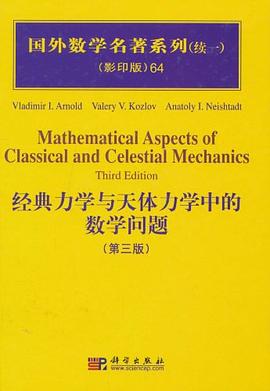
This work describes the fundamental principles, problems, and methods of classical mechanics. The main attention is devoted to the mathematical side of the subject. The authors have endeavored to give an exposition stressing the working apparatus of classical mechanics. The book is significantly expanded compared to the previous edition. The authors have added two chapters on the variational principles and methods of classical mechanics as well as on tensor invariants of equations of dynamics. Moreover, various other sections have been revised, added or expanded. The main purpose of the book is to acquaint the reader with classical mechanics as a whole, in both its classical and its contemporary aspects.The book addresses all mathematicians, physicists and engineers.
作者简介
目录信息
1.1 Newtonian Mechanics
1.1.1 Space, Time, Motion
1.1.2 Newton-Laplace Principle of Determinacy
1.1.3 Principle of Relativity
1.1.4 Principle of Relativity and Forces of Inertia
1.1.5 Basic Dynamical Quantities. Conservation Laws
1.2 Lagrangian Mechanics
1.2.1 Preliminary Remarks
1.2.2 Variations and Extremals
1.2.3 Lagranges Equations
1.2.4 Poincares Equations
1.2.5 Motion with Constraints
1.3 Hamiltonian Mechanics
1.3.1 Symplectic Structures and Hamiltons Equations
1.3.2 Generating Functions
1.3.3 Symplectic Structure of the Cotangent Bundle
1.3.4 The Problem of n Point Vortices
1.3.5 Action in the Phase Space
1.3.6 Integral Invariant
1.3.7 Applications to Dynamics of Ideal Fluid
1.4 Vakonomic Mechanics
1.4.1 Lagranges Problem
1.4.2 Vakonomic Mechanics
1.4.3 Principle of Determinacy
1.4.4 Hamiltons Equations in Redundant Coordinates
1.5 Hamiltonian Formalism with Constraints
1.5.1 Diracs Problem
1.5.2 Duality
1.6 Realization of Constraints
1.6.1 Various Methods of Realization of Constraints
1.6.2 Holonomic Constraints
1.6.3 Anisotropic Friction
1.6.4 Adjoint Masses
1.6.5 Adjoint Masses and Anisotropic Friction
1.6.6 Small Masses
2 The n-Body Problem
2.1 The Two-Body Problem
2.1.1 Orbits
2.1.2 Anomalies
2.1.3 Collisions and Regularization
2.1.4 Geometry of Keplers Problem
2.2 Collisions and Regularization
2.2.1 Necessary Condition for Stability
2.2.2 Simultaneous Collisions
2.2.3 Binary Collisions
2.2.4 Singularities of Solutions of the n-Body Problem
2.3 Particular Solutions
2.3.1 Central Configurations
2.3.2 Homographic Solutions
2.3.3 Effective Potential and Relative Equilibria
2.3.4 Periodic Solutions in the Case of Bodies cf Equal Masses
2.4 Final Motions in the Three-Body Problem
2.4.1 Classification of the Final Motions According to Chazy.
2.4.2 Symmetry of the Past and Future
2.5 Restricted Three-Body Problem
2.5.1 Equations of Motion. The Jacobi Integral
2.5.2 Relative Equilibria and Hill Regions
2.5.3 Hills Problem
2.6 Ergodic Theorems of Celestial Mechanics
2.6.1 Stability in the Sense of Poisson
2.6.2 Probability of Capture
2.7 Dynamics in Spaces of Constant Curvature
2.7.1 Generalized Bertrand Problem
2.7.2 Keplers Laws
2.7.3 Celestial Mechanics in Spaces of Constant Curvature
2.7.4 Potential Theory in Spaces of Constant Curvature
3 Symmetry Groups and Order Reduction.
3.1 Symmetries and Linear Integrals
3.1.1 NSthers Theorem
3.1.2 Symmetries in Non-Holonomic Mechanics
3.1.3 Symmetries in Vakonomic Mechanics
3.1.4 Symmetries in Hamiltonian Mechanics
3.2 Reduction of Systems with Symmetries
3.2.1 Order Reduction (Lagrangian Aspect)
3.2.2 Order Reduction (Hamiltonian Aspect)
3.2.3 Examples: Free Rotation of a Rigid Body and the Three Body Problem
3.3 Relative Equilibria and Bifurcation of Integral Manifolds
3.3.1 Relative Equilibria and Effective Potential
3.3.2 Integral Manifolds, Regions of Possible Motion, and Bifurcation Sets
3.3.3 The Bifurcation Set in the Planar Three-Body Problem
3.3.4 Bifurcation Sets and Integral Manifolds in the Problem of Rotation of a Heavy Rigid Body with a Fixed Point
4 Variational Principles and Methods
4.1 Geometry of Regions of Possible Motion
4.1.1 Principle of Stationary Abbreviated Action
4.1.2 Geometry of a Neighbourhood of the Boundary
4.1.3 Riemannian Geometry of Regions of Possible Motion with Boundary
4.2 Periodic Trajectories of Natural Mechanical Systems
4.2.1 Rotations and Librations
4.2.2 Librations in Non-Simply-Connected Regions of Possible Motion
4.2.3 Librations in Simply Connected Domains and Seiferts Conjecture
4.2.4 Periodic Oscillations of a Multi-Link Pendulum
4.3 Periodic Trajectories of Non-Reversible Systems
4.3.1 Systems with Gyroscopic Forces and Multivalued Functionals
4.3.2 Applications of the Generalized Poincare Geometric Theorem
4.4 Asymptotic Solutions. Application to the Theory of Stability of Motion
4.4.1 Existence of Asymptotic Motions
4.4.2 Action Function in a Neighbourhood of an Unstable Equilibrium Position
4.4.3 Instability Theorem
4.4.4 Multi-Link Pendulum with Oscillating Point of Suspension
4.4.5 Homoclinic Motions Close to Chains of Homoclinic Motions
5 Integrable Systems and Integration Methods
5.1 Brief Survey of Various Approaches to Integrability of Hamiltonian Systems
5.1.1 Quadratures
5.1.2 Complete Integrability
5.1.3 Normal Forms
5.2 Completely Integrable Systems
5.2.1 Action-Angle Variables
5.2.2 Non-Commutative Sets of Integrals
5.2.3 Examples of Completely Integrable Systems
5.3 Some Methods of Integration of Hamiltonian Systems
5.3.1 Method of Separation of Variables
5.3.2 Method of L-A Pairs
5.4 Integrable Non-Holonomic Systems
5.4.1 Differential Equations with Invariant Measure
5.4.2 Some Solved Problems of Non-Holonomic Mechanics.
6 Perturbation Theory for Integrable Systems
6.1 Averaging of Perturbations
6.1.1 Averaging Principle
6.1.2 Procedure for Eliminating Fast Variables. Non-Resonant Case
6.1.3 Procedure for Eliminating Fast Variables. Resonant ase
6.1.4 Averaging in Single-Frequency Systems
6.1.5 Averaging in Systems with Constant Frequencies
6.1.6 Averaging in Non-Resonant Domains
6.1.7 Effect of a Single Resonance
6.1.8 Averaging in Two-Frequency Systems
6.1.9 Averaging in Multi-Frequency Systems
6.1.10 Averaging at Separatrix Crossing
6.2 Averaging in Hamiltonian Systems
6.2.1 Application of the Averaging Principle
6.2.2 Procedures for Eliminating Fast Variables
6.3 KAM Theory
6.3.1 Unperturbed Motion. Non-Degeneracy Conditions
6.3.2 Invariant Tori of the Perturbed System
6.3.3 Systems with Two Degrees of Freedom
6.3.4 Diffusion of Slow Variables in Multidimensional Systems and its Exponential Estimate
6.3.5 Diffusion without Exponentially Small Effects
6.3.6 Variants of the Theorem on Invariant Tori
6.3.7 KAM Theory for Lower-Dimensional Tori
6.3.8 Variational Principle for Invariant Tori. Cantori
6.3.9 Applications of KAM Theory
6.4 Adiabatic Invariants
6.4.1 Adiabatic Invariance of the Action Variable in Single-Frequency Systems
……
7 Non-Integrable Systems
8 Theory of Small Oscillations
9 Tensor Invariants of Equations of Dynamics
Recommended Reading
Bibliography
Index of Names
Subject Index
· · · · · · (收起)
读后感
用户评价
这本书的行文风格是一种非常内敛而精确的理性美学。作者的语言极其克制,每一个词语的选择似乎都经过了反复的推敲,以确保其表达的无歧义性。它不像有些科普读物那样,为了吸引眼球而使用过多夸张的修辞,而是保持着一种学者特有的严谨和淡定。即便是讨论到那些已经被历史证明的伟大理论,作者也保持着一种批判性的眼光,例如在对比牛顿体系和解析力学体系的优劣时,作者清晰地指出了各自的适用范围和潜在的哲学差异,而非盲目崇拜。这种客观和公正的叙述态度,让我感到无比信赖。读这本书,就像是跟一位技艺精湛的老匠人一起打磨一件精密仪器,你不仅学会了工具的使用方法,更重要的是,体会到了制造这件工具背后的哲学和对完美的不懈追求。它教会我的,是如何以一种更加审慎和深入的方式去面对科学问题。
这本书的深度和广度,着实让我这个自认为对经典物理有一定了解的读者感到震撼。我原本以为,经典力学无非就是牛顿定律和少数几个守恒量的问题,但这本书彻底颠覆了我的认知。它将数学的抽象性与物理的实在性完美地结合起来,展示了如何用群论的视角去审视对称性和守恒律之间的深刻联系。特别是当涉及到刚体运动的欧拉方程部分,作者没有仅仅停留在求解层面,而是深入探讨了李群和李代数在描述旋转对称性上的威力。那种将纯粹的代数结构与具体的物理运动精确映射的瞬间,带来的智力上的满足感是无与伦比的。我甚至忍不住停下来,查阅了许多作者在脚注中提到的参考资料,因为作者的叙述总是在恰到好处的地方留下一个悬念或一个更深层次的暗示,激发读者主动探索的欲望。这种“授人以渔”的教学风格,远比填鸭式的灌输要高明得多,它培养的不是记忆力,而是物理直觉和数学建模的能力。
这本书的封面设计简洁却又不失庄重感,那种深邃的蓝色调配合着烫金的书名,让人一眼就能感受到它所蕴含的厚重学术气息。初次翻开时,那种纸张特有的微黄和印刷的清晰度,都透露出一种匠心。我尤其欣赏作者在章节安排上的逻辑性,它并非简单地罗列知识点,而是构建了一个从基础概念到复杂应用的完整知识体系。例如,在介绍拉格朗日量和哈密顿量时,作者并未急于展示那些令人望而却步的微分方程,而是先用非常直观的物理图像和类比,将“作用量最小原理”这个核心思想刻画得淋漓尽致。这对于我这种基础相对薄弱,但对物理思想又充满好奇心的读者来说,简直是福音。它成功地搭建了一座坚实的桥梁,让那些原本看似高高在上的数学工具,变得触手可及,仿佛作者正耐心地在耳边讲解,引导着我们一步步深入那个优雅而精确的力学世界。这种循序渐进的引导方式,极大地降低了初学者的畏难情绪,让人有信心将整本书读完并真正领悟其中精髓。
阅读过程中,我发现这本书的插图和图解质量极高,这在很多理工科教材中是难以企及的。它们并非简单的示意图,而是经过精心设计的,旨在帮助读者理解那些空间上难以想象的抽象概念。譬如,在讲解相空间轨迹和庞加莱截面时,作者提供的三维图示,清晰地展示了系统的稳定性和混沌行为的临界点。这种视觉辅助的效力是惊人的,它将原本需要花费大量时间在脑海中构建的复杂图像,直接呈现在眼前,极大地加速了理解过程。更值得称道的是,书中提供的例题和习题设置,其难度梯度设计得非常巧妙。前面的习题侧重于对基本公式的熟练运用,而后面的挑战性题目,则往往需要读者综合运用多章节的知识,甚至需要一些创新性的数学技巧才能攻克。我花了两周时间才完全理清了其中一个关于微扰理论应用的习题,过程虽然艰辛,但最终的豁然开朗感,完全值回票价。
我发现这本书的价值远超出了“教材”的范畴,它更像是一部关于“物理学家思维方式”的导论。作者似乎有意地在书中嵌入了许多历史性的思考脉络,让你能感受到知识是如何一步步被“发现”和“完善”的。例如,在讲述变分原理时,作者没有直接跳到欧拉-拉格朗日方程,而是先回顾了费马的光学原理,再引出牛顿的力学原理,最终汇聚到哈密顿的最小作用量表述,这使得整个理论体系的建立过程充满了历史的厚重感和必然性。这种将理论置于其历史发展背景中的做法,极大地增强了学习的代入感和趣味性。它让读者明白,那些看似天经地义的公式,背后是无数先驱者智慧的结晶和思想的碰撞。读完这本书,我感觉自己不仅掌握了一套强大的数学工具,更重要的是,我的思维框架似乎也得到了某种程度的重塑和升级,对物理世界的认知维度被拓宽了许多。
这本书轨道力学老师讲过,太偏理论。
这本书轨道力学老师讲过,太偏理论。
这本书轨道力学老师讲过,太偏理论。
这本书轨道力学老师讲过,太偏理论。
这本书轨道力学老师讲过,太偏理论。