
具体描述
What makes a written work eternal—its message still so fundamental to the way we live that it continues to speak to us, hundreds or thousands of years distant from the lifetime of its author?
Why do we still respond to an ancient Greek playwright's tale of the Titan so committed to humanity's survival that he is willing to endure eternal torture in his defiance of the gods? To the cold advice of a 16th-century Florentine exiled from the corridors of power? To the words of a World War I German veteran writing of the horrors of endless trench warfare?
Most important of all, what do such works—"Great Books" in every sense—mean to us? Can they deepen our self-knowledge and wisdom? Are our lives changed in any meaningful way by the experience of reading them?
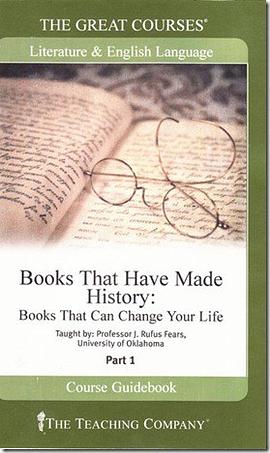
In this course, Professor J. Rufus Fears presents his choices of some of the most essential writings in history. These are books that have shaped the minds of great individuals, who in turn have shaped events of historic magnitude.
This course does not analyze the literature or discuss it in detail; rather, it focuses on intellectual history and ethics. What Professor Fears does is to take the underlying ideas of each great work and show how these ideas can be put to use in a moral and ethical life.
Beginning with his definition of a great book as one that possesses a great theme of enduring importance, noble language that "elevates the soul and ennobles the mind," and a universality that enables it to "speak across the ages," Professor Fears examines a body of work that offers an extraordinary gift of wisdom to those willing to receive it.
From the Aeneid and the Book of Job to Othello and 1984, the selections range in time from the 3rd millennium B.C. to the 20th century, and in locale from Mesopotamia and China to Europe and America.
A Chronology of Fundamental Choices
And though every thoughtful reader's list of historically important books will likely differ, few would argue against the profound importance of any of these selections. Together, they show how humankind has dealt with the choices revolving around the three themes of God, Fate, and Good-and-Evil—and how those choices shape our morality and direct our lives as we answer the question in the fourth main theme of this course: How should we live?
This course by the University of Oklahoma's three-time "Professor of the Year" is a vital intellectual and moral journey that remains constantly invigorating because of a teaching style that keeps even the most abstract concepts readily accessible.
Professor Fears is especially diligent about referring back to the main themes identified at the beginning of the course and comparing the position taken by each new author to what previously discussed authors have said. As a result, you'll find that each new lecture is smoothly layered into an ever-growing accumulation of knowledge. Each work comes alive, its ideas rich in consequence.
Even if you're already familiar with these works from a literary standpoint, this is a course well worth your attention; Professor Fears approaches each of these works from an entirely different direction, considering philosophical and moral perspectives that superbly complement a purely literary understanding.
Ideas Crucial To Every Thoughtful Person
And as Professor Fears is eager to point out, a grasp of those perspectives is crucial to the education of every thoughtful person.
"History is our sense of the past," he notes. "And these great books are our links to the great ideas of the past. This course is built upon the belief that great books, great ideas and great individuals make history.
"That's not a popular notion today, and certainly not in the academic world. In the academic world, we like to think that it is anonymous social and economic forces that make history. Slavery, for example, is the great object of study for those who ponder the lessons of the ancient world. Well à they're wrong. Karl Marx, who is the intellectual father of this notion that social and economic forces make great ideas, was wrong.
"It is the great ideas that propel men and women to become great in themselves. It was the great idea of truth that made Dietrich Bonhoeffer [the Lutheran pastor who defied Hitler and was hanged as a traitor] into a great man. It was a great idea of truth—and the great idea of God and of conscience—that made Socrates into a great man and left those Sophists, those academics, those professors of his day, trailing in the dust bin of history.
"History will say how well we have learned these values from the great books... all come together to educate us. For that is the ultimate goal of a course on the great books: wisdom."
作者简介
Dr. J. Rufus Fears is David Ross Boyd Professor of Classics at the University of Oklahoma, where he holds the G. T. and Libby Blankenship Chair in the History of Liberty. He also serves as David and Ann Brown Distinguished Fellow of the Oklahoma Council of Public Affairs. He earned his Ph.D. from Harvard University.
Before joining the faculty at the University of Oklahoma, Professor Fears was Professor of History and Distinguished Faculty Research Lecturer at Indiana University, and Professor of Classical Studies at Boston University.
An acclaimed teacher and scholar with more than 25 awards for teaching excellence, Professor Fears was chosen Professor of the Year on three occasions by students at the University of Oklahoma. His other accolades include the Medal for Excellence in College and University Teaching from the Oklahoma Foundation for Excellence, the University Continuing Education Association (UCEA) Great Plains Region Award for Excellence in Teaching, and the UCEA's National Award for Teaching Excellence.
Professor Fears's books and monographs include The Cult of Jupiter and Roman Imperial Ideology and The Theology of Victory at Rome. He edited a three-volume edition of Selected Writings of Lord Acton. His discussions of the Great Books have appeared in newspapers across the country and have aired on national television and radio programs.
目录信息
30 minutes / lecture
1. Bonhoeffer, Letters and Papers From Prison
This lecture uses the life of Dietrich Bonhoeffer, who sacrificed his life to fight totalitarianism, to illustrate a great book's most important attribute—its ability to speak to you as an individual and help shape the ideals by which you live your life.
1. Bonhoeffer, Letters and Papers From Prison (info)
2. Homer, Iliad
We discuss the Iliad's role as one of the most deeply religious books ever composed, an enduring statement of the living tradition of polytheism and a profound effort to understand the meaning of life.
2. Homer, Iliad (info)
3. Marcus Aurelius, Meditations
Though written to himself, this Roman emperor's great work has proven an enduring legacy, a reflection of an ethical life as applicable today as it was almost 2,000 years ago and a monument to self-sufficient wisdom.
3. Marcus Aurelius, Meditations (info)
4. Bhagavad Gita
Composed in the same period as the Iliad, the Bhagavad Gita is regarded as the supreme creation of Sanskrit literature. Though an epic statement of polytheism, it proclaims truth as an all-encompassing, single, divine power.
4. Bhagavad Gita (info)
5. Book of Exodus
The most influential religious book ever composed, the Book of Exodus has shaped three great living religious traditions—Judaism, Christianity, and Islam—in its proclamation of a single, all-powerful God.
5. Book of Exodus (info)
6. Gospel of Mark
Each of the Gospels presents a portrait of Jesus differing in emphasis. Mark, drawn from the firsthand account of Peter, is the most concise and dramatic. Its Jesus is both prophet and philosopher, testifying to his search for wisdom by his trial and death.
6. Gospel of Mark (info)
7. Koran
We examine the sacred book that holds for Muslims the same place that the words of Jesus do for Christians, the words of the book itself held as the revelation of God to humankind.
7. Koran (info)
8. Gilgamesh
The question of fate or destiny is at the core of the earliest literary work to come down to us, the Sumerian Epic of Gilgamesh, composed in the 3rd millennium B.C. in what is now Iraq.
8. Gilgamesh (info)
9. Beowulf
Gilgamesh proclaims a heroic ideal: We are fated to die, but in the meantime, let us strive to be as great as possible. This same message is the theme of the first great work of English literature, the 8th-century Anglo-Saxon epic, Beowulf.
9. Beowulf (info)
10. Book of Job
If God is good, why does evil exist? The Book of Job is the most enduring attempt to answer that question, a profound disquisition on the ultimate mystery of God and the frailty of any human attempt to understand the divine.
10. Book of Job (info)
11. Aeschylus, Oresteia
The three plays of the Oresteia rank with the Oedipus of Sophocles as the greatest of Greek tragedies, a story of murder, revenge, duty, and divine intervention that raises in stark form the dilemma of free will.
11. Aeschylus, Oresteia (info)
12. Euripides, Bacchae
For the great Athenian tragedians, it is moral blindness that leads to hybris (also hubris) and ruin. Pentheus in the Bacchae of Euripides exemplifies those who believe themselves wise but are, in fact, fatally ignorant.
12. Euripides, Bacchae (info)
13. Plato, Phaedo
Fifth-century Greece sees the development of a more profound concept of the immortality of the soul. For Socrates, the belief in such an immortal soul was the ultimate question, as portrayed by Plato in the Phaedo.
13. Plato, Phaedo (info)
14. Dante, The Divine Comedy
The Divine Comedy is the supreme summary of the thought of medieval Europe, ranking with the Aeneid of Vergil as one of the most influential epic poems ever composed and key to shaping the Italian language as it is spoken today.
14. Dante, The Divine Comedy (info)
15. Shakespeare, Othello, the Moor of Venice
The ancient Greeks and Romans did not have a figure comparable to Satan or the devil. To them, evil came in the form of human actions. In Renaissance England, this same idea was portrayed magnificently in Othello.
15. Shakespeare, Othello, the Moor of Venice (info)
16. Aeschylus, Prometheus Bound
Aeschylus, like the other great Greek tragedians, believes that we gain wisdom from those who suffered on a titanic stage—in this case, the great rebel Prometheus, who defied the will of Zeus to benefit humanity.
16. Aeschylus, Prometheus Bound (info)
17. Aleksandr Solzhenitsyn, The Gulag Archipelago
Aleksandr Solzhenitsyn's book stands as a massive indictment of the evil of Joseph Stalin and of the Communist system, portraying with chilling insight the role of ordinary people in carrying out this evil.
17. Aleksandr Solzhenitsyn, The Gulag Archipelago (info)
18. Shakespeare, Julius Caesar
Like Othello, Julius Caesar was written at the height of Shakespeare's creative talents. Its theme is honor and duty, the duty of a man to resist evil by violence and murder if necessary.
18. Shakespeare, Julius Caesar (info)
19. George Orwell, 1984
In his novel 1984, George Orwell raises the pertinent and disturbing question of whether any individual can resist the modern power of the state, brilliantly illuminating the logical consequences of subordinating the individual to anonymous social and economic forces.
19. George Orwell, 1984 (info)
20. Vergil, Aeneid
We examine Vergil's epic as both a work of literature and as a powerful and influential statement of the necessity of war in a just cause and the moral value of duty.
20. Vergil, Aeneid (info)
21. Pericles, Oration; Lincoln, Gettysburg Address
Two great democratic statesmen used the occasion of a public funeral for the war dead to proclaim democracy an absolute good. Separated by almost 2,500 years, these two funeral orations represent the most profound statements of the necessity of just wars.
21. Pericles, Oration; Lincoln, Gettysburg Address (info)
22. Remarque, All Quiet on the Western Front
Published in 1928, the best novel about war ever written gave voice to the feeling that nothing was worth another war, paving the way for appeasement policies in both Britain and France that in fact made another and even more horrible war inevitable.
22. Remarque, All Quiet on the Western Front (info)
23. Confucius, The Analects
Few intellectual figures in history have so influenced a civilization as Confucius, the teacher whose wisdom guided the intellectual, political, and ethical life of China for more than two millennia.
23. Confucius, The Analects (info)
24. Machiavelli, The Prince
Confucius taught the art of government as it should be; Machiavelli as it really is. Written in 1513, The Prince might be called the handbook of modern politics and foreign policy, just as useful now as it was then for anyone interesting in gaining and keeping power.
24. Machiavelli, The Prince (info)
25. Plato, Republic
Plato's Republic might be called the greatest book on politics, education, and justice ever written. As The Divine Comedy embodies the values of the Middle Ages and the Aeneid those of Rome, the Republic embodies the ideals and values of classical Greece.
25. Plato, Republic (info)
26. John Stuart Mill, On Liberty
Published in 1859, John Stuart Mill's On Liberty is the classic statement of the liberal ideal of democratic government and social justice. For Mill, government exists to serve the individual, and individual liberty is the end of government, not a means to an end.
26. John Stuart Mill, On Liberty (info)
27. Sir Thomas Malory, Morte d'Arthur
Thomas Malory's Morte d'Arthur captures the passion, consequences, and contradictions of romantic and spiritual love. One of the first great works of English prose, it summarizes the civilization of medieval chivalry in its ideal form.
27. Sir Thomas Malory, Morte d'Arthur (info)
28. Johann Wolfgang von Goethe, Faust, Part 1
Goethe ranks with Shakespeare and Dante as one of the three supreme geniuses of European literature, comparable to Homer and Vergil. In the first part of Faust, Goethe grapples with the implications of attaining knowledge at any cost.
28. Johann Wolfgang von Goethe, Faust, Part 1 (info)
29. Johann Wolfgang von Goethe, Faust, Part 2
The question of the role of beauty and cultural standards is one that every thoughtful person must decide on his or her own terms. We explore these themes against the backdrop of the moral growth and ultimate redemption of Dr. Faust.
29. Johann Wolfgang von Goethe, Faust, Part 2 (info)
30. Henry David Thoreau, Walden
Thoreau, the most American of thinkers, is an unabashed Romantic in exploring the relationship of Man to the natural world. Walden is the journal of his recovery of self-meaning and independence by his return to nature.
30. Henry David Thoreau, Walden (info)
31. Gibbon, Decline and Fall of the Roman Empire
Gibbon's The Decline and Fall of the Roman Empire is the greatest history written in the English language. Here, we look at Gibbon and his history as a statement of "a philosophical historian," who searches the past for laws to guide us in the future.
31. Gibbon, Decline and Fall of the Roman Empire (info)
32. Lord Acton, The History of Freedom
Though Acton never wrote his planned history of liberty, he left behind, in numerous essays and unpublished notes, a legacy of historical thought that remains a message of supreme importance to us today.
32. Lord Acton, The History of Freedom (info)
33. Cicero, On Moral Duties (De Officiis)
On Moral Duties is one of the most influential works on education ever written, directly contradicting the view that might makes right and making clear that an immoral act can never be expedient.
33. Cicero, On Moral Duties (De Officiis) (info)
34. Gandhi, An Autobiography
By drawing on the traditions of Indian thought and reading the Bhagavad Gita daily, Gandhi makes his own path, focusing his entire life on a search for truth and teaching us that there are many roads to wisdom and victory.
34. Gandhi, An Autobiography (info)
35. Churchill, My Early Life; Painting as a Pastime; WWII
Churchill might well be called the greatest figure in the 20th century. We look at three books by this Nobel Prize–winning author and find wisdom to guide us in drawing fundamental lessons for our own lives.
35. Churchill, My Early Life; Painting as a Pastime; WWII (info)
36. Lessons from the Great Books
We review the lessons of the course and our definition of what makes a great book—a definition as true and vital today as it was in the age of Socrates and Cicero.
36. Lessons from the Great Books (info)
· · · · · · (收起)
读后感
用户评价
读完这本作品,我感到一种强烈的智力上的满足感,这本书的架构之宏大,信息的密度之高,简直令人叹为观止。它不像一般的叙事作品那样只关注个人情感的起伏,而是将视野拓展到了更广阔的领域,仿佛是一部披着小说外衣的严肃学术探讨。作者对于专业领域的知识掌握得极其扎实,那些复杂的概念和理论,被巧妙地编织进了故事的脉络中,既保证了内容的深度,又避免了枯燥的理论灌输。我必须承认,在某些段落,我需要放慢速度,甚至查阅一些背景资料才能完全理解其深意,但这绝不是一种负担,反而是一种探索的乐趣。这本书挑战了我的认知边界,迫使我跳出固有的思维定式去审视一些既定的观念。它没有给出简单的答案,而是提出了一系列引人深思的问题,留给读者巨大的想象和解读空间。整体来看,这更像是一部需要“解构”的作品,而非简单的“消费”,非常适合那些渴望在阅读中进行深度脑力激荡的读者。
这是一部节奏轻快、充满生活气息的佳作。它的语言非常平易近人,就像是与一位老友在午后咖啡馆里闲聊家常,但聊的却是那些细微而又重要的生命片段。作者擅长捕捉日常生活中的“瞬间之美”和“小确丧”,那些被我们匆忙忽略的、充满人情味的细节,被他用温暖的笔墨一一拾起。故事线索并不复杂,更像是一系列相互关联的生活片段或人物侧写,围绕着一个特定社区或群体展开,读起来非常放松,没有巨大的情感压力。我特别喜欢作者处理幽默感的方式,那种自嘲式的、带着淡淡忧伤的幽默,让人在会心一笑的同时,又能感受到生活不易的底色。这本书的优点在于它的“真实感”和“代入感”,它没有宏大的叙事目标,只是专注于描绘“人”的生存状态,让人在其中看到自己的影子,感受到一种被理解的慰藉。它就像一碗热腾腾的粥,朴实无华,却能抚慰人心。
这本书给我的感觉,就像是走进了一个光怪陆离的梦境,现实与虚幻的界限变得模糊不清。叙事手法上,作者采用了大量的意识流和非线性叙事,时间线索如同被打散的玻璃碎片,需要读者自己去拼凑和重构。这种破碎感恰恰完美地契合了作品探讨的主题——记忆的不可靠性与主观经验的相对性。初读时,我确实感到有些迷失,需要不断地回顾前文,试图捕捉那些隐藏在文字背后的线索。但一旦适应了这种独特的节奏,便会发现其中蕴含着一种迷人的韵律。作者的想象力是狂野而不受拘束的,他创造的场景和符号系统复杂而富有象征意义,每一次重读似乎都能发现新的含义。这本书的魅力在于它的多义性,它拒绝被单一地定义,每一次翻页都像是在揭开新的谜团。对于追求创新和形式实验的读者来说,这无疑是一场盛宴,它不仅是关于“发生了什么”,更重要的是关于“我们如何感知和讲述发生的事情”。
如果说文学作品是心灵的慰藉,那么这本书则更像是一剂猛烈的精神兴奋剂。它的基调是尖锐而充满批判性的,毫不留情地撕开了社会表层那些虚伪的温情脉脉,直指人性深处的冷酷与自私。作者的文字带着一种近乎外科手术般的精准和冷峻,他对权力运作的剖析入木三分,那些描写权势阶层如何利用信息不对称来操控大众的桥段,读来令人不寒而栗。我感觉自己被拉进了一个极其真实的社会寓言之中,那些发生在书中的事件,尽管夸张,却又如此贴近我们日常观察到的现实的影子。这本书的社会责任感非常强烈,它不是在说教,而是在用一种近乎残酷的写实手法,迫使读者直面那些令人不安的真相。读完后,我无法像读完一部轻松小说那样立刻放下,它带来的那种沉重感和对世界的不满感会持续很久,促使我反思自己在这套复杂的系统中所处的位置。
这本书简直是一场思维的冒险,它将我带入了一个个错综复杂的世界观构建之中。作者的笔触细腻而有力,对人物内心的刻画入木三分,仿佛每一个角色都在我眼前鲜活起来。特别是对那种边缘人物的深入挖掘,那种在时代洪流中挣扎求存的个体命运,读来令人唏嘘不已。故事情节跌宕起伏,但绝不是那种刻意制造的悬念,而是源于人物性格和环境冲突的必然发展,逻辑严密得让人拍案叫绝。我尤其欣赏作者在叙事节奏上的掌控,时而如平静的湖面,缓缓推进,沉淀情绪;时而又如疾风骤雨,将所有矛盾推向高潮,让人喘不过气来。在阅读过程中,我多次停下来,反复咀嚼那些富有哲理性的对话,它们并非空洞的说教,而是融入在情节中的点睛之笔,引发了我对人性、对社会结构更深层次的思考。这本书的语言风格非常独特,它时而华丽,充满隐喻,时而又极其朴实、直击人心,这种张弛有度的文字功力,使得阅读体验极为丰富和立体。
2012.1.2 刚开始不是很能适应这个教授讲课的style, 穿插了自己语言和原作思想的糅合,像讲故事,如果没看过书,看不出什么是原著,什么是点评。有点confusing. 听多了习惯了就好了。里面举的书无一例外都没看过... 听完本课有了点bragging right... 不过也唤起了我对某些书的兴趣。
2012.1.2 刚开始不是很能适应这个教授讲课的style, 穿插了自己语言和原作思想的糅合,像讲故事,如果没看过书,看不出什么是原著,什么是点评。有点confusing. 听多了习惯了就好了。里面举的书无一例外都没看过... 听完本课有了点bragging right... 不过也唤起了我对某些书的兴趣。
2012.1.2 刚开始不是很能适应这个教授讲课的style, 穿插了自己语言和原作思想的糅合,像讲故事,如果没看过书,看不出什么是原著,什么是点评。有点confusing. 听多了习惯了就好了。里面举的书无一例外都没看过... 听完本课有了点bragging right... 不过也唤起了我对某些书的兴趣。
2012.1.2 刚开始不是很能适应这个教授讲课的style, 穿插了自己语言和原作思想的糅合,像讲故事,如果没看过书,看不出什么是原著,什么是点评。有点confusing. 听多了习惯了就好了。里面举的书无一例外都没看过... 听完本课有了点bragging right... 不过也唤起了我对某些书的兴趣。
2012.1.2 刚开始不是很能适应这个教授讲课的style, 穿插了自己语言和原作思想的糅合,像讲故事,如果没看过书,看不出什么是原著,什么是点评。有点confusing. 听多了习惯了就好了。里面举的书无一例外都没看过... 听完本课有了点bragging right... 不过也唤起了我对某些书的兴趣。