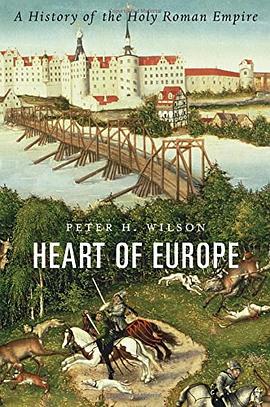

具体描述
The Holy Roman Empire lasted a thousand years, far longer than ancient Rome. Yet this formidable dominion never inspired the awe of its predecessor. Voltaire distilled the disdain of generations when he quipped it was neither holy, Roman, nor an empire. Yet as Peter Wilson shows, the Holy Roman Empire tells a millennial story of Europe better than the histories of individual nation-states. And its legacy can be seen today in debates over the nature of the European Union.
Heart of Europe traces the Empire from its origins within Charlemagne’s kingdom in 800 to its demise in 1806. By the mid-tenth century its core rested in the German kingdom, and ultimately its territory stretched from France and Denmark to Italy and Poland. Yet the Empire remained stubbornly abstract, with no fixed capital and no common language or culture. The source of its continuity and legitimacy was the ideal of a unified Christian civilization, but this did not prevent emperors from clashing with the pope over supremacy―the nadir being the sack of Rome in 1527 that killed 147 Vatican soldiers.
Though the title of Holy Roman Emperor retained prestige, rising states such as Austria and Prussia wielded power in a way the Empire could not. While it gradually lost the flexibility to cope with political, economic, and social changes, the Empire was far from being in crisis until the onslaught of the French revolutionary wars, when a crushing defeat by Napoleon at Austerlitz compelled Francis II to dissolve his realm.
作者简介
Peter H. Wilson is Chichele Professor of the History of War at the University of Oxford.
目录信息
List of Tables**
Maps
1. The Empire in 800
2. Frankish Partitions
3. Ottonians: The Empire in 962
4. Salians: The Empire around 1050
5. Staufer: The Empire in 1195
6. From Little Kings to Big Dynasties: The Empire in 1378
7. The Empire in 1512 (showing the Kreise)
8. The Empire in 1555
9. The Empire in 1648
10. The Empire in 1792
11. The Empire in 1803
12. The Empire in 1806
13. The Imperial Church, c. 1020
14. Royal Palaces (showing Conrad II’s Royal Progress, 1024–5)
15. Ducal Burgundy in 1471
16. The Swiss Confederation in 1540
17. Mainz and Hessian Territorial Development (possessions in the eighteenth century)
18. The Swabian League (membership after 1523)
19. Protestant Union and Catholic League Membership
20. The Rhenish Civic League of 1254
21. The Hansa and the Teutonic Order in 1370
22. Communual Regimes in Northern Germany, c. 1500
Family Trees
1. Carolingians
2. Ottonians
3. Salians
4. Staufers and Welfs
5. Luxembourgs
6. Habsburgs part 1
7. Habsburgs part 2
Note on Form
Acknowledgements
Introduction
I. Ideal
1. Two Swords
2. Christendom
3. Sovereignty
II. Belonging
4. Lands
5. Identities
6. Nation
III. Governance
7. Kingship
8. Territory
9. Dynasty
IV. Society
10. Authority
11. Association
12. Justice
13. Afterlife
Glossary
Appendix 1: Emperors 800–1806
Appendix 2: German Kings to 1519
Appendix 3: Kings of Italy 774–962
Chronology
List of Abbreviations
Endnotes
Index
* Illustrations
1. St Peter, Pope Leo III and Charlemagne. Detail from the Triclinium mosaic in the Lateran Palace, Rome. 1743 copy after 798/9 original.
2. Charlemagne, portrait by Albrecht Dürer, c. 1512. Germanisches Nationalmuseum, Nuremberg.
3. Napoleon in Aachen, painting by Henri-Paul Motte, 1798.
4. Carolingian troops besieging towns, illumination from Balterium Aureum Sancti Gallen, c. 883. Stiftsbibliothek, St Gallen, Cod. Sang. 22, p. 141.
5. The Act of Canossa in 1077, illumination from Vita Mathildis by Donizone, Italian school, twelfth century. Biblioteca Apostolica Vaticana, Ms Lat 4922, fol.49.
6. Henry VII’s Roman expedition in 1312, illumination from Codex Balduini trevirensis, c. 1340. Landeshauptstaatsarchiv, Koblenz, Best. 1 C Nr. 1 fol. 22.
7. Charles V and Clement VII at the last imperial coronation by a pope in 1530, engraving by Nicolas Hogenberg, with later handcolouring, from the Einzugsfolge, 1532.
8. Charles V as victor at the battle of Mühlberg in 1547, portrait by Titian, 1548. Prado, Madrid.
9. Tefillin bag in green velvet, embroidered with the imperial coat of arms, Jewish, c. 1700.
10. Charles V, woodcut by Lucas Cranach the Younger, c. 1550.
11. Charles VI, portrait by Martin van Meytens, eighteenth century.
12. Joseph II’s Coronation Banquet in the Frankfurt Römer on 3 April 1764, painting by Martin von Meytens the Younger, 1764. Bundesmobilienverwaltung, Vienna.
13. The three ecclesiastical electors, detail from The Coronation of Joseph II in the Bartholomäusdom in Frankfurt in 1764 by the studio of Martin von Meytens the Younger, 1764. Gemäldegalerie, Kunsthistorisches Museum, Vienna, Inv.-Nr. GG 7468.
14. Francis II, portrait by Friedrich von Amerling, 1832. Weltliche und Geistliche Schatzkammer, Vienna.
15. Figures representing the Slavs, Germans, Gauls and Romans pay homage to Emperor Otto III, illumination from the Luithar Gospels, produced in Reichenau, late tenth century.
16. Salian monarchs and abbots of St Emmeram monastery, illumination from the Evangelary of St Emmeram in Regensburg, 1105/6.
17. Map of Europe as a single empire, by Johannes Patsch, 1537. From Sebastian Münster, Cosmographia, 1556.
18. Woman from Metz, illustration from Hans Weigel (attr.), Habitvs praceipvorvm popvlorvm, Nuremberg, 1577. Trinity College Library, Cambridge, L.11.33, plate XCIX. By courtesy of the Master and Fellows of Trinity College, Cambridge.
19. The Quaternionenadler by Hans Burgkmaier the Elder, 1510.
20. Regensburg’s two town halls, painting by an anonymous artist, eighteenth century.
21. Maximilian II and the Seven Electors, coloured woodcut, Nuremberg school, 1564.
22. Christ crowning and blessing Otto II and his wife Theopanu, ivory relief, Byzantine school, c.982/983. Musée National du Moyen Age et des Thermes de Cluny, Paris.
23. Frederick II enfeoffing Hohenzollern with Brandenburg in 1417, coloured woodcut from a coetaneous copy of the Chronicle of the Council of Constance by Ulrich von Richental, Augsburg, 1485. Österreichisches Staatsarchiv, Vienna.
24. Nicolas of Cusa, portrait by Dr Winard von Steeg, fifteenth century.
25. Reliquary bust of Frederick I, gilded bronze, produced in Aachen, 1155–71. Church of St Johannes, Cappenberg.
26. The Reichstag in plenary session in Regensburg in June 1653, print published in Nuremburg, 1653.
27. Carolingian peasants, illumination from a calendar of the abbey of St Peter in Salzburg, 818. Österreichische Nationalbibliothek Vienna, Cod.387, fol.90v.
28. Annual oath ceremony in Ulm, 1650.
29. Charlemagne with his son Pippin and a scribe, copy of 991 after an original illumination from Lupus of Ferrières, Leges Barbarorum, c.829–32. Biblioteca Capitalare, Modena.
30. The Reichskammergericht in session, engraving after Hermann Bols in Wilhelm Roding, Pandectae Juris Cameralis, 1688.
31. Carl von Dalberg receiving Napoleon in front of the Aschaffenburg palace in 1806, detail from a painting by Florent Fidèle Constant Bourgeois and Jean-Baptiste Debret, 1812: Châteaux de Versailles et de Trianon, Versailles.
32. Barbarossa Awakes in the Kyffhäuser Hills, mural by Hermann Wislicensus, 1879–97. Imperial Palace, Goslar.
33. Himmler laying a wreath on the first Heinrichsfeier, 1 July 1936.
34. Sergeant Babcock wearing the Aachen copy of the imperial crown which had been hidden in a mine near Siegen, 13 June 1945.
35. Imperia, statue erected in the harbour of Konstanz, by Peter Lenk, 1993.
** Tables
1. Imperial Reigns and German Kings
2. Anti-Kings
3. Co-Kings and Emperors
4. The Growth of Writing in Imperial Governance
5. New Ducal Titles
6. Changes in the Electoral College
7. Reichstag Participation Rates, 1521
8. Territory and Formal Status in 1792
9. Annual Revenue Derived from Imperial Prerogatives, c. 1780
10. Imperial Taxation, 1521–1613
11. War Funding Raised during the Long Turkish War, 1593–1606
12. Tax Grants during the Permanent Reichstag, 1663–1742
13. Imperial Defence, 1664–1714 (annual averages)
14. Revenue and Debt in Selected Principalities, c. 1500
15. The Removal of Immediate Vassals
16. Official Reichskammergericht Staff Levels
· · · · · · (收起)
读后感
用户评价
这本书的叙事节奏感真是让人惊艳,作者对场景的描绘细腻入微,仿佛能闻到空气中弥漫的尘土和湿润的泥土气息。故事的主线是关于一个家族的兴衰,但它巧妙地穿插了对那个特定时代社会变迁的深刻洞察。我特别喜欢作者处理人物冲突的方式,那种克制而又暗流涌动的张力,让人在阅读时既感到揪心又不忍释卷。比如,书中对主人公童年阴影的逐步揭示,不是那种直白的心理剖析,而是通过一系列生活琐事和不经意的对话悄悄渗透出来,高明之处在于,读者需要自己去拼凑和理解,这极大地增强了阅读的参与感。更值得称道的是,尽管故事背景宏大,涉及跨越数十年的历史变迁,但作者始终没有让宏大的历史叙事压倒个体命运的真实感。每一次视角转换都精准到位,时而沉浸在某个角色的内心独白中,时而又被拉回到一个更广阔的社会背景下审视这一切。读完后,那种余韵久久不散,仿佛我亲身经历了那段岁月,对人性的复杂和历史的必然性有了更深层次的体会。这本书绝不是那种读完就忘的消遣之作,它更像是一面镜子,映照出我们自己内心深处的一些不易察觉的情感和挣扎。
这是一部结构复杂、信息量巨大的作品,初读时我需要花费不少精力去梳理人物关系和时间线,但一旦适应了作者的叙事“语法”,便会发现其精妙之处。作者运用了大量的倒叙和穿插叙事技巧,像一位技艺高超的织工,将无数条看似不相关的线索最终汇集成一幅完整而壮丽的挂毯。特别是书中关于权力斗争和知识分子命运交织的那几个章节,论述之深刻,见解之独到,让人不得不停下来反复咀嚼。我尤其欣赏作者在处理哲学思辨时的那种不回避、不妥协的态度,他敢于触碰那些关于道德困境和存在意义的终极问题,却又保持了一种冷静的、近乎科学的客观性。这种冷静并非冷漠,而是一种饱含同理心后的理性升华。文字风格上,它偶尔会流露出一种古典的韵味,句式冗长而富有音乐感,但在描述冲突场景时,笔触又会变得极其犀利和直接,形成了强烈的反差美学。对于喜爱深度阅读、不畏惧复杂文本的读者来说,这无疑是一次智力上的盛宴,它要求你投入时间,但回报给你的远超你付出的努力。
这本书的文学语言达到了令人叹为观止的境界,它不像是在讲述故事,更像是在演奏一部气势磅礴的交响乐。每一个章节的过渡都像是乐章的转换,时而低沉婉转,时而激昂澎湃。作者对于意象的运用极为高超,比如反复出现的“雾”和“河流”,它们不仅仅是背景元素,更像是角色们内心状态的具象化。我尤其被其中对于记忆和时间流逝的哲学探讨所吸引。作者似乎在探讨,我们所经历的一切,最终是否都将沉淀为一种无法触及的“幽灵”,萦绕在我们日常生活的边缘。阅读过程中,我常常需要停下来,不是因为情节紧张,而是因为某个词语的搭配或某个句子的结构美得让人驻足。这本书的节奏感是缓慢而深远的,它不会迎合现代人碎片化的阅读习惯,而是要求你沉浸其中,跟随作者的思维轨迹去探索。它更像是一部需要细细品味的经典文学作品,而不是快餐式的娱乐读物。如果你追求的是文字的纯粹美感和深层次的哲学思考,这本书绝对是上乘之选。
坦白说,这本书的开篇并不算轻松愉快,它带着一种沉重的宿命感扑面而来。但随着故事的推进,我逐渐被作者描绘出的那种坚韧的生命力所吸引。它讲述的与其说是一个故事,不如说是一种精神的韧性。书中描绘的几位女性角色尤其让我印象深刻,她们在男权社会和历史洪流的夹缝中,用自己的智慧和隐忍撑起了一片天空。作者对女性内心世界的刻画细腻入微,她们的每一次妥协、每一次反抗,都写得真实可信,没有丝毫的廉价煽情。这种真实感来源于作者对生活细枝末节的敏锐捕捉,比如一次眼神的交汇,一封未寄出的信,或者一句未说出口的道歉,这些“微不足道”的瞬间,构成了支撑起整个悲剧色彩故事的基石。我尤其欣赏作者对“沉默的力量”的探讨,在那个喧嚣的年代,真正的力量往往隐藏在那些不为人知的角落,通过日常的坚持来实现对自我价值的捍卫。这本书读完后,我感觉自己被洗礼了一番,对“坚持”二字有了全新的理解。
我必须承认,这本书的篇幅令人望而生畏,但一旦翻开,那种被叙事洪流卷入的感觉便让人欲罢不能。这本书最成功的地方在于它对“异乡人”主题的深入挖掘。故事中的几代人物,无论身处何地,似乎都带着一种挥之不去的疏离感,这种疏离感既是外部环境造成的,更是他们内心深处无法弥合的裂痕。作者对于文化冲突和身份认同危机的描绘,精准而有力,它超越了简单的地域描写,直指人类在面对“他者”时的普遍焦虑。书中有一段描写主人公在异国城市中迷路的场景,那段文字的氛围营造极其到位,那种被陌生环境包裹的无助感,读来让人感同身受。此外,这本书的对话艺术也值得称赞,人物间的交流往往言未尽而意已足,大量的潜台词构成了叙事的重要支撑。它探讨了归属感的本质,以及我们如何在一个不断变化的世界中,努力构建属于自己的精神家园。读完后,我忍不住思考,我们每个人又何尝不是在世界的某个角落里,扮演着一个永恒的“局外人”呢?