
具体描述
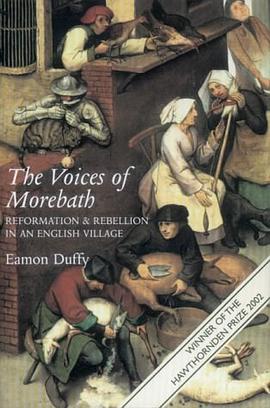
Eamon Duffy’s The Stripping of the Altars (Yale, 1992) provided a broad, compelling account of popular religion in England before and during the Reformation, and was a book which undoubtedly changed the way we think about late medieval Catholicism and the popular experience of religious change. The Voices of Morebath is, as the author admits in the preface, in part a ‘pendant’ to that larger work, and the metaphor is a good one. This book is a gem: small, colourful, many-faceted. It is based for the most part upon a single source, namely the parish accounts from Morebath, a remote Devonshire village twenty-five miles north of Exeter. For fifty-four years the man responsible for keeping these accounts was Christopher Trychay, the village priest from 1520 to 1574. The records he kept were more than mere accounting: the life of the parish, the preoccupations of its priest and the material consequences of religious change appear in vivid detail, meticulously noted. The result is one man’s careful record of the English Reformation at parish level.
The Morebath accounts have long been known as a valuable source. A version was published in 1904 by J. Erskine Binney, who had himself been vicar of Morebath. Duffy, however, makes these records speak as never before, whilst incidentally clearing up some of the errors made by the first transcriber. He extracts from them an account of how this Tudor parish functioned in the 1520s, and how it survived the vicissitudes of the mid-Tudor period. The gradual erosion of traditional practice under Henry VIII gives way to the more radical initiatives of Edward VI’s reign, where the manuscript ‘positively breathes a sense of crisis’, in particular with the startling inclusion in the parish accounts of payments to equip the five Morebath men who joined the 1549 rebellion. These accounts also bear witness to the flurry of activity which greeted the Marian restoration, and the slow adaptation to conformity in the first sixteen years of Elizabeth’s reign. This book is in one sense a biography of Christopher Trychay’s working life, and it concludes with his death. In another sense it could be seen as a biography of Morebath’s Tudor Catholicism, which also, by the end, seems dead and gone.
The Voices of Morebath is a highly personal account on two levels. Perhaps the chief highlight of the book is the immediate acquaintance it gives with Christopher Trychay, whom Duffy refers to throughout as ‘Sir Christopher’, according him the usual honorific title given to priests at that time. He emerges as a strong, sometimes pedantic, occasionally difficult man, with a pithy and powerful turn of phrase. He had definite ideas about how his parishioners should behave, and he encouraged them to cooperate, not least by being as meticulous in his records of those who failed to contribute to parish expenses as he was in recording those who were more generous. Duffy argues that some, at least, of the written record was meant to be read aloud, and this seems probable. So we get to see Sir Christopher standing in the church as he addresses the parish on the subject of the four large flagstones ‘that lay here be fore the quyre dore’: he is standing in front of the chancel screen as he speaks. We can even hear his voice with its Devon accent that renders ‘font’ as ‘vawnte’, or can describe someone as a ‘nonest’ woman. The fragments of Latin that drop into his accounts, mingled together with English, support Duffy’s argument that church Latin may not have been as alien to popular understanding as we sometimes think. As he gives account of his parishioners obligations and bequests, he provides a map of his community, a ‘beating of the bounds’ by the written and spoken word. His determination to dedicate the side altar to the local saint, St. Sidwell, and encourage her cult, is successful, and it is interesting to note that he baptizes a girl called Sidwell after the saint as late as 1570. When the book concludes with his last will and testament, there is something very touching in the admission that ‘at the making of this will I have but little money and but one quick beast’, and when this feisty octogenarian dies, and is symbolically laid to rest between the old altar place and the new communion table, it is hard not to mourn.
Yet this is in part because Christopher Trychay’s evident personal involvement in the fortunes of his parish is clearly matched by that of the author. The Stripping of the Altars was a very moving book, written with an intense and imaginative appreciation of religion as a social and personal experience. The Voices of Morebath has some of the same quality, and reiterates some of the same conclusions. It lovingly illustrates the extent of communal involvement in the small and precious rituals of the church year, drawing out enormous significance from the minutiae of tiny bequests and careful purchases. In 1529 one female parishioner leaves her silver wedding ring which is melted down to make a little silver shoe for the figure of St. Sidwell, the local saint. Five years later, a thief breaks in and takes the silver shoe, along with a chalice, and the sense of outrage is immediate. And when the young people of the parish club together and voluntarily produce the money for a new chalice, Duffy is in no doubt that the priest’s entry in the accounts concerning their effort must have been ‘recorded with pride.’ Equally, when Christopher Trychay finally achieves the purchase of a new set of black vestments for requiem masses, the crowning achievement of twenty years painstaking effort, it is hard not to rejoice with him. The sense of loss is palpable, therefore, when the images, vestments and traditional trappings are removed under the new Protestant order. In many ways this book is an elegy on the loss of our Catholic past. When describing how the country parishes dutifully responded to the death of Mary I in 1558 with the appropriate ceremonies, for Duffy these were ‘the funeral rites of Catholic England.’
Yet the emotional force of this vision of the Reformation can sometimes be as misleading as it is beguiling. Pre-Reformation religion was undoubtedly the focus for great popular piety which bore fruit in communal involvement in parish ritual, and had its material expression in church decorations, particularly the images of the saints. Yet to call this level of communal participation ‘staggering’ seems over-emphatic, and fails to take account that this kind of engagement was equally present after the Reformation, albeit in different forms. Parish religion constantly alters and adapts to changing circumstances, and Reformation changes may not have seemed as radical at the time as they have appeared subsequently. The Henrician Reformation which began to encroach upon the old ways, especially in its restrictions on the use of images, is portrayed as an ineluctable slide towards Protestantism, yet there no conclusive proof that contemporaries saw it that way; in fact it is clear that denied one form of devotional expression, the Morebath parishioners turned to another, and fulfilled the 1538 Injunctions more speedily than many parishes.
The difficulty with Duffy’s interpretation is that it has a tendency to describe the popular experience of Reformation in terms of triumph and tragedy, when there was also so much that was mundane, and so much that remained the same. His is a vision of the Reformation as an assault upon a whole way of life, or as the author describes it in the preface, ‘the most decisive revolution in English history.’ This vision can undoubtedly be inspirational, but it can also fail to take account of some of the complexities of the process, and some of the obvious continuities in parish religion despite the Reformation. It can also ascribe questionable symbolic importance to inanimate objects. The sources are all about material objects and their monetary value; the question of what those objects symbolized is fascinating, but must remain speculative. When royal injunctions stripped the churches of their ornamentation, for Duffy this was an assault upon the belief structures underlying that church decoration. Yet we cannot be sure that the statues and vestments had this much symbolic value for all the inhabitants of Morebath, any more than we can be sure that the new English Bible was not equally precious to them. The one thing we can be sure of, is that the monetary value of all these different items was carefully recorded and husbanded.
Duffy seems to take it for granted that the symbolic value of all these church ornaments was immense, and that the network of parish organization that helped to sustain the finances of the parish was about ‘the construction of community.’ This may indeed be true. It seems to have been the view of Sir Christopher, from the way in which he wrote the parish records; but can we be sure that his parishioners thought exactly the same way? The author has to conclude, reluctantly, that in fact his sources cannot tell us anything about the piety of the Morebath parishioners; they reveal only the facts of parish expenditure. The clear implication, however, is that for them, as for Duffy, the symbolism of these material objects was self-evident. The black vestments for requiem masses are described as if they were a physical manifestation of the Catholic doctrines concerning death and salvation. Duffy makes little distinction between monetary bequests to the images of the saints, and a belief in the intercessionary powers of those saints. But the reader is left wondering whether these connections would have been as clear to the parishioners as they were to their priest, or to the author telling their story. Were these parishioners demonstrating an impressive level of religious devotion, or were they merely following the usual custom?
There are strong suggestions that reactions to religious change were more complicated than straightforward Catholic loyalism. Reformation may have seemed like revolution to some, but clearly not to all. The dissolution of the monasteries, we are told, was a terrible shock to the populace. Yet although some religious houses, like the priory of St. Nicholas in Exeter, noted for its charity, were defended by the populace, the dissolution of Morebath’s more tight-fisted local monastery seems to have gone unlamented. The 1549 rebellion may have had strong religious overtones, but the Morebath records indicate how much it was also a protest at the financial exactions of the regime. The book gives a vivid impression of the economic problems of the time, without which the new Book of Common Prayer might not have been single-handedly capable of sparking rebellion. Rebellions cannot be reduced to single causes, as the author is keen to point out with reference to the traditionally more ‘Protestant’ disturbances in East Anglia. But Duffy cannot have it both ways: if, as he argues, the Protestantism of the East Anglian rebels may have been only skin-deep, adopted for political purposes and at the behest of rebel leaders, then the same may be true of the Catholic loyalism of the western rebels.
Furthermore, even if the loss of the old system of parish organization did indeed ‘cut deep into the living tissue of Morebath’s communal life’, the evidence suggests that the wound may nonetheless have healed quite quickly. One reason that Duffy’s argument can at times seem a little overstated, is that he also provides so much evidence of how the village community adapted to change, redirecting its vitality through different channels. The parishioners who contributed the money for the parish’s Catholic devotions before the Reformation were frequently the same people who were quite willing to pay for the acquisition of Protestant trappings after 1547 or 1558. We cannot be sure that they rated the value of the old above that of the new. When the Catholic vestments were kept secretly during Edward’s reign, it could perhaps be construed as a mark of devotion, a clinging to the old ways. But it could equally be construed in financial terms, as the prudent conservation of valuable articles by the parish that had paid for them. Undoubtedly Sir Christopher mourned the ‘decay’ in religion during Edward VI’s time, but we cannot be sure that his parishioners all thought as he did. ‘All the voices of Morebath are one voice’, concludes Duffy, but it is a conclusion that can work two ways. We cannot be sure that the dominance of Sir Christopher’s voice indicates that it was representative of his parishioners: his voice may have just been the loudest. This is by no means to suggest that Duffy’s preferred interpretation is inaccurate: it remains extremely persuasive. Yet there are other possibilities to be explored.
This point is driven home by the central problem of conformity, particularly that of Sir Christopher Trychay himself. It is important to emphasize that this priest, who for much of the book is portrayed as a bastion of Catholic piety, nonetheless conformed for sixteen years under Elizabeth. Indeed, as Duffy points out, his conformity was ‘more than a grudging minimalism’. He was noted, and presumably therefore accepted, by the Elizabethan visitation of 1561, as being a regular preacher. ‘There is no easy accounting for it,’ says Duffy. Yet much of the evidence deployed in this book suggests that there is an explanation. The parish, and its priest, had conformed to every single change brought in by the authorities over the course of four different reigns, with the single exception of the five men who joined the rebellion of 1549. Whatever his private judgement, Sir Christopher obeyed orders. The duty of obedience was as powerfully felt, perhaps, as more obviously religious obligations, and it may have been as pious in intent. And his duty of service to his parishioners may have had a moral weight which went above and beyond issues of Catholic or Protestant doctrine.
Obedience can be hard to interpret, a problem which has long frustrated Reformation historians, who find it so difficult to determine if a religious act is motivated by genuine piety or grudging compliance. The response of the Morebath parishioners to clerical exhortation also perhaps deserves closer consideration. If Morebath’s conformity to a Protestant regime may have been based on duty rather than genuine conviction, we ought at least to allow the possibility that so might earlier conformity to pre-Reformation religious expectations. The parishioners accepted the Elizabethan changes just as they had accepted Sir Christopher’s insistence in the 1520s that they subscribe to the fund for the black vestments. If their obedience after the Reformation was far from heartfelt, might their conformity in the 1520s not also have been a response to authority?
This book takes full account of the pressures brought to bear by higher authorities, but it could take a sterner line with Sir Christopher’s own authority in Morebath. In fact, the weight of clerical authority in general is perhaps not given the attention it merits, considering that elsewhere in the realm it provoked a level of anticlerical feeling which was an important contribution to the Reformation. The sources clearly demonstrate Sir Christopher’s dominant role in the village. The long-drawn out controversy in the 1530s over the payment of the parish clerk, who was appointed by Sir Christopher, and whose wages some in the parish refused to pay, might be held to hint at some resentment of the priest’s authority. This was, after all, a valuable post, one to which Sir Christopher was later to appoint his nephew and godson. In this, as in so many episodes, we see the priest directing affairs, recording his disapproval or satisfaction, applying pressure to his flock. It must remain questionable whether his parishioners followed his wishes out of devotion or constraint. This kind of clerical influence could be found too on the wider stage. During the 1549 ‘Prayer-Book Rebellion’, the articles submitted by the rebels seemed to make a powerful case for the strength of popular Catholicism, and the widespread popular outrage at the break with tradition. Yet we cannot be sure that these articles truly reflected popular opinion, or whether the rebels’ own motives were more complicated, given straightforward religious expression only because the articles were written by their priests. Duffy thinks that the Morebath men ‘believed that they too were behaving like "honest good and godlie men" defending the traditions of their fathers and the well-being of their community’. We cannot be sure. It is tempting to identify people with their priest, not least because Sir Christopher as priest so obviously identified with his people, but it is not the only possible interpretation.
Duffy’s argument could perhaps take more account of the likelihood that Morebath’s devotion to St. Sidwell may have been as much a question of obedience as its dutiful purchase of an English Bible. These carefully documented religious changes may thus have felt less like a revolution, therefore, and at points Duffy himself suggests as much. He allows that the piecemeal changes, dragged out over four decades, were not necessarily interpreted by the parishioners in terms of the larger confrontation between Protestantism and Catholicism which exercized governments and intellectuals. Looking at how the Elizabethan Settlement would have appeared to the parishioners of Morebath, Duffy notes a number of continuities that would presumably have made Elizabethan Protestantism easier to swallow than its Edwardian equivalent. The churching of women, the parish ales, and the rogation tide processions all continued, all important symbols as well as ceremonies. And clearly the fact that Sir Christopher was still officiating, albeit from a slightly different part of the church, must have lessened the sense of revolution. The symbolism of the ‘stripping of the altars’ may have been less significant than the symbolism of Sir Christopher’s continuing ministry.
This book is at its most successful as a chronicle of the small concerns of the parish. If it works slightly less well when it seeks to engage with certain wider debates, this is purely because the evidence is too slender to sustain any very broad conclusions. There is a useful modification to the arguments of Clive Burgess concerning the limitations of churchwardens’ accounts as historical sources: the Morebath accounts certainly seem to suggest a rather different, more prosaic purpose than the more ostentatious records of big city churches. The contribution to the now very sophisticated debate concerning the 1549 rebellions is perforce delicate, but undoubtedly thought-provoking. The fact that Morebath acquired a cucking-stool in 1557, which was repaired in 1569 and remade in 1570, is too slight to contribute much to David Underdown’s arguments about a shift in gender relations. Duffy’s suggestion that women were perhaps treated better in an era where the Virgin and St. Sidwell were widely venerated is an interesting speculation, but it cannot go further than that.
As a contribution to the debate on the English Reformation, however, The Voices of Morebath is invaluable. The evidence deployed in this book is fascinating, and the central figure of Sir Christopher Trychay a great addition to the personalities which throng the sixteenth century. The source material is carefully and sensitively handled to produce a beautifully detailed understanding of the Reformation as it happened in one small parish. There perhaps remains some underlying tension between two different interpretations, between the emphasis on radical change and the evidence of obvious continuity. No doubt the English Reformation contained both, and in varying quantities according to which of the thousands of different parishes we examine. In the past Duffy has given most eloquent testimony of how the Reformation was a violation of all that the ordinary people held dear, and this is where The Voices of Morebath begins, with the Reformation as social revolution. But by the end of the book the suggestion is that ‘the sharp distinctions between Catholic and Protestant, traditionalist and reformed, may look more straightforward and clear-cut to the historian than they did to those immersed in the press of events.’ The evidence so painstakingly explored in this book suggests that there was a willingness to embrace change and a level of religious adaptability, in at least one English village, which we would do well not to underestimate. It almost appears as if some of the author’s own views have been gently reconfigured as the book progresses, even perhaps as Sir Christopher Trychay’s views were modified by fifty-four years of experience. It is in this exploration of the complexities of religious change that we find the greatest strengths of this book. The gradual readjustments in the intricate religious life of this one parish stand as a useful warning against adopting too straightforward an interpretation of the Reformation.
作者简介
目录信息
读后感
用户评价
这本书所描绘的那个世界,与其说是现实的写照,不如说是一种高度风格化的、内化的景观。作者对环境细节的刻画达到了近乎痴迷的程度,无论是光影在特定材质上反射出的冷光,还是空气中弥漫的某种特有的气味,都被捕捉得无比精准。然而,这种精准并非为了写实,而是为了烘托一种挥之不去的、压抑的氛围。人物的行为逻辑也常常游走在理性和非理性之间,他们的动机并非总是清晰可辨,很多时候,行动本身似乎就是为了填补某种内在的虚空。我感觉自己像是在观看一出精心编排的、没有剧本的舞台剧,演员们凭借着深植于角色骨髓的直觉在行动。更妙的是,作者对“沉默”的运用达到了炉火纯青的地步。那些没有被说出来的话,那些停顿和空白,比任何激烈的陈述都更有力量,它们在读者心中留下了巨大的想象空间,让人不禁思考,在那些未被触及的角落里,究竟隐藏着怎样惊人的秘密。
这部作品简直像是一面多棱镜,折射出的是人性的幽微与复杂。它没有落入那种直白的叙事陷阱,而是用一种近乎迷离的笔触,将一幕幕场景徐徐铺开,让人仿佛置身于一个充满回音的巨大空间里。叙述者的视角如同钟摆,在不同的时间点和人物的内心世界之间来回摆动,每一次停顿都带来新的领悟。我特别欣赏作者处理那种细微的情感波动的方式,它不是那种山呼海啸式的爆发,而更像是水面下暗流涌动,不动声色地改变着整个局面的走向。书中的对话尤其精妙,那些看似寻常的言语里,往往藏着足以颠覆既有认知的潜台词,需要读者屏息凝神,反复咀嚼才能体会到那份深意。读完合上书本的那一刻,脑海中久久挥之不去的是那些未被完全解答的谜团,它们不是情节上的漏洞,而是作者有意留给读者去填补的、关于存在与选择的哲学空间。这种阅读体验是极具挑战性,但也因此格外令人沉醉,它强迫你走出被动接受信息的舒适区,主动参与到意义的建构之中。
不同于很多强调个人英雄主义或明确道德判断的作品,这部作品的视角是极其分散和去中心化的。它没有一个高高在上的全知叙述者来为我们划定是非黑白,更多的时候,我们被抛入到一个由多个相互矛盾的证词和回忆构成的迷宫中。每个人都坚信自己所见的“真相”,而这些真相往往是如此的支离破碎、充满偏见和遗忘的痕迹。这种处理方式非常高明,它避免了说教,反而迫使我们去直面一个深刻的命题:在缺乏一个统一的参照系时,我们如何定义和构建我们的现实?书中的人物关系也异常疏离和微妙,他们之间的连接似乎总是系于一线,随时可能断裂,充满了易碎的美感。这种对确定性的拒绝,赋予了整部作品一种深刻的现代性,它不提供答案,而是提供了一种面对不确定性的、充满张力的存在状态,令人久久不能忘怀,并且在未来还会不断地被重新审视和解读。
我必须承认,这本书的文字密度极高,简直是一场对词汇的盛宴。作者的句式变化多端,时而如急流般一泻千里,将思想和情感毫无保留地倾泻而出;时而又像工匠打磨玉石般,每一个词的选择都经过了反复的斟酌,力求达到一种近乎诗歌般的凝练和韵律感。阅读的体验更像是在进行一场高强度的翻译工作,需要不断地停下来,查阅那些不常见的词汇,或者仅仅是为了细细品味他如何将一个日常的动词,通过微妙的修饰,赋予其全新的、令人不安的重量感。这种语言上的考究,使得全书的质感变得异常厚重和迷人。它不追求快速消费,而是要求读者放慢速度,去感受每一个句子的重量和纹理。对于那些热衷于语言艺术,并享受在文字的复杂结构中穿梭的读者来说,这本书无疑是一次顶级的享受,它证明了文字本身的力量,远超其承载的叙事内容。
我得说,这本书的结构安排简直是一场精心的智力游戏。它没有按照传统的小说那样线性推进,而是采用了碎片化的、非时间顺序的叙事手法,这无疑给初次接触的读者设置了不小的门槛。起初我有些迷茫,感觉自己像是在一堆被打乱的拼图前束手无策,需要不断地回顾、对比,才能将散落在各处的线索重新串联起来。然而,一旦适应了这种节奏,那种“豁然开朗”的满足感是无与伦比的。作者似乎非常享受这种“隐藏信息”的乐趣,他巧妙地运用意象和重复出现的象征符号,让那些看似无关紧要的细节,在后来的章节中爆发出惊人的关联性。这种叙事上的实验性,使得阅读过程本身变成了一种探险,你不再是故事的旁观者,而是成为了一个主动的考古学家,在文字的废墟中挖掘真相的骨架。这种对叙事边界的探索,让我想起某些先锋派的文学作品,它挑战了我们对“故事该如何被讲述”的基本假设,读起来酣畅淋漓,充满了智识上的刺激。
修正派用微观史探究宗教改革时期不同时段,人们是怎样适应的,他们reactive,responsive,他们的希望与痛苦。我不禁要感慨,作者探究的非常详细,从枯燥的数据accounts里,发现了许多教士Trychay的心理变迁。
修正派用微观史探究宗教改革时期不同时段,人们是怎样适应的,他们reactive,responsive,他们的希望与痛苦。我不禁要感慨,作者探究的非常详细,从枯燥的数据accounts里,发现了许多教士Trychay的心理变迁。
修正派用微观史探究宗教改革时期不同时段,人们是怎样适应的,他们reactive,responsive,他们的希望与痛苦。我不禁要感慨,作者探究的非常详细,从枯燥的数据accounts里,发现了许多教士Trychay的心理变迁。
Favorite history book ever
修正派用微观史探究宗教改革时期不同时段,人们是怎样适应的,他们reactive,responsive,他们的希望与痛苦。我不禁要感慨,作者探究的非常详细,从枯燥的数据accounts里,发现了许多教士Trychay的心理变迁。