
具体描述
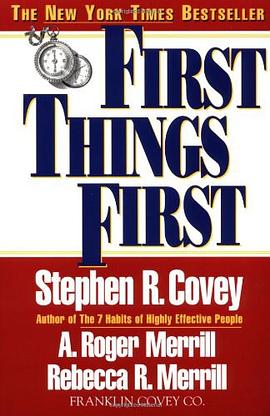
Book Description
I'm getting more done in less time, but where are the rich relationships, the inner peace, the balance, the confidence that I'm doing what matters most and doing it well?
Does this nagging question haunt you, even when you feel you are being your most efficient? If so, First Things First can help you understand why so often our first things aren't first. Rather than offering you another clock, First Things First provides you with a compass, because where you're headed is more important than how fast you're going.
Amazon.com
What are the most important things in your life? Do they get as much care, emphasis, and time as you'd like to give them? Far from the traditional "be-more-efficient" time-management book with shortcut techniques, First Things First shows you how to look at your use of time totally differently. Using this book will help you create balance between your personal and professional responsibilities by putting first things first and acting on them. Covey teaches an organizing process that helps you categorize tasks so you focus on what is important, not merely what is urgent. First you divide tasks into these quadrants:
1.Important and Urgent (crises, deadline-driven projects)
2.Important, Not Urgent (preparation, prevention, planning, relationships)
3.Urgent, Not Important (interruptions, many pressing matters)
4.Not Urgent, Not Important (trivia, time wasters)
Most people spend most of their time in quadrants 1 and 3, while quadrant 2 is where quality happens. "Doing more things faster is no substitute for doing the right things," says Covey. He points you toward the real human needs--"to live, to love, to learn, to leave a legacy"--and how to balance your time to achieve a meaningful life, not just get things done.
--Joan Price
From Publishers Weekly
This is the latest time-management book from the author of The 7 Habits of Highly Effective People.
From Library Journal
Covey ( The Seven Habits of Highly Effective People , LJ 3/15/90) and Roger and Rebecca Merrill here create a new paradigm for taking control of busy lives. Unlike the dozens of self-help books that focus on the clock or the way people spend their time, they offer a "principle-centered" approach to time management that emphasizes what "represents our vision, values, principles, mission, conscience, direction--what we feel is important and how we lead our lives." The authors argue that central to our lives are "four needs and capacities--to live, to love, to learn, to leave a legacy." The ideas here are not only clearly explained but are reinforced by scenarios from the authors' lives and self-directed activities for the reader. Introspection and self-reflection play a larger role here than in most time management books. Highly recommended for all types of collections. Previewed in Prepub Alert, LJ 5/15/93.
- Jane M. Kathman, Coll. of St. Benedict Lib., St. Joseph, Minn.
From Booklist
Time management isn't enough, say Covey and his co-authors, Roger and Rebecca Merrill. But it's an effective starting point, so first lay out your life in four quadrants labeled urgent, not urgent, important, and unimportant. That is, a task may have a deadline, but not much importance; or a task may be important, but require preparation and planning. You should stop doing what's unimportant and without urgency. Where the important and the urgent intersect is where you need to expend most of your energies. Assuming that urgency announces itself, the real question is knowing what's important, and Covey and the Merrills draw from a variety of sources to guide you toward determining just that. Much of their argument goes beyond the linear time of time management and centers on quality time; to properly prioritize and spend one's moments happily and productively, one sets goals--or principles--from which all else flows. These goals embody a perfect balance of the mental, the physical, the spiritual, and the social--that is, you need a challenging job, you need to exercise, you need a system of beliefs, and you need someone to love you. Covey, whose The Seven Habits of Highly Effective People has sold 4,000,000 copies, with the aid of the Merrills again offers common sense for those who are working like dogs and, in the bargain, living dogs' lives.
John Mort
Book Dimension :
length: (cm)21 width:(cm)14
作者简介
目录信息
读后感
这本书我看得很快,大概两小时就看完了,如果不是这个速度,我反而觉得不正常,那一定表明,我对于《高效能人士的七个习惯》和《精力管理》都理解得不好。 《要事第一》总共385页,是一部挺厚的书了,而事实上,它脱胎于《高效能人士的七个习惯》中第三个习惯“要事第一”,那...
由时间管理转到个人领导,确定由内而外以“原则为中心”的第四代时间管理系统,重点在于“第二象限”——重要但并非紧急的事。 人类生活要达到平和的四个生活基本需求:身体、精神、心智、社会,重点在于保持四者之间的平衡。第四代时间管理系统最大的特点在于:...
上完7 Habits的培训后,一直以为Habit 3: First thing first是关于时间管理。这次,从头到尾看了一遍,发现有被Covey这老头耍了。 First thing first其实是打着时间管理的幌子的个人管理的书。掰来掰去,还是Covey关于价值观的书。真正时间管理的部分,不到1/3就说完了。后面...
用户评价
这本书的魅力在于其深刻的实践指导性,它不像许多管理学书籍那样停留在理论层面,而是充满了可操作的案例和步骤。我个人是一个典型的“完美主义倾向”患者,总想把所有事情都做到无可挑剔,结果就是拖延症泛滥,真正有价值的项目却总是被搁置。这本书中关于“最小可行性产出”的讨论,对我来说简直是醍醐灌顶。它用一种近乎残酷的现实主义态度告诉我:完成比完美更重要,至少在启动阶段是如此。我记得其中有一个关于时间分配的练习,要求读者将一周内所有活动按其对长期目标的贡献度进行打分,那个过程简直是痛苦但又极其必要的自我审视。当我看到自己花费了大量时间在那些“低回报、高频率”的事务上时,那种被时间愚弄的感觉油然而生。随后的内容,则细致地讲解了如何构建“防护网”,隔离那些无谓的干扰,确保核心精力能够倾注在那些能产生复利效应的事情上。这本书的字体排版和章节划分也体现了极高的专业水准,阅读起来非常舒适,即使是面对复杂的概念,也能迅速找到逻辑支撑点,不会感到迷失。
这本书的语言风格有一种奇妙的平衡感——既有学者的严谨逻辑,又不失一位智者对人性的深刻洞察。它没有指责读者的弱点,而是将“拖延”和“分心”视为人类固有的思维陷阱,然后循循善诱地提供破解之道。我特别欣赏作者在书中对“反思性实践”的推崇。他认为,任何体系的有效性都依赖于定期的回顾与调整,一成不变的计划注定会因环境变化而失效。为此,书中设计了多个“月度复盘”的环节,引导读者跳出日常的琐碎,从更高的维度审视自己的目标是否依然相关,以及当前采取的行动是否仍然是最优解。这种要求持续学习和自我校准的理念,使得这本书的价值得以持续释放,而不是一次性消费品。我身边一些读过此书的朋友,他们的变化并非在于突然间变得无所不能,而是在于他们对于“什么不该做”的判断力大大增强了,从而释放出了惊人的专注力,这种内敛而持久的改变,远比那种浮躁的“快速成功”更具价值。
坦白说,我最初对这类“效率提升”的书持怀疑态度,总觉得它们往往沦为心灵鸡汤的变体,看完之后除了情绪短暂高涨,并无实质性改变。然而,这本书彻底颠覆了我的看法。它的核心论点,并不是关于“如何做更多”,而是关于“如何更少地做但更有意义”。书中对“边界感”的强调尤为深刻,它不仅是时间上的边界,更是精力与情感上的边界。作者细腻地描绘了在现代信息爆炸的环境下,我们的大脑是如何被不断地碎片化,以及这种碎片化如何系统性地侵蚀我们的决策质量。我发现,很多时候我的“忙碌”只是一种被动反应,而不是主动选择的结果。这本书提供了一种积极主动的框架,鼓励读者成为自己生活的“首席执行官”,而不是一个随波逐流的“流程执行者”。我尝试运用书中的某些概念,比如“精力预算”的概念,去规划我的日常,效果立竿见影。我不再试图将我的待办事项列表塞满,而是根据我一天中精力的高峰期,有策略地安排那些最需要认知投入的任务。这种对“自我资源管理”的重视,是这本书最宝贵的财富之一。
这本书的封面设计极具吸引力,那种沉静的蓝与点缀其中的金色字体,透露出一种内敛的智慧感。我是在朋友的强烈推荐下入手这本书的,坦白说,最初抱着试一试的心态,毕竟市面上同类主题的书籍汗牛充栋,很容易让人产生审美疲劳。然而,一旦翻开扉页,那种扑面而来的清晰感和结构性便立刻抓住了我的注意力。作者的叙事风格非常流畅,没有故作高深的术语堆砌,而是用一种近乎对话的口吻,引导读者进入一个关于如何梳理生活优先级的深度思考过程。我尤其欣赏其中关于“意愿与能力”的平衡论述,它没有简单粗暴地告诉我们“必须做什么”,而是提供了一套工具箱,让我们自己去辨识出那些真正驱动我们前行的核心动力。这本书的阅读体验是渐进式的,第一遍读像是快速浏览地图,了解整体地形;第二遍细读,则像是在地图上标记出自己的关键路径,开始有针对性地调整方向。那种豁然开朗的感觉,并非源于获得了某个惊天秘密,而是对于自身长期以来模糊处理“重要不紧急”事务的清晰认识。它迫使我停下来,去审视那些我一直逃避的关键决策点,而不是在日常琐碎的“救火”中耗尽精力。
读完这本书,我感觉自己像经历了一次彻底的思维“重装系统”。它提供的视角是宏观的,关乎人生方向的选择,同时也微观到每一天的具体执行层面。最让我印象深刻的是,作者始终强调“意义”在优先级排序中的核心地位。在所有关于效率、时间管理、目标设定的讨论背后,这本书最终落脚点在于:你为什么要这么做?你的“第一要务”是否与你内心深处的价值观相符?这种将目标与自我价值深度绑定的做法,极大地增强了执行的内在驱动力。与那些只谈论工具和技巧的书籍不同,这本书更像是一部关于“如何成为一个有目的性的人”的指南。它教会了我如何识别那些徒有其表的“忙碌”,并勇敢地拒绝它们。阅读过程中,我常常需要停下来,拿起笔在书的空白处写下自己的感悟和计划,这是一种罕见的互动式体验,让我感觉作者的智慧是鲜活地与我的思维碰撞在一起。这本书不是读完就束之高阁的工具书,它已经内化为我日常思考问题的底层逻辑框架。
best book I have read this year!!!
best book I have read this year!!!
best book I have read this year!!!
the best book in time management
1. Understanding the priority setting situation (what to do today?). 2. Purpose or goal to be achieved (to use one free hour today most effectively). 3. Available alternatives (letters, booklets, phone calls, coffee break, or conversation). 4. Proba