
具体描述
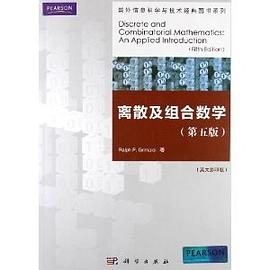
《离散及组合数学(第5版)(英文影印版)》内容主要由四部分组成:(1)基本离散结构,包括集合论与逻辑、函数与关系、语言与有限状态自动机;(2)组合数学,包括排列组合、容斥原理、生成函数、递推关系、鸽巢原理;(3)图论及其应用,包括图论基本知识、树、最优化与匹配;(4)现代应用代数,包括环论与模算术、布尔代数与交换函数、群、编码理论、波利亚计数方法、有限域与组合设计。
《离散及组合数学(第5版)(英文影印版)》可作为计算机、软件工程和电子类相关专业的本科生或研究生教材,也可供工程技术人员参考。
作者简介
目录信息
1 Fundamental Principles of Counting
1.1 The Rules of Sum and Product
1.2 Permutations
1.3 Combinations:The Binomial Theorem
1.4 Combinations with Repetition
1.5 The Catalan Numbers(Optional)
1.6 Summary and Historical Review
2 Fundamentals of Logic
2.1 Basic Connectives and Truth Tables
2.2 Logical Equivalence:The Laws of Logic
2.3 Logical Implication:Rules of Inference
2.4 The Use of Quantifiers
2.5 Quantifiers,Definitions,and the Proofs of Theorems
2.6 Summary and Historical Review
3 Set Theory
3.1 Sets and Subsets
3.2 Set Operations and the Laws of Set Theory
3.3 Counting and Venn Diagrams
3.4 A FirstWord on Probability
3.5 The Axioms of Probability(Optional)
3.6 Conditional Probability:Independence(Optional)
3.7 Discrete Random Variables(Optional)
3.8 Summary and Historical Review
4 Properties of the Integers:Mathematical Induction
4.1 TheWell-Ordering Principle:Mathematical Induction
4.2 Recursive Definitions
4.3 The Division Algorithm:Prime Numbers
4.4 The Greatest Common Divisor:The Euclidean Algorithm
4.5 The Fundamental Theorem of Arithmetic
4.6 Summary and Historical Review
5 Relations and Functions
5.1 Cartesian Products and Relations
5.2 Functions:Plain and One-to-One
5.3 Onto Functions:Stirling Numbers of the Second Kind
5.4 Special Functions
5.5 The Pigeonhole Principle
5.6 Function Composition and Inverse Functions
5.7 Computational Complexity
5.8 Analysis of Algorithms
5.9 Summary and Historical Review
6 Languages:Finite State Machines
6.1 Language:The Set Theory of Strings
6.2 Finite State Machines:A First Encounter
6.3 Finite State Machines:A Second Encounter
6.4 Summary and Historical Review
7 Relations:The Second Time Around
7.1 Relations Revisited:Properties of Relations
7.2 Computer Recognition:Zero-One Matrices and Directed Graphs
7.3 Partial Orders:Hasse Diagrams
7.4 Equivalence Relations and Partitions
7.5 Finite State Machines:The Minimization Process
7.6 Summary and Historical Review
PART 2 Further Topics in Enumeration
8 The Principle of Inclusion and Exclusion
8.1 The Principle of Inclusion and Exclusion
8.2 Generalizations of the Principle
8.3 Derangements:Nothing Is in Its Right Place
8.4 Rook Polynomials
8.5 Arrangements with Forbidden Positions
8.6 Summary and Historical Review
9 Generating Functions
9.1 Introductory Examples
9.2 Definition and Examples:Calculational Techniques
9.3 Partitions of Integers
9.4 The Exponential Generating Function
9.5 The Summation Operator
9.6 Summary and Historical Review
10 Recurrence Relations
10.1 The First-Order Linear Recurrence Relation
10.2 The Second-Order Linear Homogeneous Recurrence Relation with Constant
10.3 The Nonhomogeneous Recurrence Relation
10.4 The Method of Generating Functions
10.5 A Special Kind of Nonlinear Recurrence Relation(Optional)
10.6 Divide-and-Conquer Algorithms(Optional)
10.7 Summary and Historical Review
PART 3 Graph Theory and Applications
11 An Introduction to Graph Theory
11.1 Definitions and Examples
11.2 Subgraphs,Complements,and Graph Isomorphism
11.3 Vertex Degree:Euler Trails and Circuits
11.4 Planar Graphs
11.5 Hamilton Paths and Cycles
11.6 Graph Coloring and Chromatic Polynomials
11.7 Summary and Historical Review
12 Trees
12.1 Definitions,Properties,and Examples
12.2 Rooted Trees
12.3 Trees and Sorting
12.4 Weighted Trees and Prefix Codes
12.5 Biconnected Components and Articulation Points
12.6 Summary and Historical Review
13 Optimization and Matching
13.1 Dijkstra恠 Shortest-Path Algorithm
13.2 Minimal Spanning Trees:The Algorithms of Kruskal and Prim
13.3 Transport Networks:The Max-Flow Min-Cut Theorem
13.4 Matching Theory
13.5 Summary and Historical Review
PART 4 Modern Applied Algebra
14 Rings and Modular Arithmetic
14.1 The Ring Structure:Definition and Examples
14.2 Ring Properties and Substructures
14.3 The Integers Modulo n
14.4 Ring Homomorphisms and Isomorphisms
14.5 Summary and Historical Review
15 Boolean Algebra and Switching Functions
15.1 Switching Functions:Disjunctive and Conjunctive Normal Forms
15.2 Gating Networks:Minimal Sums of Products:Karnaugh Maps
15.3 Further Applications:Don恡-Care Conditions
15.4 The Structure of a Boolean Algebra(Optional)
15.5 Summary and Historical Review
16 Groups,Coding Theory,and Polya恠 Method of Enumeration
16.1 Definition,Examples,and Elementary Properties
16.2 Homomorphisms,Isomorphisms,and Cyclic Groups
16.3 Cosets and Lagrange恠 Theorem
16.4 The RSA Cryptosystem(Optional)
16.5 Elements of Coding Theory
16.6 The Hamming Metric
16.7 The Parity-Check and Generator Matrices
16.8 Group Codes:Decoding with Coset Leaders
16.9 Hamming Matrices
16.10 Counting and Equivalence:Burnside恠 Theorem
16.11 The Cycle Index
16.12 The Pattern Inventory:Polya恠 Method of Enumeration
16.13 Summary and Historical Review
17 Finite Fields and Combinatorial Designs
17.1 Polynomial Rings
17.2 Irreducible Polynomials:Finite Fields
17.3 Latin Squares
17.4 Finite Geometries and Affine Planes
17.5 Block Designs and Projective Planes
17.6 Summary and Historical Review
Appendix 1 Exponential and Logarithmic Functions A-1
Appendix 2 Matrices,Matrix Operations,and Determinants A-11
Appendix 3 Countable and Uncountable Sets A-23
Solutions S-1
· · · · · · (收起)
读后感
用户评价
这本书的封面设计实在太……朴实了,简直像是九十年代的教科书重印,那种米黄色的纸张泛着一股淡淡的、说不清道不明的年代感。我原本是冲着“离散及组合数学”这个标题来的,期望能在这本书里找到一些深入浅出的讲解,毕竟现在市面上的教材动辄就把基础讲得云里雾里。然而,这本书的开篇部分,尤其是在讲授集合论和逻辑推理的那几章,简直让人昏昏欲睡。作者似乎完全没有意识到,对于初学者来说,抽象的符号和定义堆砌在一起是多么可怕的事情。我花了好大力气才勉强理解了什么是良序原理,而书中对这个概念的阐述,不过是机械地罗列了几个定理和定义,没有一个生动的例子来辅助理解。翻到后面关于图论的部分,情况也没有好转。那些关于连通性和遍历性的讨论,虽然在理论上是完备的,但缺乏实际的应用场景描述,读起来就像是在啃一块干巴巴的石头,嚼不出任何滋味。我甚至怀疑,这本书是不是直接从某篇年代久远的数学期刊论文集里摘抄出来的,缺乏现代教材应有的互动性和引导性。如果不是因为我的课程大纲强制要求使用它,我可能早就把它丢到角落里积灰了。希望接下来的内容能够有所起色,否则,这本厚重的书本对我来说,更像是一个沉重的负担。
这本书的语言风格简直就像是一位沉浸在自己世界里的老教授在娓娓道来,充满了学术上的准确性,却完全缺乏与现代读者的对话感。它充斥着大量冗长、拗口的从句和被动语态,使得原本应该清晰的逻辑推导变得晦涩难懂。例如,在介绍图的着色问题时,书中用了整整一页纸来阐述一个非常基础的定理,期间穿插了大量的数学术语的精确定义,仿佛生怕读者误解了任何一个微小的概念。但问题是,当我们试图去理解这些术语的应用时,书中提供的例子却少得可怜,而且选取的例子本身也过于偏门和抽象。我感觉作者似乎过于自信于读者的数学背景,默认我们已经掌握了足够的预备知识。这种高高在上的叙述姿态,让我在阅读时时刻刻都需要保持高度的警惕,生怕错过任何一个隐藏在复杂句式中的关键信息。这本书更适合作为一本“参考手册”放在案头,供已经精通此道的人士查阅特定定理的严谨表述,而绝不适合作为初学者的入门读物。
我必须承认,这本书的习题部分是它为数不多的亮点之一,尽管找到这个亮点也经历了一番波折。前面章节的例题讲解得太过简略,很多关键的过渡步骤都被一笔带过,让人感觉作者是在“跳着”讲授知识点。然而,一旦进入到每章末尾的习题部分,你就会发现,这些题目难度梯度设置得非常合理且具有挑战性。它不像有些教材,把所有题目都设计成基础概念的机械重复运用,而是从简单的应用题开始,逐步过渡到需要创造性思维才能解决的综合性难题。特别是最后几章关于生成函数和递推关系的部分,那些习题设计得相当精巧,迫使你必须深入理解理论背后的逻辑,而不是仅仅套用公式。我甚至发现,有些难题的解法并不唯一,不同的解题路径体现了对不同数学工具的灵活掌握程度。如果能把这种对习题设计的匠心用在对基础概念的解释上,这本书的整体质量将会有质的飞跃。不过,话说回来,这本书的答案和详细解析部分极其稀少,很多难题只有最终答案,没有中间步骤,这对于需要逐步学习的学生来说,无疑是又一个打击。
关于本书的装订和纸张质量,我持有保留意见。虽然这本书的定价并不算低廉,但实际的触感却远低于预期。纸张偏薄,以至于在翻阅较厚的章节时,隐约能看到背面的文字阴影,尤其是在光线稍暗的环境下阅读,对眼睛的负担非常大。更让我担忧的是,因为内容深度较大,很多定理和证明需要反复查阅,频繁的翻动让一些页面的装订处已经出现了轻微的松动迹象,书脊的胶水似乎不够结实。考虑到这是一本工具书,需要陪伴我度过至少一整个学期的学习过程,这种略显粗糙的物理制作工艺让人不禁捏一把汗。如果这本书的内涵足够卓越,或许我们可以忍受其外在的不足,但正如我之前感受到的,内容上存在诸多晦涩和引导不足的问题,再加上这种勉强合格的装帧,使得这本书的整体性价比大打折扣。我更希望出版方能在保证学术内容的同时,提升一下读者接触这些知识的“物理体验”,毕竟,阅读的过程本身也应该是愉悦和舒适的。
这本书的排版简直是一场视觉灾难。字体选择上,正文字体和公式字体之间的协调性极差,公式往往显得突兀而笨重,尤其是涉及到那些复杂的排列组合公式时,整个页面看起来就像是被人用尺子和圆规生硬地拼凑起来的。更要命的是,书中几乎没有插图,或者说,那些勉强算作图的部分,也只是用简单的ASCII字符拼凑出来的简陋示意图,完全无法帮助读者建立空间想象或者结构概念。例如,在讲解容斥原理时,作者仅仅是用文字和数学表达式进行推导,如果读者没有强大的心算和空间想象能力,很容易在中间步骤迷失方向。对比我之前看的国外引进版教材,人家会用清晰的彩色图示来展示集合的交并关系,配上直观的维恩图,即便是复杂的包含与排除也能一目了然。而这本《离散及组合数学》,似乎完全抛弃了图形辅助的理念,固执地坚守着纯文本的“严谨性”,结果却是牺牲了绝大多数读者的可读性。我常常需要对照着网上的视频教程,才能把书本上那些密密麻麻的符号串对应到具体的数学模型上,这极大地降低了我的学习效率和阅读兴趣。