
具体描述
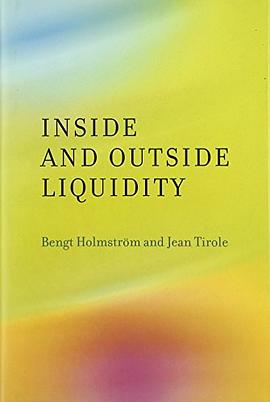
Why do financial institutions, industrial companies, and households hold low-yielding money balances, Treasury bills, and other liquid assets? When and to what extent can the state and international financial markets make up for a shortage of liquid assets, allowing agents to save and share risk more effectively? These questions are at the center of all financial crises, including the current global one.
In Inside and Outside Liquidity, leading economists Bengt Holmström and Jean Tirole offer an original, unified perspective on these questions drawing on insights from modern corporate finance. In a slight, but important departure from the standard theory of finance, they show how imperfect pledgeability of corporate income leads to a demand for as well as a shortage of liquidity with interesting implications for the pricing of assets, investment decisions, and liquidity management. The government has an active role to play in improving risk-sharing between consumers with limited commitment power and firms dealing with the high costs of potential liquidity shortages. In this perspective, private risk sharing is always imperfect and may lead to financial crises that can be alleviated through government interventions. In an epilogue, Holmström and Tirole show how their theory can be used to understand some aspects of the recent financial crisis.
作者简介
Bengt Holmström is Paul A. Samuelson Professor of Economics at MIT, where he was Head of the Economics Department from 2003 to 2006.
Jean Tirole is Scientific Director of IDEI (Institut d'Economie Industrielle), Chairman of the Board of TSE (Toulouse School of Economics), and Annual Visiting Professor of Economics at MIT.
目录信息
Bengt Holmstrom and Jean Tirole
Acknowledgments vii
Prologue: Motivation and Roadmap 1
I Basics of Leverage and Liquidity 9
1 Leverage 15
2 A Simple Model of Liquidity Demand 27
II Complete Markets 61
3 Aggregate Liquidity Shortages and Liquidity Premia 65
4 A Liquidity Asset Pricing Model (LAPM) 89
III Public Provision of Liquidity 115
5 Public Provision of Liquidity in a Closed Economy 121
6 Liquidity Provision with Access to Global Capital Markets 145
IV Waste of Liquidity and Public Policy 165
7 Financial Muscle and Overhoarding of Liquidity 169
8 Specialized Inputs and Secondary Markets 199
Epilogue: Summary and Concluding Thoughts on the Subprime Crisis 227
Bibliography 243
Index
· · · · · · (收起)