
具体描述
The Books
by Sylvie Lacerte
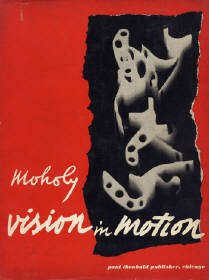
Vision in Motion
"This book is written for the artist and the layman, for everyone interested in his relationship to our existing civilization"
(Moholy-Nagy, Vision in Motion, 1947, p.5)
The opening sentence of this book, written by Laszlo Moholy-Nagy in 1946 and published posthumously by his wife Sibyl Moholy-Nagy in 1947, illustrates in an unquestionnable fashion, the author's philosophy. Vision in Motion is the continuation of The New Vision, published in 1930, in which the author presented the Bauhaus School's pedagogical project and methods.
In a way, Vision in Motion is Moholy-Nagy's manifesto, or rather his testament pertaining to his notions on art and education, as well as to the philosophy he had instilled in the New Bauhaus School, that he founded in 1937, within the Chicago Design Institute.
For MOHOLY-NAGY the book, Vision in Motion is the expression of art and life's interpenetration which he illustrated abundantly and where texts and images entertain a dialogue with one another; which is to say that they are in total interaction. The images are not only there to illustrate the discourse, but rather to complete it in order to attain "a better visual communication" (Moholy-Nagy 1947: 6). Thus, this work is intimately related to the New Bauhaus's pedagogical project.
"This book is an attempt to add to the politico-social a biological 'bill of rights' asserting the interrelatedness of man's fundamental qualities, of his intellectual and emotional requirements, of his psychological well-being and his physical health. It proposes that new tools and technologies cause social changes; that they shift ways of production, possessions, wealth and power; yet though the inevitable logic of new technologies, offering easy advantages for labor saving and profit making, is willingly accepted on pragmatic intellectual terms, it is stubbornly opposed in the emotional sphere, where man clings to obsolete standards and empty conventions of the past, unnaproachable by logical argument and often against his best interests." (Moholy-Nagy 1947: 5)."
MOHOLY-NAGY's desire to witness an inalterable link between art and life (following in John Dewey's footpath, cf. Art as experience, 1934) is included in the New Bauhaus's philosophy via its pedagogical program in which interdisciplinarity acts as the school's keystone. The table of contents of Vision in Motion is particularly revelating as far as MOHOLY-NAGY's visionis concerned:
Foreword
Acknowledgement
Introduction
Analyzing the Situation
Vision in Motion
The Discrepancy - The Inalienable Rights - Specialists - Moral Obligations Diminish- Indivisible Education - Official and Unofficial Education - Confusion Around Science - The Propaganda Machine - Carreerists - Liberal Education - Stabilizing the Transitory - Second-hand Facts - Attempts at Improvements - The Task of this Generation - Capacities - Fear - The Amateur - The Function of Art - The "Professional" Artist - Art and Science.
New Method of Approach - Design for Life
Axioms - Quality of Relationships - Designing is not a Profession but an Attitude - Design Potentialities - Established Paths of Thought - Forms and Shapes - The Age of Assemblage - Streamlining - New Working Conditions - Other Social Implications - Economy of Production - The Role of Intuition - The Avant-Garde - Dissemination of Knowledge - Mental Adjustment.
New Education - Organic approach
general outline
The Background - The Bauhaus - The Foundation (Basic) Course - Policy - The Educational Technique - Practising Correlations - Scientific Curiosity - Common Denominator - Aptitude Tests: Vocationnal Guidance - Hand Sculptures - Weight Sculptures - Tactile Sculptures - Measuring Exercise - Machine Exercise - Sheets, Slabs, Joints - Glass, Mirror and Spatial Exercises - Motions Studies - Emphasis on "Objective" Quality - The Specialized Workshops - The Architectural Department - Mechnical Draughting - Space Modulator - The Primitive House - Contemporary House - The Larger Concept of Structure - Spatial Concepts - Social Planning.
integration - the arts
Painting
Issues - Cubism - Distortion - Attempts of Rendering Motion - The System of Cubism - Visual Fundamentals - Solutions of Legilbility - Vision in Motion - In Defense of "Abstract" Art - Stages in Space Interpretation On Color - From Pigments to Colored Light - "Optophonetic".
Photography
Color Photography - Black and White - Photographic Quality - Teaching Photography - Photography Without Camera (Photogram) - Light Modulator - Other Experiments - Photographic Vision - Eight Varieties of Photographic Vision - Image Sequences; Series - Photogenic Versus Photocreative - New Directions - Superimposition - Photomontage.
Sculpture
The General Situation - Aspects of Representation - Fudamental Attitudes in Treating Materials - Volume Creation - The Five Stages of Volume Modulation (Articulation) - Parallel Phenomena - Volume Modulator: First Stage, Second Stage, Third Stage - Succession in Time - Amplification - Fourth Stage - Fifth Stage - The History of Kinetic Scultpture - Duality of Volume - Sculptural Development and Emotional Experience.
Space-Time Problems
Rendering Motion (space-time) on the Static Plane - Speed - Analysis of Speed - Transparency and Light - Photographic Practice - Symbols - Mobile Architecture - Exposition Architecture, Display, Theatre, Dance - Space - Time?
Motion Pictures
The Situation - The Problem - The Visual - Light - Abstract Film - Documentary Film - Pioneers - Sound Film - Film Cutting (Montage) - Genuine Technique for the Sound Film - Colour Film and Long Shot Montage - The Visual Axis - Color Economy - Projection - The Tasks of Film Production - Institute of Light - Film Script.
Literature
First Steps - Verbalized Communication - Whitman and Lautréamont - Appolinaire, Morgenstern, Stein - Futurism - "The Geometrical and Mechanical Splendor" - The New Typography - Rimbaud - Dadaism - Hans Arp - Tristan Tzara - Hugo Ball, Richard Huelsenbeck - Kurt Schwitters - Writing on the Psychotic - Children's Verses - Sound and Number Magic - The New Poetry Arrived - Surrealism - Art and Society - Sigmund Freud - James Joyce - Finnegan's Wake - Freedom and Unpredictability.
Group Poetry
Group Poetry as "Word Modulator" - Individual Work.
A Proposal
Youth Only - Parliament of Social Design4
Although, for the purpose of this article, it may seem fastidious at first glance, to replicate the table of contents in its integral form, if we delve closer into it, it not only allows to notice, in a nutshell, M.-N.'s attention to detail, but also his deeply felt belief in the interrelatedness of all artistic disciplines and life. It is also very interesting to recognize, fifty years after Vision in Motion's publication, how actual and fitting M.-N.'s philosophy still is today. The visionnary that he was not only limited himself to the listing of the different stages of the creative process, from the inception of the first idea to the consumption of the final product, but granted a great deal of significance to the context in which and for which the objects were created. The links established between the artistic disciplines, between arts and the "new technologies" and between arts and sciences were always taken into account in relation to their integration into the environment for which they were designed.
© Sylvie Lacerte & OLATS, septembre 2000
作者简介
目录信息
读后感
用户评价
这本书的排版和装帧设计本身就构成了一种无声的宣言。纸张的质感粗粝而坚韧,油墨的颜色深沉,内文的行距和字间距都设置得非常紧凑,给人一种强烈的压迫感和紧凑感。这种物理上的感受,恰好呼应了内容上的那种密不透风的逻辑结构。我发现自己阅读速度极慢,很大一部分原因在于,我需要不断地在页边空白处写下自己的疑问和联想,因为书中的论证链条实在是太长了,任何一个疏忽都可能导致后续理解的断裂。特别是关于“信息熵与文化衰退”的章节,作者引用了大量的统计图表,这些图表被巧妙地嵌入到文本流中,而不是被隔离在附录里,这迫使读者必须同步解读视觉信息和文字论证。这种高度的整合性,使得每一次翻页都像是一次对注意力的重新校准。这本书的阅读体验,与其说是在吸收知识,不如说是在完成一项需要极度专注力的“工程”。它似乎在暗示,如此深刻的思考,不应以轻松随意的方式被对待。
这本书的文字密度实在惊人,仿佛每一页都塞满了作者对某个领域的深刻洞察和不倦探索。我花了几乎两倍于平常阅读其他书籍的时间来啃读,不是因为文笔晦涩,而是信息的洪流太过丰沛。尤其是探讨到关于“非线性时间感知”的章节,作者巧妙地引入了多个看似无关的学科分支——从量子纠缠的理论模型到古代哲学对“永恒”的诠释——构建了一个令人叹为观止的理论框架。我必须承认,有些地方我需要停下来,在笔记本上画图、梳理逻辑链条,才能跟上作者思绪的跳跃。这不像是在阅读一本传统意义上的著作,更像是在参与一场智力上的马拉松,作者始终保持着近乎苛刻的精确性,生怕遗漏任何一个细微的变量。它挑战了你对既有认知的舒适区,强迫你以全新的视角去审视那些你习以为常的日常现象。读完合上书本时,产生了一种奇异的疲惫感,但这种疲惫里夹杂着一种强烈的智识上的满足,仿佛脑子里被重新布线了一遍。对于那些寻求智力刺激、不惧怕复杂推演的读者来说,这无疑是一次难得的“硬核”体验。它绝不是那种可以轻松翻阅的消遣读物,更像是一份需要全身心投入的学术宣言。
翻开这本书的时候,我原本期待的是一种流畅的叙事体验,一种能带着我轻松穿越特定主题的引导,但实际读下来的感受,却像是在迷宫中寻找出口。作者的叙述风格极其碎片化,充满了大量的脚注和旁征博引,这些引用本身就构成了另一层复杂的文本网络。我印象最深的是其中关于“意象的物质化倾向”的论述,它没有提供一个清晰的定义,而是通过一系列相互矛盾的案例和诗意的比喻来展现这种趋势的模糊性。你必须自己去提炼,去拼接,才能拼凑出一个属于你自己的理解框架。这种阅读体验极其依赖读者的主动性,它拒绝被动接受,要求你像一个侦探一样,从蛛丝马迹中构建案件的真相。有那么几页,我甚至怀疑自己是不是漏看了什么关键的过渡段落,但反复查阅后发现,作者故意省略了那些“显而易见”的连接点,将构建桥梁的任务交给了读者。这使得每一次的“顿悟”都显得尤为珍贵,但同时也意味着阅读过程中的挫败感也时常出现。这本书更像是一个高难度的智力拼图,成品的美感在于它完全由你的努力塑造而成。
坦白说,这本书的‘人味’似乎被刻意削弱了。它在探讨宏大概念时展现出了惊人的广度,但当涉及到个体经验或情感层面时,笔触就变得冰冷而抽离。我试图在作者的论述中找到一丝可以依附的情感锚点,一种能够让我与这些深奥理论产生共鸣的人性温度,但几乎没有。比如在分析“感知延迟”对社会结构的影响时,所有的论述都基于纯粹的逻辑推演和数据模型的假设,缺乏对那些被理论边缘化的‘具体人物’的关注。这让我想起一些早期的结构主义文本,它们更关心体系的运行规则,而非体系内个体的挣扎。这并非是批评,而是一种风格的辨识。它成功地创造了一个超脱于日常情感判断的分析空间,使得讨论得以在极度客观的层面展开。然而,对于那些期望在阅读中获得心灵慰藉或情感投射的读者来说,这本书可能会显得异常疏离和‘学术化’。它更像是一套精密设计的仪器,而非一本充满温度的日记。
这本书最让我感到‘不安’,但又无比着迷的地方在于其‘目的论’的模糊性。作者似乎一直在构建一个巨大的、自洽的理论体系,这个体系可以解释过去和预测未来,但当你读到最后一章,却发现作者从未明确指出:‘所以,我们该做什么?’ 所有的分析都指向一个高度复杂的、几乎无法干预的系统性真相,但随之而来的行动指南却异常空泛,或者说,根本不存在具体的行动建议。这留下了一个巨大的哲学真空。我们花费了数百页的篇幅,搭建起一座令人惊叹的知识高塔,然而塔顶的风景虽然壮阔,却无法提供一个清晰的下山路径。这引发了我长久的沉思:究竟是作者故意留下了这个缺口,让读者自己去填充行动的意义,还是说,在作者的终极逻辑中,‘理解’本身就是唯一的、最高级的行动?这种对‘意义’的刻意悬置,使得这本书的阅读体验充满了智性的辩证,让人在赞叹其结构完整性的同时,又对这种‘形而上’的徒劳感感到一丝丝的无可奈何。
在美国亚马逊上买了本二手
谢谢大黄不辞辛苦的越洋翻拍
作为BAUHAUS主力之一的NAGY在美国发扬光大的力作,引用他自己前言中的话,“more general view of the interrelatedness of art and life”,柯林罗寻找透明性的足迹,可以看到NAGY思想在闪光。
the German-American shift.
Moholy-Nagy最后一本书。一生追求的东西都没变。