
具体描述
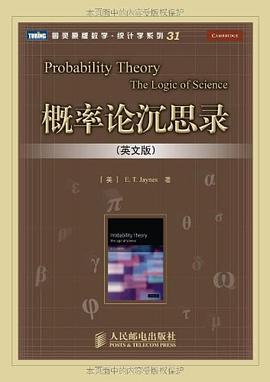
《概率论沉思录(英文版)》将概率和统计推断融合在一起,用新的观点生动地描述了概率论在物理学、数学、经济学、化学和生物学等领域中的广泛应用,尤其是它阐述了贝叶斯理论的丰富应用,弥补了其他概率和统计教材的不足。全书分为两大部分。第一部分包括10章内容,讲解抽样理论、假设检验、参数估计等概率论的原理及其初等应用;第二部分包括12章内容,讲解概率论的高级应用,如在物理测量、通信理论中的应用。《概率论沉思录(英文版)》还附有大量习题,内容全面,体例完整。
《概率论沉思录(英文版)》内容不局限于某一特定领域,适合涉及数据分析的各领域工作者阅读,也可作为高年级本科生和研究生相关课程的教材。
作者简介
目录信息
1 Plausiblereasoning
1.1 Deductiveandplausiblereasoning
1.2 Analogieswith slcaltheories
1.3 Thethinkingcomputer
1.4 Introducingtherobot
1.5 Booleanalgebra
1.6 Adequatesetsofoperations
1.7 Thebasicdesiderata
1.8 Comments
1.8.1 Commonlanguagevs.formallogic
1.8.2 Nitpicking
2 Thequantitativerules
2.1 Theproductrule
2.2 Thesumrule
2.3 Qualitativeproperties
2.4 Numericalvalues
2.5 Notationandfinite-setspolicy
2.6 Comments
2.6.1 Suectlvevs.oectlve
2.6.2 G/3delstheorem
2.6.3 Venndiagrams
2.6.4 TheKolmogorovaxioms
3 Elementarysamplingtheory
3.1 Samplingwithoutreplacement
3.2 Logicvs.propensity
3.3 Reasoningfromlesspreciseinformation
3.4 Expectations
3.5 Otherformsandextensions
3.6 Probabilityasamathematicaltool
3.7 Thebinomialdistribution
3.8 Samplingwithreplacement
3.8.1 Digression:asermononrealityvs.models
3.9 Correctionforcorrelations
3.10 Simplification
3.11 Comments
3.11.1 Alookahead
4 Elementaryhypothesistesting
4.1 Priorprobabilities
4.2 Testingbinaryhypotheseswithbinarydata
4.3 Nonextensibilitybeyondthebinarycase
4.4 Multiplehypothesistesting
4.4.1 Digressiononanotherderivation
4.5 Continuousprobabilitydistributionfunctions
4.6 Testinganinfinitenumberofhypotheses
4.6.1 Historicaldigression
4.7 Simpleandcompound(orcomposite)hypotheses
4.8 Comments
4.8.1 Etymology
4.8.2 Whathaveweaccomplished?
5 Queerusesforprobabilitytheory
5.1 Extrasensoryperception
5.2 MrsStewartstelepathicpowers
5.2.1 Digressiononthenormalapproximation
5.2.2 BacktoMrsStewart
5.3 Converginganddivergingviews
5.4 Visualperception-evolutionintoBayesianity?
5.5 ThediscoveryofNeptune
5.5.1 Digressiononalternativehypotheses
5.5.2 BacktoNewton
5.6 Horseracingandweatherforecasting
5.6.1 Discussion
5.7 Paradoxesofintuition
5.8 Bayesianjurisprudence
5.9 Comments
5.9.1 Whatisqueer?
6 Elementaryparameterestimation
6.1 Inversionoftheumdistributions
6.2 BothNandRunknown
6.3 Uniformprior
6.4 Predictivedistributions
6.5 Truncateduniformpriors
6.6 Aconcaveprior
6.7 Thebinomialmonkeyprior
6.8 Metamorphosisintocontinuousparameterestimation
6.9 Estimationwithabinomialsamplingdistribution
6.9.1 Digressiononoptionalstopping
6.10 Compoundestimationproblems
6.11 AsimpleBayesianestimate:quantitativepriorinformation
6.11.1 Fromposteriordistributionfunctiontoestimate
6.12 Effectsofqualitativepriorinformation
6.13 Choiceofaprior
6.14 Onwiththecalculation!
6.15 TheJeffreysprior
6.16 Thepointofitall
6.17 Intervalestimation
6.18 Calculationofvariance
6.19 Generalizationandasymptoticforms
6.20 Rectangularsamplingdistribution
6.21 Smallsamples
6.22 Mathematicaltrickery
6.23 Comments
7 Thecentral,Gaussianornormaldistribution
7.1 Thegravitatingphenomenon
7.2 TheHerschel-Maxwellderivation
7.3 TheGaussderivation
7.4 HistoricalimportanceofGausssresult
7.5 TheLandonderivation
7.6 WhytheubiquitoususeofGausslandistributions?
7.7 Whytheubiquitoussuccess?
7.8 Whatestimatorshouldweuse?
7.9 Errorcancellation
7.10 Thenearirrelevanceofsamplingfrequencydistributions
7.11 Theremarkableefficiencyofinformationtransfer
7.12 Othersamplingdistributions
7.13 Nuisanceparametersassafetydevices
7.14 Moregeneralproperties
7.15 ConvolutionofGaussians
7.16 Thecentrallimittheorem
7.17 Accuracyofcomputations
7.18 Galtonsdiscovery
7.19 PopulationdynamicsandDarwinianevolution
7.20 Evolutionofhumming-birdsandflowers
7.21 Applicationtoeconomics
7.22 ThegreatinequalityofJupiterandSaturn
7.23 ResolutionofdistributionsintoGaussians
7.24 Hermitepolynomialsolutions
7.25 Fouriertransformrelations
7.26 Thereishopeafterall
7.27 Comments
7.27.1 Terminologyagain
8 Sufficiency,ancillarity,andallthat
8.1 Sufficiency
8.2 Fishersufficiency
8.2.1 Examples
8.2.2 TheBlackwell-Raotheorem
8.3 Generalizedsufficiency
8.4 Sufficiencyplusnuisanceparameters
8.5 Thelikelihoodprinciple
8.6 Ancillarity
8.7 Generalizedancillaryinformation
8.8 Asymptoticlikelihood:Fisherinformation
8.9 Combiningevidencefromdifferentsources
8.10 Poolingthedata
8.10.1 Fine-grainedpropositions
8.11 Samsbrokenthermometer
8.12 Comments
8.12.1 Thefallacyofsamplere-use
8.12.2 Afolktheorem
8.12.3 Effectofpriorinformation
8.12.4 Clevertricksandgamesmanship
9 Repetitiveexperiments:probabilityandfrequency
9.1 Physicalexperiments
9.2 Thepoorlyinformedrobot
9.3 Induction
9.4 Aretheregeneralinductiverules?
9.5 Multiplicityfactors
9.6 Partitionfunctionalgorithms
9.6.1 Solutionbyinspection
9.7 Entropyalgorithms
9.8 Anotherwayoflookingatit
9.9 Entropymaximization
9.10 Probabilityandfrequency
9.11 Significancetests
9.11.1 Impliedalternatives
9.12 Comparisonofpsiandchi-squared
9.13 Thechi-squaredtest
9.14 Generalization
9.15 Halleysmortalitytable
9.16 Comments
9.16.1 Theirrationalists
9.16.2 Superstitions
10 Physicsofrandomexperiments
10.1 Aninterestingcorrelation
10.2 Historicalbackground
10.3 Howtocheatatcoinanddietossing
10.3.1 Experimentalevidence
10.4 Bridgehands
10.5 Generalrandomexperiments
10.6 Inductionrevisited
10.7 Butwhataboutquantumtheory?
10.8 Mechanicsundertheclouds
10.9 Moreoncoinsandsymmetry
10.10 Independenceoftosses
10.11 Thearroganceoftheuninformed
PartⅡ Advancedapplications
11 Discretepriorprobabilities:theentropyprinciple
11.1 Anewkindofpriorinformation
11.2 Minimum∑Pi2
11.3 Entropy:Shannonstheorem
11.4 TheWallisderivation
11.5 Anexample
11.6 Generalization:amorerigorousproof
11.7 Formalpropertiesofmaximumentropydistributions
11.8 Conceptualproblems-frequencycorrespondence
11.9 Comments
12 Ignorancepriorsandtransformationgroups
12.1 Whatarewetryingtodo?
12.2 Ignorancepriors
12.3 Continuousdistributions
12.4 Transformationgroups
12.4.1 Locationandscaleparameters
12.4.2 APoissonrate
12.4.3 Unknownprobabilityforsuccess
12.4.4 Bertrandsproblem
12.5 Comments
13 Decisiontheory,historicalbackground
13.1 Inferencevs.decision
13.2 DanielBernoullissuggestion
13.3 Therationaleofinsurance
13.4 Entropyandutility
13.5 Thehonestweatherman
13.6 ReactionstoDanielBernoulliandLaplace
13.7 Waldsdecisiontheory
13.8 Parameterestimationforminimumloss
13.9 Reformulationoftheproblem
13.10 Effectofvaryinglossfunctions
13.11 Generaldecisiontheory
13.12 Comments
13.12.1 Objectivityofdecisiontheory
13.12.2 Lossfunctionsinhumansociety
13.12.3 AnewlookattheJeffreysprior
13.12.4 Decisiontheoryisnotfundamental
13.12.5 Anotherdimension?
14 Simpleapplicationsofdecisiontheory
14.1 Definitionsandpreliminaries
14.2 Sufficiencyandinformation
14.3 Lossfunctionsandcriteriaofoptimumperformance
14.4 Adiscreteexample
14.5 Howwouldourrobotdoit?
14.6 Historicalremarks
14.6.1 Theclassicalmatchedfilter
14.7 Thewidgetproblem
14.7.1 SolutionforStage2
14.7.2 SolutionforStage3
14.7.3 SolutionforStage4
14.8 Comments
15 Paradoxesofprobabilitytheory
15.1 Howdoparadoxessurviveandgrow?
15.2 Summingaseriestheeasyway
15.3 Nonconglomerability
15.4 Thetumblingtetrahedra
15.5 Solutionforafinitenumberoftosses
15.6 Finitevs.countableadditivity
15.7 TheBorel-Kolmogorovparadox
15.8 Themarginalizationparadox
15.8.1 Ontogreaterdisasters
15.9 Discussion
15.9.1 TheDSZExample#5
15.9.2 Summary
15.10 Ausefulresultafterall?
15.11 Howtomass-produceparadoxes
15.12 Comments
16 Orthodoxmethods:historicalbackground
16.1 Theearlyproblems
16.2 Sociologyoforthodoxstatistics
16.3 RonaldFisher,HaroldJeffreys,andJerzyNeyman
16.4 Pre-dataandpost-dataconsiderations
16.5 Thesamplingdistributionforanestimator
16.6 Pro-causalandanti-causalbias
16.7 Whatisreal,theprobabilityorthephenomenon?
16.8 Comments
16.8.1 Communicationdifficulties
17 Principlesandpathologyoforthodoxstatistics
17.1 Informationloss
17.2 Unbiasedestimators
17.3 Pathologyofanunbiasedestimate
17.4 Thefundamentalinequalityofthesamplingvariance
17.5 Periodicity:theweatherinCentralPark
17.5.1 Thefollyofpre-filteringdata
17.6. ABayesiananalysis
17.7 Thefollyofrandomization
17.8 Fisher:commonsenseatRothamsted
17.8.1 TheBayesiansafetydevice
17.9 Missingdata
17.10 Trendandseasonalityintimeseries
17.10.1 Orthodoxmethods
17.10.2 TheBayesianmethod
17.10.3 ComparisonofBayesianandorthodoxestimates
17.10.4 Animprovedorthodoxestimate
17.10.5 Theorthodoxcriterionofperformance
17.11 Thegeneralcase
17.12 Comments
18 TheApdistributionandruleofsuccession
18.1 Memorystorageforoldrobots
18.2 Relevance
18.3 Asurprisingconsequence
18.4 Outerandinnerrobots
18.5 Anapplication
18.6 Laplacesruleofsuccession
18.7 Jeffreysobjection
18.8 Bassorcarp?
18.9 Sowheredoesthisleavetherule?
18.10 Generalization
18.11 Confirmationandweightofevidence
18.11.1 Isindifferencebasedonknowledgeorignorance?
18.12 Camapsinductivemethods
18.13 Probabilityandfrequencyinexchangeablesequences
18.14 Predictionoffrequencies
18.15 One-dimensionalneutronmultiplication
18.15.1 Thefrequentistsolution
18.15.2 TheLaplacesolution
18.16 ThedeFinettitheorem
18.17 Comments
19 Physicalmeasurements
19.1 Reductionofequationsofcondition
19.2 Reformulationasadecisionproblem
19.2.1 SermononGaussianerrordistributions
19.3 Theunderdeterminedcase:Kissingular
19.4 Theoverdeterminedcase:Kcanbemadenonsingular
19.5 Numericalevaluationoftheresult
19.6 Accuracyoftheestimates
19.7 Comments
19.7.1 Aparadox
20 Modelcomparison
20.1 Formulationoftheproblem
20.2 Thefairjudgeandthecruelrealist
20.2.1 Parametersknowninadvance
20.2.2 Parametersunknown
20.3 Butwhereistheideaofsimplicity?
20.4 Anexample:linearresponsemodels
20.4.1 Digression:theoldsermonstillanothertime
20.5 Comments
20.5.1 Finalcauses
21 Outliersandrobustness
21.1 Theexperimentersdilemma
21.2 Robustness
21.3 Thetwo-modelmodel
21.4 Exchangeableselection
21.5 ThegeneralBayesiansolution
21.6 Pureoutliers
21.7 Onerecedingdatum
22 Introductiontocommunicationtheory
22.1 Originsofthetheory
22.2 Thenoiselesschannel
22.3 Theinformationsource
22.4 DoestheEnglishlanguagehavestatisticalproperties?
22.5 Optimumencoding:letterfrequenciesknown
22.6 Betterencodingfromknowledgeofdigramfrequencies
22.7 Relationtoastochasticmodel
22.8 Thenoisychannel
AppendixA Otherapproachestoprobabilitytheory
A.1 TheKolmogorovsystemofprobability
A.2 ThedeFinettisystemofprobability
A.3 Comparativeprobability
A.4 Holdoutsagainstuniversalcomparability
A.5 Speculationsaboutlatticetheories
AppendixB Mathematicalformalitiesandstyle
B.1 Notationandlogicalhierarchy
B.2 Ourcautiousapproachpolicy
B.3 WillyFelleronmeasuretheory
B.4 Kroneckervs.Weierstrasz
B.5 Whatisalegitimatemathematicalfunction?
B.5.1 Delta-functions
B.5.2 Nondifferentiablefunctions
B.5.3 Bogusnondifferentiablefunctions
B.6 Countinginfinitesets?
B.7 TheHausdorffsphereparadoxandmathematicaldiseases
B.8 WhatamIsupposedtopublish?
B.9 Mathematicalcourtesy
AppendixC Convolutionsandcumulants
C.1 Relationofcumulantsandmoments
· · · · · · (收起)
读后感
Probability theory as extended logic. ##preface ### comparisons The author violently slashes frequentist statistics. Bayesian analysis is kinda speculative, amouting to expressing some prior knowledge or working hypothesis, while Maximum Entropy method is n...
Probability theory as extended logic. ##preface ### comparisons The author violently slashes frequentist statistics. Bayesian analysis is kinda speculative, amouting to expressing some prior knowledge or working hypothesis, while Maximum Entropy method is n...
Probability theory as extended logic. ##preface ### comparisons The author violently slashes frequentist statistics. Bayesian analysis is kinda speculative, amouting to expressing some prior knowledge or working hypothesis, while Maximum Entropy method is n...
现在回过头来再看看这本书的前言,只能说,庆幸自己能看到 E. T. Jaynes 的这本了用半个世纪完成的著作。因为就在几年前的概率论课上我学的还是那种由一些基本的奇怪的论述构建起的令人十分不安的理论,比如说扔一个均匀硬币头朝上的概率是二分之一(你要证实这一点只要扔无数...
现在回过头来再看看这本书的前言,只能说,庆幸自己能看到 E. T. Jaynes 的这本了用半个世纪完成的著作。因为就在几年前的概率论课上我学的还是那种由一些基本的奇怪的论述构建起的令人十分不安的理论,比如说扔一个均匀硬币头朝上的概率是二分之一(你要证实这一点只要扔无数...
用户评价
我一直觉得,好的数学书籍应该具备一种“雕塑感”,这本书就完美地体现了这一点。作者对于每一个概念的阐述都经过了精心的打磨和取舍,没有一丝多余的赘述,却又充分地保证了逻辑链条的完整性。它就像是一件精心制作的艺术品,线条流畅,结构清晰,每一部分都恰到好处地承载着特定的信息和意义。我在阅读一些关于条件概率和贝叶斯推断的部分时,感受到了强烈的结构美学。作者巧妙地将看似分散的知识点编织成一张严密的网,让人清晰地看到不同概率工具之间的内在联系和相互支撑。这本书不仅教会了我如何计算,更重要的是,它教会了我如何“思考”概率问题,如何用一种更结构化、更审慎的态度去面对生活中的不确定性。
这本书的魅力在于它的“厚度”和“广度”的完美结合。它没有满足于停留在教科书的层面,而是勇敢地触及了许多前沿且富有争议性的概率应用领域。作者在介绍基础理论的同时,还穿插了大量精彩的历史典故和科学史上的关键转折点,这使得原本冰冷的数学知识变得有血有肉,充满了人性的挣扎与智慧的光芒。我特别喜欢它在论述统计推断的局限性时所展现出的那种坦诚和批判精神,这在很多同类书籍中是少见的。它鼓励读者保持怀疑,警惕过度依赖模型的陷阱,这对于培养真正的科学素养至关重要。读完后,我感觉自己对世界运作的随机性有了更成熟、更负责任的认知。
这本书真是让人大开眼界,它不仅仅是简单地堆砌公式和定理,更像是一场深入人心的哲学对话。作者的笔触细腻而富有洞察力,将那些原本晦涩难懂的概率概念,通过生动的例子和精妙的比喻,层层剥开,展现出它们背后蕴含的深刻逻辑。阅读过程中,我仿佛被带入了一个由不确定性构建的宏大世界,每一个概率事件都充满了偶然的美感和必然的规律。作者擅长引导读者去思考“为什么会这样”,而不是仅仅停留在“是什么”的层面。这种深入骨髓的探讨,让人在掌握知识的同时,也能感受到思维被拓展的愉悦。它不是那种读完就忘的工具书,而是一本值得反复咀嚼,每次都能品出新意的佳作。我尤其欣赏其中对于随机过程的描述,那种对时间流逝中事件演变的把握,充满了诗意和科学的严谨性。
说真的,我很久没读过这么“有味道”的理论书了。这本书的语言风格非常独特,它不像是在写一本严肃的学术专著,更像是一位经验丰富的智者在与你进行一场深入且充满激情的探讨。字里行间透露出作者对概率这门学科深沉的热爱和敬畏。尤其是在探讨大数定律和中心极限定理时,作者的措辞充满了力量感和画面感,让人能够清晰地“看到”那些抽象的极限过程是如何在无数次重复中实现稳定性的。它成功地将数学的严谨与人文的温度结合起来,让晦涩的证明过程也变得引人入胜。对于我这样需要将概率理论应用于复杂系统分析的人来说,这本书提供的不仅仅是知识,更是一种看待问题、解决问题的全新视角和精神激励。
说实话,我一开始有点担心内容会过于学术化,毕竟概率论这个领域听起来就挺让人头疼的。但这本书完全出乎我的意料,它的叙述方式极其流畅,读起来毫不费力,仿佛在听一位睿智的长者娓娓道来。作者对于如何构建一个可靠的概率模型有着独到的见解,他不会急于抛出复杂的数学表达,而是先从直觉和现实场景入手,慢慢引导我们建立起清晰的认知框架。这种循序渐进的教学方法,极大地降低了学习的门槛。尤其是在讲解那些经典的悖论和反直觉的案例时,作者的处理方式既尊重了数学的精确性,又兼顾了读者的理解深度,让人在恍然大悟中加深了对随机性本质的理解。对于那些希望真正理解概率论“灵魂”而非仅仅记忆公式的人来说,这本书无疑是上乘之选。
2011-01-27-我一直固执地认为,不能用于改善生活质量的理论不是好理论。这是一本有野心的书,作者是想把概率论用来作逻辑思考。probability theory as logic
没有读完,但作者的逻辑性还是非常强的。
重读。
从set theory开始就是finitism的观点,老柯的probability theoretic foundation自然被颠覆了,看得我三观毁的差不多了。对于subject bayes陈述的太主观了,把剩下的一点儿三观也毁了。不推荐。
神作,分析哲学路径的概率论