
具体描述
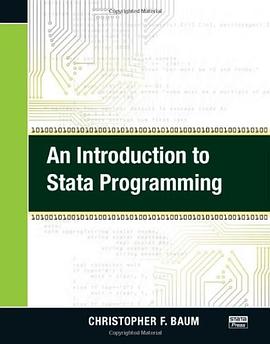
This work focuses on three types of Stata programming: do-file programming, ado-file programming, and Mata functions that work in conjunction with do- and ado-files. It explains how to usefully automate work with Stata and how to use Stata more effectively through programming on one or more of these levels. After presenting elementary concepts of the command-line interface and commonly used tools for working with programs and data sets, the text follows a unique format by offering "cookbook" chapters after each main chapter. These cookbook chapters look at how to perform a specific programming task with Stata and provide a complete solution to the problem. The text also includes numerous examples of Mata, Stata's matrix programming language.
作者简介
Christopher F. Baum’s An Introduction to Stata Programming is worthwhile for anyone wanting to learn about programming in Stata. For the beginner, Baum assumes only that the user is familiar with Stata, and so he builds up accordingly. For the more advanced Stata programmer, the book introduces Stata’s Mata programming language and provides optimization tips for day-to-day work. All readers will find better, new ways to approach old tasks.
Baum steps the reader through the three levels of Stata programming. First up are do-files. Though often thought of as simple batch files, do-files support both loops and conditional execution, and hence can be used for automation as well as reproducibility. While giving examples of do-file programming, Baum introduces useful but often-overlooked Stata constructions.
Next come ado-files, which are used to extend Stata by creating new commands that share the syntax and behavior of official commands. Baum gives an example of how to write a simple additional command for Stata, complete with documentation and certification. After writing the simple command, Baum then shows how users can write their own custom estimation commands by using both Stata’s built-in numerical maximum likelihood estimation routine, ml, and its built-in nonlinear least-squares routines, nl and nlsur.
Finishing up the book are two chapters on programming in Mata, which is Stata’s matrix programming language. Mata programs are integrated into ado-files to build a custom estimation routine that is optimized for speed and numerical stability. While stepping through these structures, Baum weaves in the details that are needed to become an expert at Stata programming, so readers will also learn more about Stata itself while learning the tools for programming.
Baum approaches each topic by first explaining the background and need for the topic, then looking at the basic usage and examples, and finally examining use within larger, more applied “cookbook” examples. Many of his examples come from questions posed on the Statalist listserver, so they address complexities of interest to a broad range of Stata users. The programming examples cover an array of topics, illustrate some of Stata’s built-in tools (such as the resampling techniques of bootstrapping and jackknifing), and offer solutions to tricky data management questions.
The breadth and depth of this book make it a necessity for anyone interested in programming in Stata.
目录信息
读后感
Baum 是Stata领域的大神之一(另一位大神是N.Cox),hero of Stata regmonkey, 本身又是Boston College的教授,算得上是Stata在经济学领域的权威了,写了无数的package, 名字也经常出现在各种stata conference speaker list 上。这样的人物能拨冗写一本Stata programming的...
Baum 是Stata领域的大神之一(另一位大神是N.Cox),hero of Stata regmonkey, 本身又是Boston College的教授,算得上是Stata在经济学领域的权威了,写了无数的package, 名字也经常出现在各种stata conference speaker list 上。这样的人物能拨冗写一本Stata programming的...
Baum 是Stata领域的大神之一(另一位大神是N.Cox),hero of Stata regmonkey, 本身又是Boston College的教授,算得上是Stata在经济学领域的权威了,写了无数的package, 名字也经常出现在各种stata conference speaker list 上。这样的人物能拨冗写一本Stata programming的...
Baum 是Stata领域的大神之一(另一位大神是N.Cox),hero of Stata regmonkey, 本身又是Boston College的教授,算得上是Stata在经济学领域的权威了,写了无数的package, 名字也经常出现在各种stata conference speaker list 上。这样的人物能拨冗写一本Stata programming的...
Baum 是Stata领域的大神之一(另一位大神是N.Cox),hero of Stata regmonkey, 本身又是Boston College的教授,算得上是Stata在经济学领域的权威了,写了无数的package, 名字也经常出现在各种stata conference speaker list 上。这样的人物能拨冗写一本Stata programming的...
用户评价
从排版和学习体验上来说,这本书的设计也体现了作者对读者的尊重。每一章的开头都有清晰的学习目标概述,结尾则有总结性的“关键点回顾”和一系列富有挑战性的“练习与思考题”。这些练习题的设计非常巧妙,它们不会直接复制书中的例子,而是要求你将学到的知识点进行创造性的组合来解决一个全新的问题。这确保了知识的真正内化,而不是机械的记忆。此外,书中的代码块格式清晰,高亮显示得当,使得在跟读代码时,眼睛不容易疲劳。对于那些需要将教学材料用于课堂演示的教师或助教来说,这本书的结构化布局也提供了极大的便利。总而言之,它成功地搭建起了一座连接Stata基础操作与高级定制化编程之间的坚固桥梁,是我近年来接触到的,对Stata编程领域最具深度和实用价值的参考读物,强烈推荐给所有希望将Stata潜力发挥到极致的用户。
与其他我翻阅过的Stata编程书籍相比,这本书在代码的可读性和维护性方面,展现出了极高的专业水准。很多入门级教程只关注代码能否运行,却忽略了代码的可读性,导致自己写的代码过一段时间后自己都看不懂了。但这本书从一开始就强调了良好的编程习惯,比如恰当的注释使用、清晰的变量命名规范,以及如何利用`local`和`global`宏来提高代码的灵活性和可移植性。这对于我这种需要与实验室其他成员协作项目的用户来说至关重要。书中关于“调试”(Debugging)的章节尤其出色,它提供了一套系统性的排错思路和工具使用方法,让我不再是盲目地修改代码,而是能够有条不紊地定位问题所在。作者在讲解复杂循环结构时,对于边界条件的探讨非常细致,这往往是新手最容易掉进去的陷阱。读完后,我感觉自己的编程思维得到了极大的提升,不再只是输入指令,而是开始构建一个健壮、易于维护的分析框架。这本教材,与其说是一本工具书,不如说是一本关于“高质量数据分析实践”的哲学指南。
这本书对于Stata编程语言核心概念的深入剖析,远远超出了我对“编程入门”的预期。我原以为它会是那种只停留在基础命令调用的说明书,但实际上,它勇敢地触及了Stata编程语言的一些更深层次的特性,比如用户定义函数(UDFs)的创建与应用,以及如何有效地利用Stata的内置数据结构(如矩阵和字符串函数)来优化性能。特别是关于性能优化的讨论,对我处理那些动辄百万观测值的超大型数据集时,提供了关键的性能洞察。作者清楚地解释了为什么某些看似相似的命令在执行速度上会有天壤之别,并提供了具体的优化建议,比如何时应该使用循环,何时应该依赖内置的向量化操作。这种对效率的关注,使得这本书不仅对学术研究有价值,对于金融计量和大规模市场数据分析等对时效性要求极高的领域,也具有极强的指导意义。它真的让你明白了,Stata不仅仅是一个统计软件,更是一个功能强大的脚本语言环境。
我是一名社会科学领域的研究生,日常工作离不开大规模的调查数据处理,过去我常常把大量时间浪费在重复性的“复制粘贴”操作上,不仅效率低下,而且极易出错。这本书的出现,彻底改变了我的工作流。它不是那种停留在“介绍Stata有什么功能”的浅尝辄止的指南,而是深入到了“如何利用Stata的编程能力来自动化你的工作流程”的核心。我尤其被其中关于“循环与条件判断在面板数据分析中的应用”那一章节所吸引。作者通过一个完整的、具有挑战性的案例——比如处理缺失值的不规则填充和时间序列的对齐——展示了编程的强大威力。我发现自己可以轻松地将原本需要耗费数小时的手动操作,压缩成一个几分钟内就能跑完的脚本。这种“解放双手”的感觉,带来的不仅是时间的节省,更是研究精力的释放。它让我有更多精力去关注理论假设和结果解释,而不是纠结于命令的语法细节。对于那些需要处理复杂抽样设计或需要进行重复性模拟分析的研究人员来说,这本书提供的编程范式是无价之宝,它教会你如何像一个真正的软件工程师那样思考数据处理。
这本关于Stata编程的书籍,从我这个初学者的角度来看,简直是一场及时的雨。我之前尝试过自己摸索Stata的一些高级功能,比如编写自定义命令或者进行复杂的数据清洗流程,但总是感觉无从下手,官方文档虽然详尽,但对于一个需要快速上手解决实际问题的人来说,未免有些晦涩难懂。这本书的叙述方式非常平易近人,它没有一开始就抛出复杂的理论框架,而是像一个经验丰富的导师,一步一步引导你走进编程的世界。作者似乎深知初学者在面对新语言时的那种畏惧感,所以他们设计了大量贴近真实研究场景的例子,从最基础的变量操作、循环结构,到更进一步的宏定义和文件管理,结构组织得极为清晰。我特别欣赏它在讲解逻辑结构时所采用的类比手法,这让抽象的编程概念变得具体可感。例如,在解释Do-file的最佳实践时,作者用“搭建乐高积木”来比喻模块化编程的重要性,这种生动的描述极大地降低了我的学习门槛。读完前几章,我不再仅仅是一个被动的数据分析执行者,开始能主动思考如何用更高效、更可重复的方式来处理我的数据,这对我来说是质的飞跃。
为复习Econometrics复习过一遍知识点,很有用。
stata入门书,从baum的角度把stata的重要功能介绍了一遍,dofile部分后几章cookbook的例子偏商科的分析,对社科不那么实用
终于把里面的程序都抄了一遍…………
为复习Econometrics复习过一遍知识点,很有用。
stata入门书,从baum的角度把stata的重要功能介绍了一遍,dofile部分后几章cookbook的例子偏商科的分析,对社科不那么实用