
具体描述
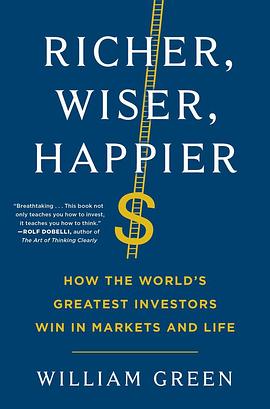
From a renowned financial journalist who has written for Time, Fortune, Forbes, and The New Yorker, a fresh and unexpectedly profound book that draws on hundreds of hours of exclusive interviews with many of the world’s super-investors to demonstrate that the keys for building wealth hold other life lessons as well.
Billionaire investors. If we think of them, it’s with a mixture of awe and suspicion. Clearly, they possess a kind of genius—the proverbial Midas Touch. But are the skills they possess transferable? And do they have anything to teach us besides making money?
In Richer, Wiser, Happier, William Green draws on interviews that he’s conducted over twenty-five years with many of the world’s greatest investors. As he discovered, their talents extend well beyond the financial realm. The most successful investors are mavericks and iconoclasts who question conventional wisdom and profit vastly from their ability to think more rationally, rigorously, and objectively. They are master game players who consciously maximize their odds of long-term success in markets and life, while also minimizing any risk of catastrophe. They draw powerful insights from many different fields, are remarkably intuitive about trends, practice fanatical discipline, and have developed a high tolerance for pain. As Green explains, the best investors can teach us not only how to become rich, but how to improve the way we think, reach decisions, assess risk, avoid costly errors, build resilience, and turn uncertainty to our advantage.
Green ushers us into the lives of more than forty super-investors, visiting them in their offices, homes, and even their places of worship—all to share what they have to teach us. Richer, Wiser, Happier brings together the thinking of many of the greatest investment minds, from Sir John Templeton to Charlie Munger, Jack Bogle to Ed Thorp, Will Danoff to Mohnish Pabrai, Bill Miller to Laura Geritz, Joel Greenblatt to Howard Marks. In explaining how they think and why they win, this landmark book provides gems of insight that will enrich you not only financially but also professionally and personally.
作者简介
William Green has written for many publications in the US and Europe, including Time, Fortune, Forbes, Fast Company, The New Yorker, The Spectator (London), and The Economist. He edited the Asian edition of Time while living in Hong Kong, then moved to London to edit the European, Middle Eastern, and African editions of Time. As an editor and coauthor, he has collaborated on several books, including Guy Spier’s much-praised memoir, The Education of a Value Investor. Born and raised in London, Green studied English literature at Oxford University and received a master’s degree in journalism at Columbia University. He lives in New York with his wife and their two children.
目录信息
Chapter One: The Man Who Cloned Warren Buffett
Chapter Two: The Willingness to Be Lonely
Chapter Three: Everything Changes
Chapter Four: The Resilient Investor
Chapter Five: Simplicity Is the Ultimate Sophistication
Chapter Six: Nick & Zak’s Excellent Adventure
Chapter Seven: High-Performance Habits
Chapter Eight: Don’t Be a Fool
Epilogue: Beyond Rich
Acknowledgments
Notes on Sources and Additional Resources
Index
· · · · · · (收起)
读后感
在这本书中作者财富了很多投资大牛,探访他们成功的经验,在投资中和在生活中。看完这本书我觉得最核心的我们能做的去提升投资成功率的就是努力+耐心+情绪管理。 书中有个人物我印象比较深刻,那就是在最后一章的财富之外的阿诺德·范登伯格他在35岁成立了自己的投资公司,没有...
📖Richer, Wiser, Happier: How the World's Greatest Investors Win in Markets and Life ✒️William P. Green 🌟Goodreads评分4.62/5 2021年4月出版的新书,名噪一时,goodreads评分高达4.62,在5月趁热读完了,目前还没有中文译本。 标题很直接:更有钱、更有智慧...
在这本书中作者财富了很多投资大牛,探访他们成功的经验,在投资中和在生活中。看完这本书我觉得最核心的我们能做的去提升投资成功率的就是努力+耐心+情绪管理。 书中有个人物我印象比较深刻,那就是在最后一章的财富之外的阿诺德·范登伯格他在35岁成立了自己的投资公司,没有...
用户评价
这本**《富足、智慧、快乐》**真是让人眼前一亮,它并非那种老生常谈的成功学鸡汤,而是真正深入到如何构建一个充实而有意义的人生。作者的叙事方式非常引人入胜,像是与一位经验丰富的朋友进行深度对话。我尤其欣赏它在探讨“富足”时,不仅仅局限于财务自由,而是将其扩展到时间、人脉和精神层面的丰盈。书中对于“如何识别并摆脱无效社交”的分析非常犀利,提供了许多实用的、可立即操作的框架。比如,它提出了一种“价值交换矩阵”,帮助读者清晰地评估每一次互动带来的净收益。在谈到“智慧”的部分,它没有陷入理论的泥潭,而是通过一系列生动的案例,展示了如何在复杂多变的现代环境中保持认知清晰,做出更少后悔的决策。我感觉读完这本书后,我不仅仅是学到了一些新概念,更重要的是,我的思维方式发生了一种微妙但关键的转变,看待问题的角度似乎更加立体和深入了。它成功地将宏大的哲学思考,落脚到了日常生活的每一个细节之中,让人读起来既有启发性,又不失烟火气。
这本书的结构安排非常精妙,它似乎遵循着一条从外在到内在,再回归到行动的螺旋上升路径。起初你会被它宏大的主题所吸引,但很快你就会发现,所有的论述都紧密地围绕着如何优化个体的日常决策流程。我发现作者在引用历史哲学家和当代神经科学研究之间的转换极其流畅自然,丝毫没有生硬的拼凑感。例如,当讨论“智慧”如何避免决策疲劳时,它巧妙地引用了古罗马斯多葛学派的训练方法,并用现代认知负荷理论加以佐证,这种跨学科的融合,极大地增强了论点的说服力。它不是那种读完后你可以随便扔到书架上的书,它更像是你书桌上的一个常驻工具箱,里面的工具需要你经常拿出来擦拭、使用。我甚至在写电子邮件或做重要会议准备时,会下意识地套用书中的某些评估模型,这表明它的影响已经渗透到了我的思维习惯之中。
坦白说,这本书的阅读体验是充满挑战的,因为它要求读者具备高度的自我反思能力。它不会轻易地喂给你甜头,相反,它会毫不留情地揭示那些我们习惯性逃避的真相,比如我们是如何用“忙碌”来合理化我们的不作为,或者我们是如何将“安全感”等同于“停滞不前”。这种直面现实的勇气,是这本书给我最深的印象。我非常欣赏作者在描述“更快乐”时,所展现出的一种清醒的乐观主义——它不否认生活的艰辛,但坚信人有能力在已知局限内,最大化自己的能见度和影响力。它提供给我的,是一种坚实的内在锚点,让我在面对外部世界的剧烈波动时,不至于被轻易地卷走。这本书更像是一份对生活质量的“高级说明书”,它没有承诺奇迹,但它提供的路径图,绝对是通往长期满足感的有效途径。
从实用性的角度来看,这本书的价值是难以估量的,但它的实用性是内生的,而非外显的。我注意到,它避免了使用任何行业术语或者过于学术化的语言,使得那些深刻的心理学和社会学洞察,能够被完全没有相关背景的普通读者所理解和吸收。特别是关于“如何建立个人意义系统”的那一章,简直像是一张为迷失者设计的导航图。它不提供现成的答案,而是提供了一套强大的提问工具集,让你自己去挖掘核心驱动力。我尝试运用书中介绍的“三个维度测试”来评估我目前的工作,结果令人震惊地清晰——原来我一直把精力放在了那些对我的长期愿景贡献度极低的事情上。这种自我校准的能力,是这本书带给我最宝贵的财富。它不是教你如何取悦世界,而是教你如何与自己达成和解,并坚定地朝着自己定义的“更好”前进,那种由内而外的驱动力,远比外界的激励更持久。
我必须说,这本书的行文风格非常独特,它有一种近乎诗意的严谨性。如果你期待的是那种快节奏、充满“干货清单”的指南,你可能会感到有些不适应,因为它更像是一部关于人生哲学的随笔集,但其深度远超一般的随笔。作者在阐述“快乐”的本质时,采取了一种反直觉的视角,挑战了我们主流社会对幸福的定义——比如,它花了很大篇幅去探讨“有益的痛苦”和“有质量的拒绝”在长期幸福中的核心作用。我个人对其中关于“心流体验的结构化设计”那一章印象深刻,它不是简单地告诉你去追求心流,而是教你如何系统性地在工作中植入那种深度沉浸的条件。文字的密度很高,我不得不常常停下来,反复咀嚼那些精炼的句子,生怕错过任何一个细微的差别。这本书更像是一块需要细细品味的陈年佳酿,每一次重读都会有新的领悟,它逼迫你停下来,审视自己过去的行为模式,并为未来的生活构建一个更具韧性的内在架构。
没有什么财富密码,就是一些价值投资者的访谈。有趣的是,最近FIRE在打工圈越来越火,全网都是什么赚够多少钱就退休的帖子,而事实上真正有financial independence的人多数都没有retire early
前几天看还没有这个条目,现在居然有了条目。本来想着自己怎么加一下。豆瓣的速度真是蛮快的。同时感谢邵晓庆女士推荐了这本书。
这本书可能是我最近几年看过的最好的一本关于投资的书。书总共八章加上一章后记。前面六章写得都很好,最后两张和后记就崩坏了,有凑字数的感觉。首先是选的人都是些不重要的人,我没有兴趣去了解他们的backstory,who cares?但是居然有些时候数十页都在介绍一个看上去不重要的人,作者的写作功力在这里见底了。另外就是最后几章提炼的内容都很肤浅,作者的阅历不足以对一些事情进行概括,这也是这本书的局限性 -- 作者自己不干投资,有些话题他并不能完全理解。
Two quick ways: 1. Read books of the wiser men before you. 2. Surround yourself with people smart than you and learn from them. The first part leave me most impression and one of them is clone. it is not a shame to clone the smart, Like the paper developed on the top of other smart mind, so do the investment strategy and wisdom.
某种意义上讲,可以当作是 investing 领域的《数学大师》来阅读。