
具体描述
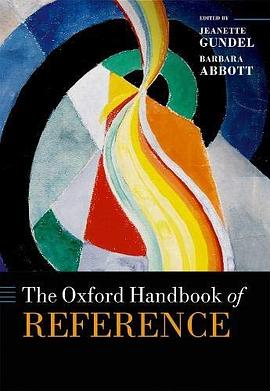
This handbook presents an overview of the phenomenon of reference - the ability to refer to and pick out entities - which is an essential part of human language and cognition. In the volume's 21 chapters, international experts in the field offer a critical account of all aspects of reference from a range of theoretical perspectives.
Chapters in the first part of the book are concerned with basic questions related to different types of referring expression and their interpretation. They address questions about the role of the speaker - including speaker intentions - and of the addressee, as well as the role played by the semantics of the linguistic forms themselves in establishing reference. This part also explores the nature of such concepts as definite and indefinite reference and specificity, and the conditions under which reference may fail. The second part of the volume looks at implications and applications, with chapters covering such topics as the acquisition of reference by children, the processing of reference both in the human brain and by machines.
The volume will be of interest to linguists in a wide range of subfields, including semantics, pragmatics, computational linguistics, and psycho- and neurolinguistics, as well as scholars in related fields such as philosophy and computer science.
作者简介
Jeanette Gundel is Professor of Linguistics at the University of Minnesota, Twin Cities, where she has been teaching since 1980. She is also Associate Director of the Center for Cognitive Science and an affiliate member of the Department of Philosophy. Her research focuses primarily on the interface between linguistic theory and pragmatics, especially reference and information structure.
Barbara Abbott is an Emeritus Professor of Linguistics and Philosophy at Michigan State University, where she taught from 1976 to 2006. Her main research interests are in semantics, pragmatics, and philosophy of language. She has published multiple journal articles on topics ranging from reference and noun phrase interpretation to conditional sentences, and is the author of Reference (OUP 2010).
Contributors:
Barbara Abbott, Michigan State University
Christopher Barkley, University of Minnesota, Twin Cities
Anne Bezuidenhout, University of South Carolina
Kaja Borthen, Norwegian University of Science and Technology
Berit Brogaard, University of University of Miami and University of Oslo
Leonard Clapp, Northern Illinois University
Ryan B. Doran, University of Regina
Emily Fedele, Institute for Defense Analyses
Jeanette Gundel, University of Minnesota, Twin Cities
Peter Hanks, University of Minnesota
Nancy Hedberg, Simon Fraser University
Elsi Kaiser, University of Southern California
Ezra Keshet, University of Michigan
Robert Kluender, University of California, San Diego
Emiel Krahmer, Tilburg University
Alfons Maes, Tilburg School of Humanities and Digital Sciences
Michael O'Rourke, Michigan State University
Marga Reimer, University of Arizona
Craige Roberts, Ohio State University
Anne Salazar Orvig, Universite Sorbonne Nouvelle - Paris 3
Matthias Scheutz, Tufts University
Florian Schwarz, University of Pennsylvania
Anne Spire, formerly University of Arizona
Kees van Deemter, University of Aberdeen
Jorrig Vogels, University of Groningen
Klaus von Heusinger, University of Cologne
Gregory Ward, Northwestern University
Tom Williams, Colorado School of Mines
Ron Zacharski, University of Mary Washington
目录信息
Part I: Foundations. Referential forms and their interpretation
2. Reference as a speech act, Peter Hanks
3. Referential intentions, Michael O'Rourke
4. Joint reference, Anne Bezuidenhout
5. Cognitive status and the form of referring expressions in discourse, Jeanette Gundel, Nancy Hedberg, and Ron Zacharski
6. Different senses of 'referential', Nancy Hedberg, Jeanette Gundel, and Kaja Borthen
7. Definiteness and familiarity, Barbara Abbott
8. The indefiniteness of definiteness, Barbara Abbott
9. Indefiniteness and specificity, Klaus von Heusinger
10. De re / de dicto, Ezra Keshet and Florian Schwarz
11. Negative existentials, Leonard Clapp, Marga Reimer, and Ann Spire
12. A taxonomy of uses of demonstratives, Ryan B. Doran and Gregory Ward
13. Contextual influences on reference, Craige Roberts
Part II: Implications and applications. Processing and acquisition of reference
14. Reference and referring expressions in first language acquisition, Anne Salazar Orvig
15. Reference resolution: A psycholinguistic perspective, Elsi Kaiser and Emily Fedele
16. Accessibility and reference production: The interplay between linguistic and non-linguistic factors, Jorrig Vogels, Emiel Krahmer, and Alfons Maes
17. What can neuroscience tell us about reference?, Berit Brogaard
18. Processing anaphoric relations: An electrophysiological perspective, Christopher Barkley and Robert Kluender
19. Computational generation of referring expressions: An updated survey, Emiel Krahmer and Kees van Deemter
20. Reference in robotics: A givenness hierarchy theoretic approach, Tom Williams and Matthias Scheutz
21. Computational models of referring: Complications of information sharing, Kees van Deemter
References
Index
· · · · · · (收起)
读后感
用户评价
坦白讲,《牛津参考手册》给我带来的阅读体验是出乎意料的。我原本以为参考书只是一个冷冰冰的知识库,但这本书却让我感受到了一种人文关怀。书中对一些复杂概念的解释,常常会追溯到其背后的人文历史背景,让我理解这些概念的产生和演变并非偶然,而是人类思想史发展的必然产物。例如,在解释某个哲学理论时,书中会详细介绍该理论的提出者所处的时代背景和社会环境,这使得我能够更深刻地理解该理论的意义和价值。此外,书中还经常引用一些文学作品、艺术作品中的例子来佐证观点,让知识的传递更加生动有趣。这种跨学科的融合,不仅丰富了我的知识储备,更让我看到了知识之间相互联系的魅力。这本书的语言风格也非常出色,既有学术的严谨性,又不失优雅和流畅,读起来一点也不枯燥。我常常会因为书中某个精彩的论述而反复品味,从中汲取灵感。
《牛津参考手册》这本书,简直就是一座行走的知识殿堂。它给我的整体感受是,内容详实,编排精巧,实用性极强。我尤其看重的是它信息的准确性和权威性。书中引用的每一个观点,每一个数据,都经过了严谨的考证,让我对书中的内容深信不疑。而且,书中对条目的解释,往往能够做到既全面又深入,对于我想要了解某个问题来龙去脉的用户来说,简直是量身定做。我经常会将这本书作为我学习和研究的起点,每当我遇到一个不熟悉的概念或者想对某个领域进行初步了解时,我都会毫不犹豫地翻开它。书中提供的丰富参考资料,更是为我进一步深入研究提供了宝贵的线索。我曾经花了好几个小时,仅仅因为被书中一个关于某个历史人物的传记条目所吸引,然后就顺着书中的线索,查阅了大量的相关文献,最终对这位历史人物有了非常深刻的认识。这种“一石激起千层浪”的阅读体验,让我觉得这本书的价值远超于一本简单的参考书。
我不得不说,《牛津参考手册》是我近年来读过的最令人印象深刻的学术工具书之一。它给我带来的最大感受是它的前沿性和包容性。书中涵盖的领域非常广泛,从人文社科到自然科学,几乎无所不包,而且对每个领域的最新研究成果和发展趋势都有很好的把握。当我查阅某个领域的热点问题时,书中提供的分析往往能够抓住问题的核心,并提供深入的见解。更难能可贵的是,书中并没有拘泥于单一的学术观点,而是尽可能地呈现了不同的学术流派和研究方法,让读者能够接触到多元化的视角。这种开放的态度,对于培养批判性思维和拓宽学术视野至关重要。我特别欣赏的是,书中不仅有严谨的学术论述,还穿插了一些引人入胜的案例分析和历史故事,让冰冷的知识变得有温度。阅读过程中,我感觉自己就像在与许多顶尖学者进行一场无声的对话,他们的智慧和见解让我受益匪浅。这本书的体量虽然不小,但因为其条理清晰和逻辑严密,阅读起来并不费力,反而有一种循序渐进、不断探索的乐趣。
这本书的书名叫做《牛津参考手册》,读了之后,我感觉它就像一本珍贵的宝藏,让我爱不释手。首先,最吸引我的就是它编排的严谨性和内容的深度。打开书的第一页,我就被它清晰的目录和详实的索引所折服。无论我想查找哪个领域的知识,只要翻开目录,都能迅速定位到我想要的部分。更令人惊喜的是,每个条目下的解释都非常到位,不仅仅是简单的定义,而是深入浅出地阐述了概念的起源、发展脉络以及在不同学科中的应用。例如,当我查阅某个历史事件时,书中不仅提供了事件发生的日期、地点和关键人物,还详细分析了其产生的深远影响,甚至还引用了不同学派的观点进行对比,让我对历史事件有了更全面、更立体的认识。这种细致入微的处理方式,使得这本书不仅仅是一本“参考”工具,更像是一位博学的老师,耐心引导我探索知识的海洋。同时,书中对概念的阐释逻辑清晰,语言凝练,避免了冗余的废话,每一句话都充满了信息量。这对于我这样一个渴望系统学习和深入理解的读者来说,无疑是一场知识的盛宴。我常常会因为某个条目而引发出一系列的好奇心,然后顺着书中提供的参考书目或相关的链接,进一步深入探索,这种阅读体验非常充实和有益。
这本书真的是颠覆了我对“参考书”的刻板印象。我原本以为参考书只会枯燥乏味地罗列事实和定义,但《牛津参考手册》完全打破了这个框架。它在提供精准信息的同时,还充满了启发性。我尤其喜欢书中对一些抽象概念的解释,作者们用非常巧妙的比喻和生动的例子,将复杂的理论变得易于理解。比如,在解释某个经济学原理时,书中就联系了日常生活中的消费行为,让我一下子就明白了其中的逻辑。这种“接地气”的讲解方式,让我觉得学习不再是一件遥不可及的事情,而是与我的生活息息相关的。而且,书中不仅限于提供“是什么”,更注重解释“为什么”和“怎么用”。在很多条目下,都会探讨该概念在实际应用中的价值和意义,甚至还会提出一些值得思考的延伸问题。这激发了我独立思考的能力,让我不仅仅是被动接受信息,而是主动去分析和判断。书中的排版也非常人性化,大量的图表、插图和信息框,使得阅读过程更加轻松有趣,也更便于记忆。我经常会拿出这本书,随手翻开一个章节,然后就沉浸其中,学到很多意想不到的知识。