
具体描述
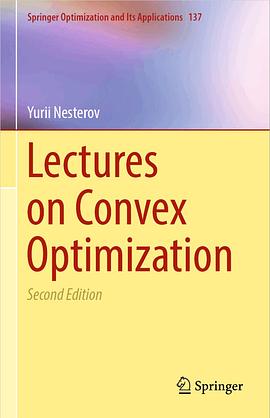
This book provides a comprehensive, modern introduction to convex optimization, a field that is becoming increasingly important in applied mathematics, economics and finance, engineering, and computer science, notably in data science and machine learning.Written by a leading expert in the field, this book includes recent advances in the algorithmic theory of convex optimization, naturally complementing the existing literature. It contains a unified and rigorous presentation of the acceleration techniques for minimization schemes of first- and second-order. It provides readers with a full treatment of the smoothing technique, which has tremendously extended the abilities of gradient-type methods. Several powerful approaches in structural optimization, including optimization in relative scale and polynomial-time interior-point methods, are also discussed in detail.Researchers in theoretical optimization as well as professionals working on optimization problems will find this book very useful. It presents many successful examples of how to develop very fast specialized minimization algorithms. Based on the author?s lectures, it can naturally serve as the basis for introductory and advanced courses in convex optimization for students in engineering, economics, computer science and mathematics.
作者简介
目录信息
1 Nonlinear Optimization
1.1 The World of Nonlinear Optimization
1.1.1 General Formulation of the Problem
1.1.2 Performance of Numerical Methods
1.1.3 Complexity Bounds for Global Optimization
1.1.4 Identity Cards of the Fields
1.2 Local Methods in Unconstrained Minimization
1.2.1 Relaxation and Approximation
1.2.2 Classes of Differentiable Functions
1.2.3 The Gradient Method
1.2.4 Newton's Method
1.3 First-Order Methods in Nonlinear Optimization
1.3.1 The Gradient Method and Newton's Method: What Is Different?
1.3.2 Conjugate Gradients
1.3.3 Constrained Minimization
2 Smooth Convex Optimization
2.1 Minimization of Smooth Functions
2.1.1 Smooth Convex Functions
2.1.2 Lower Complexity Bounds for FL∞,1(Rn)
2.1.3 Strongly Convex Functions
2.1.4 Lower Complexity Bounds for Sμ,L∞,1(Rn)
2.1.5 The Gradient Method
2.2 Optimal Methods
2.2.1 Estimating Sequences
2.2.2 Decreasing the Norm of the Gradient
2.2.3 Convex Sets
2.2.4 The Gradient Mapping
2.2.5 Minimization over Simple Sets
2.3 The Minimization Problem with Smooth Components
2.3.1 The Minimax Problem
2.3.2 Gradient Mapping
2.3.3 Minimization Methods for the Minimax Problem
2.3.4 Optimization with Functional Constraints
2.3.5 The Method for Constrained Minimization
3 Nonsmooth Convex Optimization
3.1 General Convex Functions
3.1.1 Motivation and Definitions
3.1.2 Operations with Convex Functions
3.1.3 Continuity and Differentiability
3.1.4 Separation Theorems
3.1.5 Subgradients
3.1.6 Computing Subgradients
3.1.7 Optimality Conditions
3.1.8 Minimax Theorems
3.1.9 Basic Elements of Primal-Dual Methods
3.2 Methods of Nonsmooth Minimization
3.2.1 General Lower Complexity Bounds
3.2.2 Estimating Quality of Approximate Solutions
3.2.3 The Subgradient Method
3.2.4 Minimization with Functional Constraints
3.2.5 Approximating the Optimal Lagrange Multipliers
3.2.6 Strongly Convex Functions
3.2.7 Complexity Bounds in Finite Dimension
3.2.8 Cutting Plane Schemes
3.3 Methods with Complete Data
3.3.1 Nonsmooth Models of the Objective Function
3.3.2 Kelley's Method
3.3.3 The Level Method
3.3.4 Constrained Minimization
4 Second-Order Methods
4.1 Cubic Regularization of Newton's Method
4.1.1 Cubic Regularization of Quadratic Approximation
4.1.2 General Convergence Results
4.1.3 Global Efficiency Bounds on Specific Problem Classes
4.1.4 Implementation Issues
4.1.5 Global Complexity Bounds
4.2 Accelerated Cubic Newton
4.2.1 Real Vector Spaces
4.2.2 Uniformly Convex Functions
4.2.3 Cubic Regularization of Newton Iteration
4.2.4 An Accelerated Scheme
4.2.5 Global Non-degeneracy for Second-Order Schemes
4.2.6 Minimizing Strongly Convex Functions
4.2.7 False Acceleration
4.2.8 Decreasing the Norm of the Gradient
4.2.9 Complexity of Non-degenerate Problems
4.3 Optimal Second-Order Methods
4.3.1 Lower Complexity Bounds
4.3.2 A Conceptual Optimal Scheme
4.3.3 Complexity of the Search Procedure
4.4 The Modified Gauss–Newton Method
4.4.1 Quadratic Regularization of the Gauss–Newton Iterate
4.4.2 The Modified Gauss–Newton Process
4.4.3 Global Rate of Convergence
4.4.4 Discussion
Part II. Structural Optimization
5 Polynomial-Time Interior-Point Methods
5.1 Self-concordant Functions
5.1.1 The Black Box Concept in Convex Optimization
5.1.2 What Does the Newton's Method Actually Do?
5.1.3 Definition of Self-concordant Functions
5.1.4 Main Inequalities
5.1.5 Self-Concordance and Fenchel Duality
5.2 Minimizing Self-concordant Functions
5.2.1 Local Convergence of Newton's Methods
5.2.2 Path-Following Scheme
5.2.3 Minimizing Strongly Convex Functions
5.3 Self-concordant Barriers
5.3.1 Motivation
5.3.2 Definition of a Self-concordant Barrier
5.3.3 Main Inequalities
5.3.4 The Path-Following Scheme
5.3.5 Finding the Analytic Center
5.3.6 Problems with Functional Constraints
5.4 Applications to Problems with Explicit Structure
5.4.1 Lower Bounds for the Parameter of a Self-concordant Barrier
5.4.2 Upper Bound: Universal Barrier and Polar Set
5.4.3 Linear and Quadratic Optimization
5.4.4 Semidefinite Optimization
5.4.5 Extremal Ellipsoids
5.4.6 Constructing Self-concordant Barriers for Convex Sets
5.4.7 Examples of Self-concordant Barriers
5.4.8 Separable Optimization
5.4.9 Choice of Minimization Scheme
6 The Primal-Dual Model of an Objective Function
6.1 Smoothing for an Explicit Model of an Objective Function
6.1.1 Smooth Approximations of Non-differentiable Functions
6.1.2 The Minimax Model of an Objective Function
6.1.3 The Fast Gradient Method for Composite Minimization
6.1.4 Application Examples
6.1.5 Implementation Issues
6.2 An Excessive Gap Technique for Non-smooth ConvexMinimization
6.2.1 Primal-Dual Problem Structure
6.2.2 An Excessive Gap Condition
6.2.3 Convergence Analysis
6.2.4 Minimizing Strongly Convex Functions
6.3 The Smoothing Technique in Semidefinite Optimization
6.3.1 Smooth Symmetric Functions of Eigenvalues
6.3.2 Minimizing the Maximal Eigenvalue of the Symmetric Matrix
6.4 Minimizing the Local Model of an Objective Function
6.4.1 A Linear Optimization Oracle
6.4.2 The Method of Conditional Gradients with Composite Objective
6.4.3 Conditional Gradients with Contraction
6.4.4 Computing the Primal-Dual Solution
6.4.5 Strong Convexity of the Composite Term
6.4.6 Minimizing the Second-Order Model
7 Optimization in Relative Scale
7.1 Homogeneous Models of an Objective Function
7.1.1 The Conic Unconstrained Minimization Problem
7.1.2 The Subgradient Approximation Scheme
7.1.3 Direct Use of the Problem Structure
7.1.4 Application Examples
7.2 Rounding of Convex Sets
7.2.1 Computing Rounding Ellipsoids
7.2.2 Minimizing the Maximal Absolute Value of Linear Functions
7.2.3 Bilinear Matrix Games with Non-negative Coefficients
7.2.4 Minimizing the Spectral Radius of Symmetric Matrices
7.3 Barrier Subgradient Method
7.3.1 Smoothing by a Self-Concordant Barrier
7.3.2 The Barrier Subgradient Scheme
7.3.3 Maximizing Positive Concave Functions
7.3.4 Applications
7.3.5 Online Optimization as an Alternative to Stochastic Programming
7.4 Optimization with Mixed Accuracy
7.4.1 Strictly Positive Functions
7.4.2 The Quasi-Newton Method
7.4.3 Interpretation of Approximate Solutions
Appendix A. Solving Some Auxiliary Optimization Problems
A.1 Newton's Method for Univariate Minimization
A.2 Barrier Projection onto a Simplex
Bibliographical Comments
Chapter 1: Nonlinear Optimization
Chapter 2: Smooth Convex Optimization
Chapter 3: Nonsmooth Convex Optimization
Chapter 4: Second-Order Methods
Chapter 5: Polynomial-Time Interior-Point Methods
Chapter 6: The Primal-Dual Model of an Objective Function
Chapter 7: Optimization in Relative Scale
References
Index
· · · · · · (收起)
读后感
用户评价
这本书,天哪,简直是为我这种深度学习的“炼丹师”量身定做的。我记得我刚接触到凸优化这个领域的时候,感觉就像站在一片迷雾缭绕的群山脚下,各种理论、算法堆积如山,让人望而生畏。市面上那些入门级的教材,要么过于简化,只停留在表面概念,讲一些浅尝辄止的梯度下降,完全无法满足我处理实际复杂问题的需求;要么就是上来就抛一堆高等数学的公式,把人直接淹没在抽象的集合论和拓扑学的海洋里。这本书的出现,就像一位经验丰富、不厌其烦的向导,带着你一步步攀登,但每一步都走得异常扎实、清晰。它没有急于求成,而是用一种近乎工匠精神的态度,将那些看似冰冷晦涩的数学原理,用极其直观的几何视角和严谨的代数推导完美结合起来。我尤其欣赏它处理对偶理论和KKT条件时的那种深度和广度,不是简单地罗列公式,而是深入剖析了它们背后的物理意义和经济学含义,这对于我后续设计优化算法,判断解的性质,简直是醍醐灌顶。读完一章,我总感觉自己不仅学会了一个技巧,更是对整个优化问题的结构有了更深层次的理解,那种“豁然开朗”的感觉,比解出一个复杂的优化问题本身还要令人兴奋。
我必须承认,初次翻开这本书时,我带着一丝敬畏,甚至有点害怕。毕竟,凸优化在学术界有着“皇冠上的宝石”之称,其严谨性毋庸置疑。然而,随着阅读的深入,这种敬畏逐渐转变为一种深深的信赖感——信赖作者的权威性、信赖这套理论的完备性。这本书不像某些学术著作那样,充斥着未经证实的“直觉”,它几乎每一个论断都建立在坚不可摧的数学逻辑之上。它就像一个完美的数学构造,每一个组件都严丝合缝地嵌合在一起,形成一个可以抵御任何质疑的整体。它不仅仅是一本关于“如何做”的书,更是一本关于“为什么是这样”的书。例如,它对于凸函数定义域的讨论,以及如何通过仿射变换来保持凸性的性质,这些看似基础的讨论,却奠定了整个优化问题的理论基石。阅读它,我感觉自己不是在被动接收信息,而是在主动参与一场严谨的思维训练,这种思维方式的提升,其价值远超书本本身所传授的优化技巧。
这本书的排版和结构设计,体现了一种对读者心智负担的深切体谅。我很少看到一本数学专著能够做到如此清晰的章节组织和逻辑递进。它不像某些教科书那样,把所有内容一股脑地塞进来,让人无从下手;它更像是一部精心策划的交响乐。开篇奠定基础,然后逐步引入约束条件的复杂性,随后深入到最优雅、也最强大的对偶理论,最后引向高效的迭代算法。每一部分之间的过渡都如行云流水般自然,你几乎不需要频繁地翻回去查阅前面对概念的定义,因为作者总是在你需要的时候,用一种微妙的方式将关键的定义或引理重新带回视野,加深你的记忆和理解。我喜欢它在证明过程中的那种“步步为营”,它不会跳过任何一个看似微小的代数步骤,这保证了即便是跨学科背景的读者,也能有足够的信心跟上作者的思维轨迹,而不是被一个突如其来的复杂变换搞得晕头转向。这种对教学节奏的精准把控,是很多严肃的学术著作所欠缺的。
作为一名研究机器学习泛化理论的学生,我常常为理论的“不接地气”而苦恼。很多优化理论,停留在理论家构建的理想世界中,无法完美对应到我们日常面对的那些充满噪声、非光滑、甚至非凸的真实世界问题。然而,这本书的精妙之处在于,它虽然聚焦于“凸”这个完美的范畴,但它所建立的坚实基础,恰恰是你理解和分析“非凸”世界混乱局面的起点和参照系。它教会你如何严谨地定义和论证“最优性”,即使在非凸情况下,我们退而求其次寻找的局部最优解或鞍点,其评估标准和性质判断,无不深深植根于这本书所阐述的凸集特性和次梯度理论之中。更不用说,在现代优化算法中,如张量分解、矩阵补全这些热门课题,其核心正则化项往往就是基于L1范数或核范数等凸函数,这本书对这些基础范数的深入剖析,确保了我对这些高级应用的理解不会停留在“黑箱调用”的层面,而是能够洞悉其背后的优化驱动力。
说实话,我是在一个急需快速将理论转化为生产力的项目背景下接触到这本专著的。时间紧,任务重,我需要的是一本能够快速桥接理论与实践鸿沟的工具书,而不是一本仅仅用于学术探讨的哲学著作。这本书的实战价值,可以说是超出了我的预期。它在阐述基础理论的同时,非常注重算法的收敛性和实际的计算复杂度分析。例如,在介绍内点法的时候,作者并没有停留在对数势函数的抽象构造上,而是详细地对比了不同的步长选择策略,以及它们对实际求解大型稀疏问题的性能影响。这种对计算细节的关注,对于一个天天和求解器打交道的工程师来说,简直是福音。我曾经遇到一个大规模的二次规划问题,由于数据规模庞大,传统的单纯形法根本无法处理,而这本书中关于牛顿法变种和预处理技术的章节,直接提供了我需要的优化思路和关键的数值稳定性考量。它的表达方式非常精炼,没有多余的叙述性废话,每一个定理、每一个推论都直指核心,这极大地提高了我的阅读效率,让我在短时间内就能够将书中的智慧有效地移植到我的代码实现中去。