
具体描述
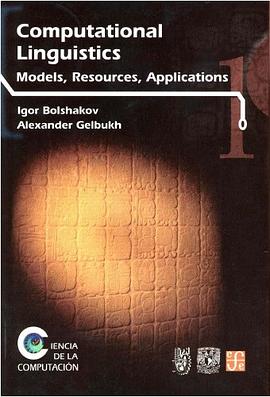
CAN COMPUTERS meaningfully process human language? If this
is difficult, why? If this is possible, how? This book introduces the
reader to the fascinating science of computational linguistics and
automatic natural language processing, which combines linguistics
and artificial intelligence.
The main part of the book is devoted to the explanation of the inner
working of a linguistic processor, a software module in charge
of translating natural language input into a representation directly
usable traditional artificial intelligence applications and, vice versa,
of translating their answer into human language.
Overall emphasis in the book is made on a well-elaborated,
though—for a number of historical reasons—so far little-known in
the literature computational linguistic model called Meaning
⇔ Text Theory. For comparison, other models and formalisms
are considered in detail.
The book is mainly oriented to researchers and students interested
in applications of natural language processing techniques to Spanish
language. In particular, most of the examples given in the book deal
with Spanish language material—which is a feature of the book distinguishing
it from other books on natural language processing.
However, our main exposition is sufficiently general to be applicable
to a wide range of languages.
Specifically, it was taken into account that many readers of the
book will be Spanish native speakers. For them, some comments on
the English terminology, as well as a short English-Spanish dictionary
of technical terms used in the book, were included. Still, reading
the book in English will help Spanish-speaking readers to become
familiar with the style and terminology used in the scientific literature
on the subject.
作者简介
IGOR A. BOLSHAKOV
was born in Moscow, Russia,
in 1934. He obtained his M.Sc.
degree in physics in 1956 from
the Department of physics of
the Moscow State “Lomonossov”
University, Ph.D.
degree in information technology
in 1961 from the VYMPEL
Institute, Moscow, Russia,
and D.Sc. degree in computer
science in 1966 from the same
institute. He received the National
Award of USSR in Science
and Technology in 1989.
Since 1996, he works for the
Natural Language and Text
Processing Laboratory of the
Computing Research Center,
National Polytechnic Institute,
Mexico City. He is National
Researcher of Mexico of excellence
level III, author of more
than 200 publications on theory
of radars, theory of probability,
and computational linguistics.
Email: igor@cic.ipn.mx
-------
ALEXANDER F. GELBUKH
was born in Moscow, Russia, in
1962. He obtained his M.Sc. degree
in mathematics in 1990 from
the Department of mechanics and
mathematics of the Moscow State
“Lomonossov” University and
Ph.D. degree in computer science
in 1995 from the All-Russian Institute
for Scientific and Technical
Information. Since 1997 he is the
head of the Natural Language and
Text Processing Laboratory of the
Computing Research Center, National
Polytechnic Institute, Mexico
City. He is academician of the
Mexican Academy of Sciences,
National Researcher of Mexico of
excellence level I, distinguished
lecturer of the ACM, founder of
the Mexican Association for Natural
Language Processing and the
CICLing international conference
series, author of more than 250
publications on computational
linguistics. Currently he is Distinguished
Visiting Professor at
Chung-Ang University, Seoul,
Korea.
Webpage: www.Gelbukh.com
目录信息
读后感
用户评价
这本书的封面设计着实引人注目,那种深沉的蓝色调配上银色的字体,立刻就给人一种严谨而又充满未来感的印象。我本以为它会是一本晦涩难懂的学术专著,没想到翻开扉页后,发现作者在行文组织上颇具匠心。开篇部分对于理论基础的梳理异常扎实,每一个概念的引入都伴随着清晰的历史脉络梳理,让人很容易跟上作者的思路。比如,在讲解早期的句法分析模型时,作者并没有止步于机械地罗列公式,而是穿插了许多有趣的案例,展示了这些模型在处理真实世界语言数据时遇到的挑战与局限性。这种教学方法极大地激发了我继续阅读的兴趣,因为我感觉自己不是在被动地接收知识,而是在和一位经验丰富的导师一起探索这个复杂领域的奥秘。特别是关于概率模型的章节,原本是我最担心会感到吃力的部分,但作者巧妙地通过可视化的方式解释了贝叶斯推断的核心思想,即便是对统计学有一定距离的读者也能大致把握其精髓。总的来说,这本书的开篇为我打开了一扇通往语言与计算交叉领域的大门,其清晰的结构和引人入胜的叙述方式,让我对接下来的内容充满了期待。
这本书的排版和印刷质量着实让我感到惊喜。在这个数字阅读盛行的年代,一本实体书如果能在装帧细节上做到极致,无疑会大大提升阅读的愉悦感。纸张的质地非常考究,不是那种廉价的、容易反光的纸张,而是偏哑光的米白色纸,长时间阅读下来眼睛不容易疲劳。更值得称道的是,全书的图表设计,尤其是流程图和架构图,色彩过渡自然,线条清晰锐利,完全没有那种粗糙的扫描件或低分辨率的图片感。我经常需要查阅书中的算法伪代码部分,这套书在这方面做得非常出色:代码块的缩进、变量的命名都遵循了良好的编程规范,注释简洁而到位,这对于我这种喜欢动手实验的读者来说,简直是福音。我尝试对照书中的一个复杂的序列标注模型的伪代码,在自己的环境中复现,发现几乎不需要额外的解读就能顺利移植。这种对细节的关注,体现了出版方对学术严谨性的尊重,也让这本书从一本普通的参考书,升华成了一件值得收藏的工具书。
这本书在伦理和社会影响方面的探讨,是我在其他同类技术书籍中很少见到的深度和广度。在最后几章,作者将焦点从纯粹的技术实现转向了对计算语言学未来发展方向的宏观思考。他没有停留在对“偏见”或“公平性”这些热门词汇的简单提及,而是深入剖析了训练数据中隐含的文化假设如何被语言模型放大和固化,以及这种固化如何影响到不同社会群体的用户体验。书中提出的“透明度量化框架”尤其发人深省,它试图建立一套标准来衡量一个模型的决策过程是否对最终用户友好和可解释。这种前瞻性的、带有社会责任感的视角,使得这本书不仅仅是一本技术手册,更像是一份面向未来的行业宣言。它提醒着每一个从事这个领域的人,我们所构建的系统,其影响远超代码本身,而是深深植根于人类的交流和认知结构之中。读完后,我感觉自己对这个专业领域的责任感也随之加重了,这是一种非常宝贵的心态上的转变。
我阅读这本书的初衷,是想了解如何将前沿的机器学习技术有效地应用于低资源语言处理中,而这本书在这方面的阐述,可以说是既有理论高度,又兼具实战指导意义。它并没有回避“数据稀缺性”这一核心难题,而是系统地介绍了迁移学习、多任务学习以及无监督预训练方法在处理小语种时的具体应用策略。作者不仅提供了各种方法的原理介绍,还非常务实地分析了每种策略的计算成本和潜在的性能瓶颈。我尤其关注了其中关于“跨语言词嵌入对齐”的章节,作者详细对比了基于典籍和基于感应式的对齐方法,并给出了在评估指标选择上的深入见解,指出单纯依赖BLEU分数来衡量低资源翻译系统的有效性是有失偏颇的。这种对评估体系的深层次反思,对我未来设计研究方案具有极强的指导性。这本书的论述逻辑层次分明,层层递进,让我感觉自己像是在跟随一位身经百战的工程师进行一次深入的技术研讨会,收获的不仅仅是知识,更多的是解决实际工程问题的思路和方法论。
坦白讲,我购买这本书的时候,是冲着它在自然语言理解(NLU)部分所承诺的深度分析去的,但实际阅读体验远超我的预期,尤其是在探讨语篇连贯性和指代消解方面。作者并没有采取那种高高在上、只谈理论的姿态,而是大量引用了近些年的顶级会议论文成果,并对它们进行了批判性的审视。我特别欣赏的是,作者在评估现有技术时所展现出的那种平衡感——既不盲目崇拜最新的深度学习架构,也不完全否定基于规则和知识图谱的传统方法。书中花了大量篇幅讨论“常识推理”在提高机器理解能力上的瓶颈,这种深入的剖析,迫使我开始重新思考许多看似基础的语言现象背后隐藏的巨大认知鸿沟。例如,书中对“隐含信息”处理的探讨,细致到令人发指,它不仅仅停留在定义层面,还展示了不同语言(比如高语境与低语境文化下的语言差异)如何影响指代链的构建。这种跨学科、跨视角的审视,让这本书的价值不仅仅停留在技术层面,更触及了认知科学和哲学思辨的领域。对于希望真正理解“机器如何理解意义”的人来说,这无疑是一本不可多得的参考书。
不错的CL导论 最又特点的是和MTT的接合
不错的CL导论 最又特点的是和MTT的接合
不错的CL导论 最又特点的是和MTT的接合
不错的CL导论 最又特点的是和MTT的接合
不错的CL导论 最又特点的是和MTT的接合