
具体描述
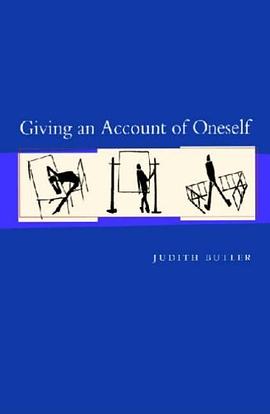
What does it mean to lead a moral life?In her first extended study of moral philosophy, Judith Butler offers a provocative outline for a new ethical practice-one responsive to the need for critical autonomy and grounded in a new sense of the human subject.Butler takes as her starting point one's ability to answer the questions What have I done?and What ought I to do?She shows that these question can be answered only by asking a prior question, Who is this 'I' who is under an obligation to give an account of itself and to act in certain ways?Because I find that I cannot give an account of myself without accounting for the social conditions under which I emerge, ethical reflection requires a turn to social theory.In three powerfully crafted and lucidly written chapters, Butler demonstrates how difficult it is to give an account of oneself, and how this lack of self-transparency and narratibility is crucial to an ethical understanding of the human. In brilliant dialogue with Adorno, Levinas, Foucault, and other thinkers, she eloquently argues the limits, possibilities, and dangers of contemporary ethical thought.Butler offers a critique of the moral self, arguing that the transparent, rational, and continuous ethical subject is an impossible construct that seeks to deny the specificity of what it is to be human. We can know ourselves only incompletely, and only in relation to a broader social world that has always preceded us and already shaped us in ways we cannot grasp. If inevitably we are partially opaque to ourselves, how can giving an account of ourselves define the ethical act? And doesn't an ethical system that holds us impossibly accountable for full self-knowledge and self-consistency inflict a kind of psychic violence, leading to a culture of self-beratement and cruelty? How does the turn to social theory offer us a chance to understand the specifically social character of our own unknowingness about ourselves?In this invaluable book, by recasting ethics as a project in which being ethical means becoming critical of norms under which we are asked to act, but which we can never fully choose, Butler illuminates what it means for us as fallible creaturesto create and share an ethics of vulnerability, humility, and ethical responsiveness. Judtith Butler is the Maxine Elliot Professor of Rhetoric and Comparative Literature at the University of California, Berkeley. The most recent of her books are Precarious Life: The Power of Mourning and Violence and Undoing Gender.
作者简介
目录信息
读后感
It would be a more accurate summary of the first chapter of Given an Account of Oneself, if Butler changed the chapter title to “Impossibility of an account of oneself”, or “Limits on an account of oneself”. In this book, she critically examined the ans...
It would be a more accurate summary of the first chapter of Given an Account of Oneself, if Butler changed the chapter title to “Impossibility of an account of oneself”, or “Limits on an account of oneself”. In this book, she critically examined the ans...
It would be a more accurate summary of the first chapter of Given an Account of Oneself, if Butler changed the chapter title to “Impossibility of an account of oneself”, or “Limits on an account of oneself”. In this book, she critically examined the ans...
It would be a more accurate summary of the first chapter of Given an Account of Oneself, if Butler changed the chapter title to “Impossibility of an account of oneself”, or “Limits on an account of oneself”. In this book, she critically examined the ans...
It would be a more accurate summary of the first chapter of Given an Account of Oneself, if Butler changed the chapter title to “Impossibility of an account of oneself”, or “Limits on an account of oneself”. In this book, she critically examined the ans...
用户评价
这本书的装帧设计简直让人爱不释手,那种沉甸甸的质感,拿在手里仿佛就能感受到作者试图传达的那种厚重感。内页的纸张选择也十分考究,墨迹清晰,阅读体验极佳。我特别喜欢封面那种简约而不失力量的设计,没有过多花哨的装饰,直截了当地将一种沉思和内省的氛围烘托出来。可以说,从翻开扉页的那一刻起,我就知道我即将踏入的不是一段轻松的旅程,而是一场深入自我肌理的探索。排版布局的疏密有致,也让长篇的文本阅读起来不至于感到压迫,这对于需要反复咀嚼的哲学性论述来说,是极其重要的细节。出版商在细节上的打磨,体现了对内容本身应有的尊重,也成功地让这本书在众多同类作品中脱颖而出,光是把它放在书架上,就是一种视觉上的享受和一种无声的宣言。
这本书的行文风格,初读时会让人感到有些挑战,它不像那些通俗易懂的自助指南那样平铺直叙,而是充满了复杂精妙的句式和层层递进的逻辑结构。我花了相当长的时间才适应作者那种跳跃式的思维路径,他似乎总是在不经意间将看似无关的概念联系起来,迫使读者不断地后退,重新审视自己刚刚读到的内容。这种阅读过程,与其说是吸收信息,不如说更像是在进行一场高强度的智力辩论,你必须时刻保持警觉,跟上作者敏锐的洞察力。对我而言,这不仅仅是阅读,更像是一次脑力的极限拉伸,每一次成功地跟上他的思路,都会带来一种酣畅淋漓的顿悟感,那种感觉比单纯的知识获取要深刻得多。
我印象最深的是作者对时间维度如何塑造“自我”的探讨。他没有采用线性的时间观,而是将过去、现在和潜在的未来编织成一个多维的网格,展示了我们如何不断地在这些时间点之间进行拉扯和重塑。这种处理方式极其富有启发性,它颠覆了我过去那种认为“我是谁”是一个固定答案的想法。读完之后,我开始用一种全新的视角去审视自己的记忆和规划,意识到每一个瞬间的选择,都在重新定义着“我”这个叙事的主体。这种对存在和时间交织的精妙描摹,让我对日常的体验多了一层哲学的滤镜,使原本平凡的日常都变得充满了张力和深意。
这本书真正触动我的地方,在于它那种近乎残酷的诚实。作者没有提供任何廉价的安慰剂或即时的解决方案,相反,他似乎更热衷于揭示我们认知结构中那些隐藏的裂痕和矛盾。他以一种近乎外科手术般的冷静,剖开了我们习以为常的叙事方式,展示了那些支撑我们身份认同的支柱,其实是多么脆弱和建构性。这种直面不确定性和内在冲突的态度,虽然一度让我感到不安和动摇,但最终却带来了一种深层的解放感——认识到“完整性”可能本身就是一个美好的误区,而我们必须学会在不完美中继续前行和构建意义。
在阅读过程中,我发现作者对于概念的界定极为严谨,每一个词语的选择都仿佛经过了反复的掂量和锤炼,拒绝一切模糊和含糊不清的表达。这种精确性,使得文本的重量感倍增,也意味着读者不能抱着“差不多就行了”的心态去对待它。我不得不频繁地停下来,查阅一些相关的背景资料,以确保我对作者所指涉的特定术语有着最准确的理解。这种对清晰度的不妥协,虽然增加了阅读的难度,但反过来也保证了论证的坚固性。它不是在讨好读者,而是在提出一个严肃的学术要求,要求我们以同样的认真态度去对待“自我”这个宏大而又私密的主题。
有点不知所云...难道因为传说作者是世界上最聪明的人之一?
Giving an Account of Noneself
Giving an Account of Noneself
可能是巴特勒写得最清楚的一本书了,也有修辞、日常语言的痕迹。
Giving an Account of Noneself