
具体描述
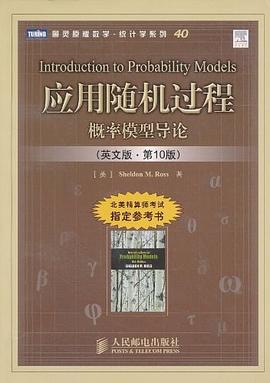
《应用随机过程:概率模型导论(英文版·第10版)》叙述深入浅出,涉及面广。主要内容有随机变量、条件概率及条件期望、离散及连续马尔可夫链、指数分布、泊松过程、布朗运动及平稳过程、更新理论及排队论等;也包括了随机过程在物理、生物、运筹、网络、遗传、经济、保险、金融及可靠性中的应用。特别是有关随机模拟的内容,给随机系统运行的模拟计算提供了有力的工具。除正文外,《应用随机过程——概率模型导论(第10版:英文版)》有约700道习题,其中带星号的习题还提供了解答。
《应用随机过程:概率模型导论(英文版·第10版)》可作为概率论与统计、计算机科学、保险学、物理学、社会科学、生命科学、管理科学与工程学等专业的随机过程基础课教材。
作者简介
Sheldon M.Ross,国际知名概率与统计学家,南加州大学工业工程与运筹系系主任。1968年博士毕业于斯坦福大学统计系,曾在加州大学伯克利分校任教多年。研究领域包括:随机模型、仿真模拟、统计分析、金融数学等。Ross教授著述颇丰,他的多种畅销数学和统计教材均产生了世界性的影响,如A First Course in Probability(《概率论基础教程》)和Simulation(《统计模拟》)等(均由人民邮电出版社引进出版)。
目录信息
1.1 introduction
1.2 sample space and events
1.3 probabilities defined on events
1.4 conditional probabilities
1.5 independent events
1.6 bayes' formula
exercises
references
2 random variables
2.1 random variables
2.2 discrete random variables
2.2.1 the bernoulli random variable
2.2.2 the binomial random variable
2.2.3 the geometric random variable
2.2.4 the poisson random variable
2.3 continuous random variables
2.3.1 the uniform random variable
2.3.2 exponential random variables
2.3.3 gamma random variables
2.3.4 normal random variables
2.4 expectation of a random variable
2.4.1 the discrete case
2.4.2 the continuous case
2.4.3 expectation of a function of a random variable
2.5 jointly distributed random variables
2.5.1 joint distribution functions
2.5.2 independent random variables
2.5.3 covariance and variance of sums of random variables
2.5.4 joint probability distribution of functions of randomvariables
2.6 moment generating functions
2.6.1 the joint distribution of the sample mean and sample variance from a normal population
2.7 the distribution of the number of events that occur
2.8 limit theorems
2.9 stochastic processes
exercises
references
3 conditional probability and conditional expectation
3.1 introduction
3.2 the discrete case
3.3 the continuous case
3.4 computing expectations by conditioning
3.4.1 computing variances by conditioning
3.5 computing probabilities by conditioning
3.6 some applications
3.6.1 a list model
3.6.2 a random graph
3.6.3 uniform priors, polya's urn model, and bose-einstein statistics
3.6.4 mean time for patterns
3.6.5 the k-record values of discrete random variables
3.6.6 left skip free random walks
3.7 an identity for compound random variables
3.7.1 poisson compounding distribution
3.7.2 binomial compounding distribution
3.7.3 a compounding distribution related to the negative binomial
exercises
4 markov chains
4.1 introduction
4.2 chapman-kolmogorov equations
4.3 classification of states
4.4 limiting probabilities
4.5 some applications
4.5.1 the gambler's ruin problem
4.5.2 a model for algorithmic efficiency
4.5.3 using a random walk to analyze a probabilistic algorithm for the satisfiability problem
4.6 mean time spent in transient states
4.7 branching processes
4.8 time reversible markov chains
4.9 markov chain monte carlo methods
4.10 markov decision processes
4.11 hidden markov chains
4.11.1 predicting the states
exercises
references
5 the exponential distribution and the poisson process
5.1 introduction
5.2 the exponential distribution
5.2.1 definition
5.2.2 properties of the exponential distribution
5.2.3 further properties of the exponential distribution
5.2.4 convolutions of exponential random variables
5.3 the poisson process
5.3.1 counting processes
5.3.2 definition of the poisson process
5.3.3 interarrival and waiting time distributions
5.3.4 further properties of poisson processes
5.3.5 conditional distribution of the arrival times
5.3.6 estimating software reliability
5.4 generalizations of the poisson process
5.4.1 nonhomogeneous poisson process
5.4.2 compound poisson process
5.4.3 conditional or mixed poisson processes
exercises
references
6 continuous-time markov chains
6.1 introduction
6.2 continuous-time markov chains
6.3 birth and death processes
6.4 the transition probability function pij (t)
6.5 limiting probabilities
6.6 time reversibility
6.7 uniformization
6.8 computing the transition probabilities
exercises
references
7 renewal theory and its applications
7.1 introduction
7.2 distribution of n(t)
7.3 limit theorems and their applications
7.4 renewal reward processes
7.5 regenerative processes
7.5.1 alternating renewal processes
7.6 semi-markov processes
7.7 the inspection paradox
7.8 computing the renewal function
7.9 applications to patterns
7.9.1 patterns of discrete random variables
7.9.2 the expected time to a maximal run of distinct values
7.9.3 increasing runs of continuous random variables
7.10 the insurance ruin problem
exercises
references
8 queueing theory
8.1 introduction
8.2 preliminaries
8.2.1 cost equations
8.2.2 steady-state probabilities
8.3 exponential models
8.3.1 a single-server exponential queueing system
8.3.2 a single-server exponential queueing system having finite capacity
8.3.3 birth and death queueing models
8.3.4 a shoe shine shop
8.3.5 a queueing system with bulk service
8.4 network of queues
8.4.1 open systems
8.4.2 closed systems
8.5 the system m/g/1
8.5.1 preliminaries: work and another cost identity
8.5.2 application of work to m/g/1
8.5.3 busy periods
8.6 variations on the m/g/1
8.6.1 the m/g/1 with random-sized batch arrivals
8.6.2 priority queues
8.6.3 an m/g/1 optimization example
8.6.4 the m/g/1 queue with server breakdown
8.7 the model g/m/1
8.7.1 the g/m/1 busy and idle periods
8.8 a finite source model
8.9 multiserver queues
8.9.1 erlang's loss system
8.9.2 the m/m/k queue
8.9.3 the g/m/k queue
8.9.4 the m/g/k queue
exercises
references
9 reliability theory
9.1 introduction
9.2 structure functions
9.2.1 minimal path and minimal cut sets
9.3 reliability of systems of independent components
9.4 bounds on the reliability function
9.4.1 method of inclusion and exclusion
9.4.2 second method for obtaining bounds on r(p)
9.5 system life as a function of component lives
9.6 expected system lifetime
9.6.1 an upper bound on the expected life of a parallel system
9.7 systems with repair
9.7.1 a series model with suspended animation
exercises
references
10 brownian motion and stationary processes
10.1 brownian motion
10.2 hitting times, maximum variable, and the gambler's ruin problem
10.3 variations on brownian motion
10.3.1 brownian motion with drift
10.3.2 geometric brownian motion
10.4 pricing stock options
10.4.1 an example in options pricing
10.4.2 the arbitrage theorem
10.4.3 the black-scholes option pricing formula
10.5 white noise
10.6 gaussian processes
10.7 stationary and weakly stationary processes
10.8 harmonic analysis of weakly stationary processes
exercises
references
11 simulation
11.1 introduction
11.2 general techniques for simulating continuous random variables
11.2.1 the inverse transformation method
11.2.2 the rejection method
11.2.3 the hazard rate method
11.3 special techniques for simulating continuous random variables
11.3.1 the normal distribution
11.3.2 the gamma distribution
11.3.3 the chi-squared distribution
11.3.4 the beta (n, m) distribution
11.3.5 the exponential distribution-the von neumann algorithm
11.4 simulating from discrete distributions
11.4.1 the alias method
11.5 stochastic processes
11.5.1 simulating a nonhomogeneous poisson process
11.5.2 simulating a two-dimensional poisson process
11.6 variance reduction techniques
11.6.1 use of antithetic variables
11.6.2 variance reduction by conditioning
11.6.3 control variates
11.6.4 importance sampling
11.7 determining the number of runs
11.8 generating from the stationary distribution of a markov chain
11.8.1 coupling from the past
11.8.2 another approach
exercises
references
appendix: solutions to starred exercises
index
· · · · · · (收起)
读后感
一本大牛写的好书翻译成这样,每一句基本感觉都只是直接照着原文变换一下,倒更像是SMT翻译的结果. 真是糟蹋. 现在这些导师翻译书,随便找几个学生敷衍了事,翻译的都不通顺,罢了,找原著吧. 龚光鲁,记住它!
一本大牛写的好书翻译成这样,每一句基本感觉都只是直接照着原文变换一下,倒更像是SMT翻译的结果. 真是糟蹋. 现在这些导师翻译书,随便找几个学生敷衍了事,翻译的都不通顺,罢了,找原著吧. 龚光鲁,记住它!
一本大牛写的好书翻译成这样,每一句基本感觉都只是直接照着原文变换一下,倒更像是SMT翻译的结果. 真是糟蹋. 现在这些导师翻译书,随便找几个学生敷衍了事,翻译的都不通顺,罢了,找原著吧. 龚光鲁,记住它!
我只是看中文时候觉得奇怪的地方去查了英文。慢慢更。 4.2 C-K方程 p147. 例4.8 “计算今天往后的四天都下雨的概率” 原文为 “then calculate the probability that it will rain four days from today given that it is raining today.” 意思为(it will rain)(four days...
一本大牛写的好书翻译成这样,每一句基本感觉都只是直接照着原文变换一下,倒更像是SMT翻译的结果. 真是糟蹋. 现在这些导师翻译书,随便找几个学生敷衍了事,翻译的都不通顺,罢了,找原著吧. 龚光鲁,记住它!
用户评价
这本书的特点在于其对教材结构和学习路径的精心设计。它并非简单地罗列知识点,而更像是一张精心绘制的认知地图。作者非常注重读者在学习过程中的“心流体验”,章节之间的过渡衔接得非常流畅自然,使得学习曲线保持在一个适度挑战但又令人充满成就感的范围内。比如,从介绍随机变量到定义随机过程,再到建立维纳过程的模型,每一步的推进都伴随着清晰的数学动机阐述,让你清楚地知道“为什么需要这个工具”。我注意到书中包含了不少历史背景的穿插介绍,虽然这些内容不直接影响解题,但它们极大地丰富了对这些数学工具的感性认识,让我明白了这些理论是如何在历史长河中被逐步发展和完善起来的。这种兼顾历史纵深感与现代应用视角的叙述方式,让这本书不仅仅是一本工具书,更像是一部概率论思想的简史。对于希望深入理解随机过程的本质而非仅仅停留在公式记忆层面的读者来说,这本书的深度和广度是无可挑剔的。
说实话,市面上关于随机过程的书籍浩如烟海,大多要么过于偏重理论的抽象证明,读起来晦涩难懂,要么就是过于追求应用实例的堆砌,缺乏理论根基的支撑。但《应用随机过程》这本书似乎找到了一个绝佳的平衡点。它的理论推导过程严谨而不失灵动,每一步的逻辑跳转都交代得清晰分明,让人心悦诚服。更难能可贵的是,它在讲解完核心理论之后,紧接着就提供了若干个精心设计的应用场景来巩固理解。我尤其对其中关于排队论(Queuing Theory)的章节印象深刻,作者没有停留在M/M/1模型的基础讨论,而是深入探讨了M/G/c系统的性能指标,并且清晰地展示了如何利用这些指标去优化一个虚拟的呼叫中心运营方案。这种将理论知识转化为实际生产力工具的过程,让我深深感受到了学习这门学科的价值所在。这本书的价值,绝不仅仅在于让你通过考试,更在于它教会你如何用一种全新的、概率性的思维框架去审视和解决现实世界中充满了不确定性的复杂问题。
初次接触这本教材时,坦白说,我对“随机过程”这个听起来就有些玄乎的学科抱着一丝畏惧。然而,这本书的叙事风格却出人意料地平易近人,仿佛一位经验丰富的导师在耐心地为你解惑,而不是冷冰冰的公式堆砌。作者的语言充满了启发性,他似乎总能抓住读者思维的盲点,提前进行预判和引导。例如,对于泊松过程的讲解,他不仅详尽地阐述了其性质,还特意辟出小节来对比它与均匀分布、指数分布之间的深刻联系,这种横向的知识串联极大地帮助我构建了更完整的概率论知识体系。我特别喜欢作者在引入新概念时,总是会先回顾一下前置知识点,这种无缝衔接的处理方式,让我在面对复杂概念时,心里踏实了很多,避免了那种“学到后面,前面忘了”的窘境。这本书的行文节奏把握得非常好,既有足够的深度来满足专业读者的需求,又不失广度让对该领域感兴趣的跨学科人士能够有效入门。我已经将它推荐给了好几位正在准备相关考试的朋友,相信他们也会从中受益匪浅。
自从拿到了这本《应用随机过程》后,我立刻被它对清晰度和实用性的极致追求所折服。在众多教材中,这本书的符号系统和术语定义达到了惊人的一致性和规范性,这在处理像鞅(Martingale)这样容易引起混淆的概念时显得尤为重要。作者在定义每一个关键术语时,都会附带一个简洁的例子或反例,这极大地减少了因歧义理解而产生的困惑。我特别欣赏书中对随机过程在信息论和信号处理领域应用的论述,这部分内容往往是其他教材会轻描淡写带过的地方。作者没有满足于表面的介绍,而是深入剖析了如何利用卡尔曼滤波(Kalman Filtering)的原理来对含噪声的时间序列数据进行最优估计,并且提供了相关的算法伪代码。这种与现代工程技术紧密结合的深度分析,体现了作者对该领域前沿发展的深刻洞察力。总而言之,这是一部极具操作价值和理论深度的著作,无论你是本科高年级学生、研究生,还是希望温故知新的工程师,这本书都能成为你宝贵的知识资产。
这本《应用随机过程》的装帧设计着实让人眼前一亮,封面采用了深邃的蓝色调,搭配简洁的白色字体,透着一种既专业又不失沉稳的气息。翻开内页,纸张的质感非常出色,印刷清晰,字迹工整,长时间阅读下来眼睛也不会感到特别疲劳。我个人特别欣赏作者在排版上的用心,定理的推导过程和重要的公式都被单独突出显示,使得复杂内容的逻辑脉络一目了然。更让我惊喜的是,书后附带的习题设计得极具层次感,从基础概念的巩固到实际工程问题的建模,难度递进自然。虽然我目前只啃完了前几章,但已经能感受到作者在讲解过程中那种深厚的学术功底和清晰的逻辑梳理能力。例如,在介绍马尔可夫链稳态分布的那一节,作者没有直接抛出复杂的矩阵运算,而是先通过一个生动的日常例子来构建直观理解,然后再逐步引入严谨的数学形式,这种“由浅入深”的教学方法对于初学者来说简直是福音。我期待着后续章节中能看到更多关于实际应用案例的深入分析,比如在金融衍生品定价或通信网络中的应用,相信这本书绝对能成为我案头常备的参考书。