具体描述
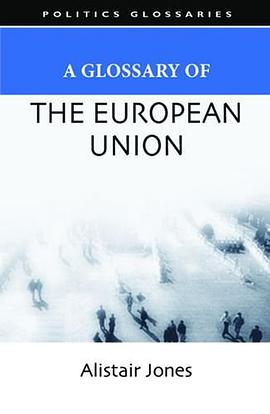
This A-Z guide explains the key concepts and institutions linked to the European Union, along with brief biographies of the leading figures related to the foundation and development of the EU. This will allow students to link some of the theoretical concepts with the people who introduced them. The book is useful in discerning between the British and European Parliaments -- students often confuse many of the concepts of the EU with those of the British Government, and the definitions in this Glossary will demonstrate that the bodies have differing roles to play in many aspects of their existence.
A Glossary of the European Union The Definitive Reference for Understanding Contemporary Europe This comprehensive glossary serves as an indispensable companion for anyone navigating the intricate landscape of the European Union. Far more than a mere collection of definitions, this volume is a meticulously curated guide designed to illuminate the historical evolution, institutional mechanics, and complex political dynamics that define the EU today. It moves beyond surface-level explanations, delving into the nuanced interpretations and practical implications of the terms that shape European policy, law, and daily life. The book is structured systematically, moving from fundamental constitutional principles to highly specific regulatory frameworks, ensuring a logical and accessible progression for both the seasoned policy analyst and the dedicated newcomer. Its scope encompasses the full spectrum of EU activity, from the foundational treaties and the roles of the principal institutions—the Commission, the Council, the Parliament, and the Court of Justice—to the specialized agencies and bodies that execute policy across twenty-seven diverse member states. Institutional Architecture and Legal Foundations A significant portion of the glossary is dedicated to demystifying the architecture of European governance. Readers will find exhaustive entries on critical concepts such as: Supranationalism vs. Intergovernmentalism: Detailed explorations of the tension and balance between shared sovereignty and national prerogative that underpins EU decision-making processes. This includes careful dissection of the decision-making procedures, such as the ordinary legislative procedure (co-decision) and its historical antecedents. The Acquis Communautaire: A thorough breakdown of this body of common rights and obligations, detailing its divisions (e.g., the acquis in Justice and Home Affairs, the common commercial policy) and the rigorous accession requirements it imposes on candidate countries. Direct Effect and Supremacy of EU Law: In-depth analysis of the landmark jurisprudence from the European Court of Justice (ECJ) that established the primacy of EU law over national legislation. This section traces the evolution of this doctrine through cases like Van Gend en Loos and Costa v ENEL, providing context for contemporary legal challenges. Comitology: A pragmatic guide to the complex system of committees through which the Council and Commission exercise implementing powers, clarifying the roles of the different committee types (regulatory, implementing, and examination procedures) and their significance in the technical application of directives and regulations. Economic and Monetary Union (EMU) Deep Dive For those focused on economic governance, the glossary offers unparalleled clarity on the mechanisms of the Eurozone. Entries illuminate the often-misunderstood instruments of economic coordination: The Stability and Growth Pact (SGP): A granular examination of the convergence criteria (Maastricht criteria) and the preventative and corrective arms of the SGP. It details the evolution of the pact post-2008 crisis, including the introduction of the "Two-Pack" and "Six-Pack" regulations designed to enhance fiscal surveillance and enforce compliance mechanisms against excessive deficits and imbalances. Banking Union Components: Clear definitions and explanations of the Single Supervisory Mechanism (SSM), the Single Resolution Mechanism (SRM), and the proposed Single Resolution Fund (SRF). The glossary meticulously outlines the bail-in versus bail-out philosophies embedded within these structures. European Semester: A step-by-step explanation of this annual cycle of economic policy coordination, detailing the process from the Commission’s Country Reports to the Council’s issuance of Country-Specific Recommendations (CSRs). Policy Areas: From Agriculture to Digitalization The volume spans the breadth of EU policy competency, offering precise terminology for core areas that profoundly affect citizens and industries: Common Agricultural Policy (CAP): Beyond simply defining ‘Pillar I’ and ‘Pillar II,’ the glossary explores the concept of coupled support, greening requirements, direct payment schemes, and the ongoing shift towards rural development funding. Competition Law: Detailed entries on concepts such as abuse of a dominant position (Article 102 TFEU), permissible state aid (Articles 107-109 TFEU), and the thresholds for merger control under the Merger Regulation. Data Protection and Digital Governance: Current definitions for the General Data Protection Regulation (GDPR), including lawful bases for processing, data subject rights (such as the ‘right to be forgotten’), and the roles of the European Data Protection Board (EDPB) and national supervisory authorities. Furthermore, it addresses key regulatory frameworks like the Digital Services Act (DSA) and the AI Act. Political Vocabulary and External Relations Understanding the EU requires grasping the language of diplomacy and internal political bargaining. The glossary provides robust definitions for: Citizens' Initiative (European Citizens' Initiative - ECI): Explaining the mechanics of gathering one million signatures across a significant number of member states and the process by which the Commission must respond. Subsidiarity and Proportionality: A nuanced exploration of these twin principles that govern the EU’s exercise of competence, detailing how they are assessed during the legislative drafting process, often involving national parliaments via the Early Warning Mechanism (the ‘yellow/orange card’ procedure). Common Foreign and Security Policy (CFSP): Delineating the roles of the High Representative for Foreign Affairs and Security Policy and the European External Action Service (EEAS), alongside definitions of restrictive measures (sanctions), joint actions, and common positions. Target Audience and Utility A Glossary of the European Union is essential reading for: Students and Academics: Providing the necessary terminological precision for dissertations, research papers, and exams in political science, European studies, law, and economics. Civil Servants and Public Administrators: Serving as a rapid reference guide for inter-institutional communication and drafting accurate legal and policy documents. Lobbyists and Stakeholders: Ensuring precise comprehension of legislative proposals, regulatory consultations, and the parliamentary stages of directive adoption. Journalists and Commentators: Offering the context needed to report accurately on Brussels’ decision-making processes without resorting to ambiguity or simplification. By offering meticulous cross-referencing and extensive contextual notes, this glossary ensures that every term—from the arcane procedures of Qualified Majority Voting (QMV) to the contemporary challenges of rule of law conditionality—is situated firmly within its broader legal and political reality. It stands as the definitive manual for mastering the vocabulary of the world’s most ambitious political and economic integration project.