
具体描述
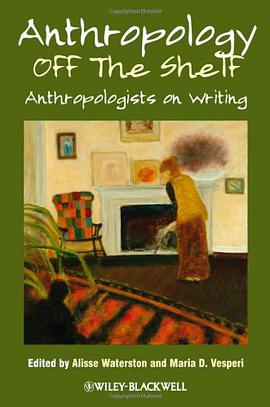
In Anthropology off the Shelf, leading anthropologists reflect on the craft of writing and the passions that fuel their desire to write books. First of its kind volume in anthropology in which prominent anthropologists and 3 respected professionals outside the discipline follow the tradition of the “writers on writing” genre to reflect on all aspects of the writing process Contributors are high-profile in anthropology and many have a strong presence outside the field, in popular culture Unique in its format: short essays, revealing and straightforward in content and writing style
作者简介
Notes on Contributors
Lee D. Baker is Dean of Academic Affairs, Trinity College of Arts and Sciences,
Duke University. He is currently completing a book entitled Anthropology
and the Racial Politics of Culture, examining the role anthropology
played in various “culture wars” that were waged throughout the twentieth
century.
Sharon Ball is currently Executive Director of the Broome County Arts
Council in Binghamton, New York. She is the former Senior Cultural Editor
at NPR News in Washington, D.C. In the village of Whitney Point where
she lives, she is an active member of the Community Planning Committee
and the Main Street Development Committee and is working to transform
the small, 100-year-old church that she bought last year into a cultural
center.
Andrew Barnes is the retired editor and CEO of the St. Petersburg Times.
He chaired the Pulitzer Prize Board and the Newspaper Association of
America. He currently chairs the Florida chapter of the Nature Conservancy,
and continues to be a trustee of the Poynter Institute for Media
Studies.
Ruth Behar is an anthropologist, writer, and documentary fi lmmaker. In
her latest book, An Island Called Home: Returning to Jewish Cuba, she
recounts her journey back to Cuba and the Jewish communities she discovers
there. Behar’s other books include Translated Woman: Crossing the
Border with Esperanza’s Story and The Vulnerable Observer: Anthropology
that Breaks Your Heart. She has also published essays, poetry, and
short fi ction. Behar is Professor of Anthropology at the University of
Michigan and the recipient of fellowships from the MacArthur
Foundation and the John Simon Guggenheim Memorial Foundation.
Karen Brodkin writes about race, gender and activism. She is author of
Making Democracy Matter: Identity and Activism in Los Angeles, and How
Jews Became White Folks and What That Says about Race in America. Her
forthcoming book is Power Politics: Environmental Activism in South Los
Angeles. She is Professor Emerita in Anthropology and Women’s Studies at
UCLA.
Micaela di Leonardo is Professor of Anthropology and Performance Studies
at Northwestern University. Her co-edited New Landscapes of Inequality:
Neoliberalism and the Erosion of American Democracy appeared with SAR
Press in 2008. She is currently fi nishing The View from Cavallaro’s, a historical
ethnography of political economy and public culture in New Haven,
Connecticut, for University of California Press. She also has an ongoing
project on black radio, progressive politics, and the American public sphere.
Paul Farmer is Presley Professor of Medical Anthropology in the Department
of Social Medicine at Harvard Medical School, Associate Chief of the
Division of Social Medicine and Health Inequalities at the Brigham and
Women’s Hospital, and a co-founder of Partners In Health (PIH), a nonprofi
t organization that provides free health care and undertakes research
and advocacy on behalf of the destitute sick. His current focus is on the
public-sector scale-up of PIH’s model of care in rural Haiti, Rwanda,
Malawi, and Lesotho.
Signithia Fordham, who teaches in the Anthropology Department at the
University of Rochester, takes lived experience as central to her critical
analysis. The author of Blacked Out: Dilemmas of Race, Identity and
Success at Capital High, she is currently writing a fi ctionalized ethnography,
tentatively titled Downed by Friendly Fire, based on her observations and
interviews regarding aggression between and among socially defi ned Black
and White girls in a suburban high school. Interrogating the gendered performance
of racial scripts, she explicates how subordination and the desire
to belong compel young Black women to learn to breathe with “no air.”
Catherine Kingfi sher is Professor of Anthropology at the University of
Lethbridge, Alberta, Canada. Her current book project, Traveling Politics,
Traveling Policies: The “New Zealand Experiment” at Home and Abroad,
has two simultaneous foci: fi rst, the travel of neoliberal cultural formations
of gender, personhood, poverty and work from Aotearoa/New Zealand to
Alberta (facilitated by the visit of a former NZ fi nance minister); and
second, the differing experiences of Native and non-Native poor single
mothers in Canada, and Pakeha (white/European), Maori, and Pacifi c Island
poor single mothers in Aotearoa/New Zealand in the context of welfare
state restructuring.
S. Eben Kirksey earned a Ph.D. from the History of Consciousness Program,
University of California at Santa Cruz, in early 2008. His writing has
appeared in major newspapers and he has served as a source for journalists
in print and broadcast media. Currently he is completing a book about the
idea of freedom (merdeka) in West Papua that combines multiple genres
and narrative forms: indigenous parable, fi gural realism, the “view from
nowhere,” ethnographic vignettes, oral history, and memoir. A postdoctoral
fellowship in the National Science Foundation’s Science and Society
program (2008–10) will allow him to conduct an ethnographic study of
tropical biology.
Irma McClaurin is Associate Vice President for System Academic Administration
and Executive Director of the fi rst Urban Research and Outreach/
Engagement Center (UROC) at the University of Minnesota. Two children’s
books have been published by Marshall Cavendish. She is working on two
new children’s books, and a longer-term project on Zora Neale Hurston
that examines Zora’s contributions as a scholar/writer, and her continuing
omission from the canon of innovative ethnographic practices. She conducts
writing workshops and continues to write poetry and essays. As Executive
Director of UROC, her goal is to use public and engaged anthropology to
develop programs and infrastructure.
Cheryl B. Mwaria is Professor of Anthropology at Hofstra University and
Executive Director of the Africa Network, a consortium of liberal arts colleges.
Currently she is working on two research projects – a cross-cultural
comparison of the ethical debates surrounding the use of pre-implantation
genetic diagnosis and a longitudinal ethnographic study of efforts to eliminate
disparities in interconceptional care received by women who have
given birth prematurely. The latter study is being undertaken in conjunction
with the Drexel University College of Medicine and the University of North
Carolina at Chapel Hill.
Carolyn Nordstrom is Professor of Anthropology at the University of Notre
Dame. Having struggled for years to fi t the world’s vast roiling multiplex
realities into an academic epistemological universe too small to accommodate
them, she is writing a book challenging the academy to update its
theoretical foundations for the twenty-fi rst century. She conducts fi eldwork
in war zones worldwide and was recently awarded John D. and Catherine
T. MacArthur and John Simon Guggenheim Fellowships. Her books include:
Global Outlaws, Shadows of War, and A Different Kind of War Story, plus
several edited volumes.
Roger Sanjek is Professor of Anthropology at Queens College, City University
of New York, where he has taught since 1972. In addition to his Gray Panther experience, he has done fi eldwork in Brazil, Ghana, and Queens,
New York City. His next project will be a collection of essays on ethnography
– past, present, and public.
Arthur K. Spears is Professor of Anthropology and Linguistics at the City
University of New York Graduate Center. At City College, he is Professor
and Chair in the Anthropology Department and Director of the Black
Studies Program. He is President (2007–9) of the Society for Pidgin and
Creole Linguistics, the largest international body devoted to promoting the
study of contact languages. Professor Spears’s current book projects deal
with Haitian Creole; African American English and Caribbean creole languages;
and introductory linguistics, focusing on increasing diversity within
the discipline.
Maria D. Vesperi is Professor of Anthropology at New College of Florida
and a trustee of the Poynter Institute, a school for journalists. She is currently
completing a book on the relationship between ethnographic narrative
and narrative journalism. By examining where ethnographers and journalists
struggle with similar writing challenges and where their experiences diverge,
she hopes to foster discussion that will help anthropologists work more
effectively with the media and lend new depth to journalists’ understanding
of the ethnographic process. She is also working on a long-term project, a
150-year social history of a utopian community turned company town.
Alisse Waterston is Professor, Department of Anthropology, at the John
Jay College of Criminal Justice, City University of New York. She edited
An Anthropology of War: Views from the Frontline with Berghahn Books
in 2008 and is working on two projects: Out of the Shadows of History
and Memory: Writing My Father’s Life is an intimate ethnography of her
father’s experiences (as a Jewish child in Jedwabne, Poland, a young man
in Havana, and an old man in San Juan, Puerto Rico); Narrating Poland
is an ethnography of Polish-Christian immigrants from northeastern Poland,
now living in New York. Her goal is to write family tales that reveal larger
histories.
Howard Zinn is Professor Emeritus of Political Science at Boston University.
He is currently involved in adapting his book A People’s History of
the United States for a television series. It will be called The People Speak,
and there will be four one-hour programs, with each hour concentrating
on a different issue: class, race, women, war. Well-known actors will read
the words of historical fi gures such as Frederick Douglass, Mark Twain,
Emma Goldman, Helen Keller – people who have kept alive the spirit of
dissent and rebellion in this country.
目录信息
Notes on Contributors ix
Foreword xiii
Cheryl Mwaria
1 Introduction: The Writer in the Anthropologist 1
Maria D. Vesperi and Alisse Waterston
Part I Conceptions 13
2 Speaking Truth to Power with Books 15
Howard Zinn
3 Remember When Writing Was Fun? Why Academics
Should Go On a Low Syllable, Active Voice Diet 21
Karen Brodkin
4 The Bard 35
Carolyn Nordstrom
5 Saggin’ and Braggin’ 46
Lee D. Baker
6 Stories for Readers: A Few Observations from
Outside the Academy 60
Andrew Barnes
Part II Creations 63
7 Writing Poverty, Drawing Readers: Stories in Love,
Sorrow and Rage 65
Alisse Waterston
8 Write-ous Indignation: Black Girls, Dilemmas of Cultural
Domination and the Struggle to Speak the Skin We Are In 79
Signithia Fordham
9 Writing Truth to Power: Racism as Statecraft 93
Arthur K. Spears
10 Remembering Octavia 101
Sharon Ball
11 Believing in Anthropology as Literature 106
Ruth Behar
Part III Receptions 117
12 Walking in Zora’s Shoes or “Seek[ing] Out de Inside
Meanin’ of Words”: The Intersections of Anthropology,
Ethnography, Identity, and Writing 119
Irma McClaurin
13 Off the Shelf and into Oblivion? 134
Catherine Kingfi sher
14 “Don’t Use Your Data as a Pillow” 146
S. Eben Kirksey
15 The Trope of the Pith Helmet: America’s Anthropology,
Anthropology’s America 160
Micaela di Leonardo
16 The Book that Wrote Me 172
Roger Sanjek
17 Fighting Words 182
Paul Farmer
18 Taking Chances 191
Maria D. Vesperi
Index 203
· · · · · · (收起)
读后感
某次与一位比利时艺术家做访谈,我说,要不说说你为啥爱艺术吧。比利时帅哥那淡蓝色的眼睛顿时眼神黯淡了一下,望向我身后的玻璃橱窗,低沉地说了一句,有时我恨艺术。我说为啥捏?帅哥不语,沉默了一会儿说,如果我能弄清楚为啥恨艺术,可能就知道为啥爱艺术了,不幸的是,两...
某次与一位比利时艺术家做访谈,我说,要不说说你为啥爱艺术吧。比利时帅哥那淡蓝色的眼睛顿时眼神黯淡了一下,望向我身后的玻璃橱窗,低沉地说了一句,有时我恨艺术。我说为啥捏?帅哥不语,沉默了一会儿说,如果我能弄清楚为啥恨艺术,可能就知道为啥爱艺术了,不幸的是,两...
某次与一位比利时艺术家做访谈,我说,要不说说你为啥爱艺术吧。比利时帅哥那淡蓝色的眼睛顿时眼神黯淡了一下,望向我身后的玻璃橱窗,低沉地说了一句,有时我恨艺术。我说为啥捏?帅哥不语,沉默了一会儿说,如果我能弄清楚为啥恨艺术,可能就知道为啥爱艺术了,不幸的是,两...
某次与一位比利时艺术家做访谈,我说,要不说说你为啥爱艺术吧。比利时帅哥那淡蓝色的眼睛顿时眼神黯淡了一下,望向我身后的玻璃橱窗,低沉地说了一句,有时我恨艺术。我说为啥捏?帅哥不语,沉默了一会儿说,如果我能弄清楚为啥恨艺术,可能就知道为啥爱艺术了,不幸的是,两...
某次与一位比利时艺术家做访谈,我说,要不说说你为啥爱艺术吧。比利时帅哥那淡蓝色的眼睛顿时眼神黯淡了一下,望向我身后的玻璃橱窗,低沉地说了一句,有时我恨艺术。我说为啥捏?帅哥不语,沉默了一会儿说,如果我能弄清楚为啥恨艺术,可能就知道为啥爱艺术了,不幸的是,两...