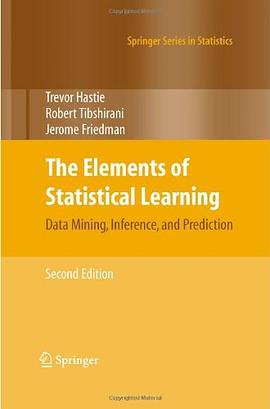

具体描述
During the past decade there has been an explosion in computation and information technology. With it have come vast amounts of data in a variety of fields such as medicine, biology, finance, and marketing. The challenge of understanding these data has led to the development of new tools in the field of statistics, and spawned new areas such as data mining, machine learning, and bioinformatics. Many of these tools have common underpinnings but are often expressed with different terminology. This book describes the important ideas in these areas in a common conceptual framework. While the approach is statistical, the emphasis is on concepts rather than mathematics. Many examples are given, with a liberal use of color graphics. It is a valuable resource for statisticians and anyone interested in data mining in science or industry. The book's coverage is broad, from supervised learning (prediction) to unsupervised learning. The many topics include neural networks, support vector machines, classification trees and boosting---the first comprehensive treatment of this topic in any book. This major new edition features many topics not covered in the original, including graphical models, random forests, ensemble methods, least angle regression & path algorithms for the lasso, non-negative matrix factorization, and spectral clustering. There is also a chapter on methods for "wide" data (p bigger than n), including multiple testing and false discovery rates.
作者简介
Trevor Hastie, Robert Tibshirani, and Jerome Friedman are professors of statistics at Stanford University. They are prominent researchers in this area: Hastie and Tibshirani developed generalized additive models and wrote a popular book of that title. Hastie co-developed much of the statistical modeling software and environment in R/S-PLUS and invented principal curves and surfaces. Tibshirani proposed the lasso and is co-author of the very successful An Introduction to the Bootstrap. Friedman is the co-inventor of many data-mining tools including CART, MARS, projection pursuit and gradient boosting.
目录信息
2 Overview of Supervised Learning
2.1 Introduction
2.2 Variable Types and Terminology
2.3 Two Simple Approaches to Prediction:
Least Squares and Nearest Neighbors
2.3.1 Linear Models and Least Squares
2.3.2 Nearest-Neighbor Methods
2.3.3 From Least Squares to Nearest Neighbors
2.4 Statistical Decision Theory
2.5 Local Methods in High Dimensions
2.6 Statistical Models, Supervised Learning
and Function Approximation
2.6.1 A Statistical Model
for the Joint Distribution Pr(X, Y )
2.6.2 Supervised Learning
2.6.3 Function Approximation
2.7 Structured Regression Models
2.7.1 Difficulty of the Problem
2.8 Classes of Restricted Estimators
2.8.1 Roughness Penalty and Bayesian Methods
2.8.2 Kernel Methods and Local Regression
2.8.3 Basis Functions and Dictionary Methods
2.9 Model Selection and the Bias–Variance Tradeoff
Bibliographic Notes
Exercises
3 Linear Methods for Regression
3.1 Introduction
3.2 Linear Regression Models and Least Squares
3.2.1 Example: Prostate Cancer
3.2.2 The Gauss–Markov Theorem
3.2.3 Multiple Regression
from Simple Univariate Regression
3.2.4 Multiple Outputs
3.3 Subset Selection
3.3.1 Best-Subset Selection
3.3.2 Forward- and Backward-Stepwise Selection
3.3.3 Forward-Stagewise Regression
3.3.4 Prostate Cancer Data Example (Continued)
3.4 Shrinkage Methods
3.4.1 Ridge Regression
3.4.2 The Lasso
3.4.3 Discussion: Subset Selection, Ridge Regression
and the Lasso
3.4.4 Least Angle Regression
3.5 Methods Using Derived Input Directions
3.5.1 Principal Components Regression
3.5.2 Partial Least Squares
3.6 Discussion: A Comparison of the Selection
and Shrinkage Methods
3.7 Multiple Outcome Shrinkage and Selection
3.8 More on the Lasso and Related Path Algorithms
3.8.1 Incremental Forward Stagewise Regression
3.8.2 Piecewise-Linear Path Algorithms
3.8.3 The Dantzig Selector
3.8.4 The Grouped Lasso
3.8.5 Further Properties of the Lasso
3.8.6 Pathwise Coordinate Optimization
3.9 Computational Considerations
Bibliographic Notes
Exercises
4 Linear Methods for Classification
4.1 Introduction
4.2 Linear Regression of an Indicator Matrix
4.3 Linear Discriminant Analysis
4.3.1 Regularized Discriminant Analysis
4.3.2 Computations for LDA
4.3.3 Reduced-Rank Linear Discriminant Analysis
4.4 Logistic Regression
4.4.1 Fitting Logistic Regression Models
4.4.2 Example: South African Heart Disease
4.4.3 Quadratic Approximations and Inference
4.4.4 L1 Regularized Logistic Regression
4.4.5 Logistic Regression or LDA?
4.5 Separating Hyperplanes
4.5.1 Rosenblatt’s Perceptron Learning Algorithm .
4.5.2 Optimal Separating Hyperplanes
Bibliographic Notes
Exercises
5 Basis Expansions and Regularization
5.1 Introduction
5.2 Piecewise Polynomials and Splines
5.2.1 Natural Cubic Splines
5.2.2 Example: South African Heart Disease (Continued)
5.2.3 Example: Phoneme Recognition
5.3 Filtering and Feature Extraction
5.4 Smoothing Splines
5.4.1 Degrees of Freedom and Smoother Matrices
5.5 Automatic Selection of the Smoothing Parameters
5.5.1 Fixing the Degrees of Freedom
5.5.2 The Bias–Variance Tradeoff
5.6 Nonparametric Logistic Regression
5.7 Multidimensional Splines
5.8 Regularization and Reproducing Kernel Hilbert Spaces
5.8.1 Spaces of Functions Generated by Kernels
5.8.2 Examples of RKHS
5.9 Wavelet Smoothing
5.9.1 Wavelet Bases and the Wavelet Transform
5.9.2 Adaptive Wavelet Filtering
Bibliographic Notes
Exercises
Appendix: Computational Considerations for Splines
Appendix: B-splines
Appendix: Computations for Smoothing Splines
6 Kernel Smoothing Methods
6.1 One-Dimensional Kernel Smoothers
6.1.1 Local Linear Regression
6.1.2 Local Polynomial Regression
6.2 Selecting the Width of the Kernel
6.3 Local Regression in IRp
6.4 Structured Local Regression Models in IRp
6.4.1 Structured Kernels
6.4.2 Structured Regression Functions
6.5 Local Likelihood and Other Models
6.6 Kernel Density Estimation and Classification
6.6.1 Kernel Density Estimation
6.6.2 Kernel Density Classification
6.6.3 The Naive Bayes Classifier
6.7 Radial Basis Functions and Kernels
6.8 Mixture Models for Density Estimation and Classification
6.9 Computational Considerations
Bibliographic Notes
Exercises
7 Model Assessment and Selection
7.1 Introduction
7.2 Bias, Variance and Model Complexity
7.3 The Bias–Variance Decomposition 223
7.3.1 Example: Bias–Variance Tradeoff
7.4 Optimism of the Training Error Rate
7.5 Estimates of In-Sample Prediction Error
7.6 The Effective Number of Parameters
7.7 The Bayesian Approach and BIC
7.8 Minimum Description Length
7.9 Vapnik–Chervonenkis Dimension
7.9.1 Example (Continued)
7.10 Cross-Validation
7.10.1 K-Fold Cross-Validation
7.10.2 The Wrong and Right Way
to Do Cross-validation
7.10.3 Does Cross-Validation Really Work?
7.11 Bootstrap Methods
7.11.1 Example (Continued)
7.12 Conditional or Expected Test Error?
Bibliographic Notes
Exercises
8 Model Inference and Averaging
8.1 Introduction
8.2 The Bootstrap and Maximum Likelihood Methods
8.2.1 A Smoothing Example
8.2.2 Maximum Likelihood Inference
8.2.3 Bootstrap versus Maximum Likelihood
8.3 Bayesian Methods
8.4 Relationship Between the Bootstrap
and Bayesian Inference
8.5 The EM Algorithm
8.5.1 Two-Component Mixture Model
8.5.2 The EM Algorithm in General
8.5.3 EM as a Maximization–Maximization Procedure
8.6 MCMC for Sampling from the Posterior
8.7 Bagging
8.7.1 Example: Trees with Simulated Data
8.8 Model Averaging and Stacking
8.9 Stochastic Search: Bumping
Bibliographic Notes
Exercises
9 Additive Models, Trees, and Related Methods
9.1 Generalized Additive Models
9.1.1 Fitting Additive Models
9.1.2 Example: Additive Logistic Regression
9.1.3 Summary
9.2 Tree-Based Methods
9.2.1 Background
9.2.2 Regression Trees
9.2.3 Classification Trees
9.2.4 Other Issues
9.2.5 Spam Example (Continued)
9.3 PRIM: Bump Hunting
9.3.1 Spam Example (Continued)
9.4 MARS: Multivariate Adaptive Regression Splines
9.4.1 Spam Example (Continued)
9.4.2 Example (Simulated Data)
9.4.3 Other Issues
9.5 Hierarchical Mixtures of Experts
9.6 Missing Data
9.7 Computational Considerations
Bibliographic Notes
Exercises
10 Boosting and Additive Trees
10.1 Boosting Methods
10.1.1 Outline of This Chapter
10.2 Boosting Fits an Additive Model
10.3 Forward Stagewise Additive Modeling
10.4 Exponential Loss and AdaBoost
10.5 Why Exponential Loss?
10.6 Loss Functions and Robustness
10.7 “Off-the-Shelf” Procedures for Data Mining
10.8 Example: Spam Data
10.9 Boosting Trees
10.10 Numerical Optimization via Gradient Boosting
10.10.1 Steepest Descent
10.10.2 Gradient Boosting
10.10.3 Implementations of Gradient Boosting
10.11 Right-Sized Trees for Boosting
10.12 Regularization
10.12.1 Shrinkage
10.12.2 Subsampling
10.13 Interpretation
10.13.1 Relative Importance of Predictor Variables
10.13.2 Partial Dependence Plots
10.14 Illustrations
10.14.1 California Housing
10.14.2 New Zealand Fish
10.14.3 Demographics Data
Bibliographic Notes
Exercises
11 Neural Networks
11.1 Introduction
11.2 Projection Pursuit Regression
11.3 Neural Networks
11.4 Fitting Neural Networks
11.5 Some Issues in Training Neural Networks
11.5.1 Starting Values
11.5.2 Overfitting
11.5.3 Scaling of the Inputs
11.5.4 Number of Hidden Units and Layers
11.5.5 Multiple Minima
11.6 Example: Simulated Data
11.7 Example: ZIP Code Data
11.8 Discussion
11.9 Bayesian Neural Nets and the NIPS 2003 Challenge
11.9.1 Bayes, Boosting and Bagging
11.9.2 Performance Comparisons
11.10 Computational Considerations
Bibliographic Notes
Exercises
12 Support Vector Machines and
Flexible Discriminants
12.1 Introduction
12.2 The Support Vector Classifier
12.2.1 Computing the Support Vector Classifier
12.2.2 Mixture Example (Continued)
12.3 Support Vector Machines and Kernels
12.3.1 Computing the SVM for Classification
12.3.2 The SVM as a Penalization Method
12.3.3 Function Estimation and Reproducing Kernels
12.3.4 SVMs and the Curse of Dimensionality
12.3.5 A Path Algorithm for the SVM Classifier
12.3.6 Support Vector Machines for Regression
12.3.7 Regression and Kernels
12.3.8 Discussion
12.4 Generalizing Linear Discriminant Analysis
12.5 Flexible Discriminant Analysis
12.5.1 Computing the FDA Estimates
12.6 Penalized Discriminant Analysis
12.7 Mixture Discriminant Analysis
12.7.1 Example: Waveform Data
Bibliographic Notes
Exercises
13 Prototype Methods and Nearest-Neighbors
13.1 Introduction
13.2 Prototype Methods
13.2.1 K-means Clustering
13.2.2 Learning Vector Quantization
13.2.3 Gaussian Mixtures
13.3 k-Nearest-Neighbor Classifiers
13.3.1 Example: A Comparative Study
13.3.2 Example: k-Nearest-Neighbors
and Image Scene Classification
13.3.3 Invariant Metrics and Tangent Distance
13.4 Adaptive Nearest-Neighbor Methods
13.4.1 Example
13.4.2 Global Dimension Reduction
for Nearest-Neighbors
13.5 Computational Considerations
Bibliographic Notes
Exercises
14 Unsupervised Learning
14.1 Introduction
14.2 Association Rules
14.2.1 Market Basket Analysis
14.2.2 The Apriori Algorithm
14.2.3 Example: Market Basket Analysis
14.2.4 Unsupervised as Supervised Learning
14.2.5 Generalized Association Rules
14.2.6 Choice of Supervised Learning Method
14.2.7 Example: Market Basket Analysis (Continued)
14.3 Cluster Analysis
14.3.1 Proximity Matrices
14.3.2 Dissimilarities Based on Attributes
14.3.3 Object Dissimilarity
14.3.4 Clustering Algorithms
14.3.5 Combinatorial Algorithms
14.3.6 K-means
14.3.7 Gaussian Mixtures as Soft K-means Clustering
14.3.8 Example: Human Tumor Microarray Data
14.3.9 Vector Quantization
14.3.10 K-medoids
14.3.11 Practical Issues
14.3.12 Hierarchical Clustering
14.4 Self-Organizing Maps
14.5 Principal Components, Curves and Surfaces
14.5.1 Principal Components
14.5.2 Principal Curves and Surfaces
14.5.3 Spectral Clustering
14.5.4 Kernel Principal Components
14.5.5 Sparse Principal Components
14.6 Non-negative Matrix Factorization
14.6.1 Archetypal Analysis
14.7 Independent Component Analysis
and Exploratory Projection Pursuit
14.7.1 Latent Variables and Factor Analysis
14.7.2 Independent Component Analysis
14.7.3 Exploratory Projection Pursuit
14.7.4 A Direct Approach to ICA
14.8 Multidimensional Scaling
14.9 Nonlinear Dimension Reduction
and Local Multidimensional Scaling
14.10 The Google PageRank Algorithm
Bibliographic Notes
Exercises
15 Random Forests
15.1 Introduction
15.2 Definition of Random Forests
15.3 Details of Random Forests
15.3.1 Out of Bag Samples
15.3.2 Variable Importance
15.3.3 Proximity Plots
15.3.4 Random Forests and Overfitting
15.4 Analysis of Random Forests
15.4.1 Variance and the De-Correlation Effect
15.4.2 Bias
15.4.3 Adaptive Nearest Neighbors
Bibliographic Notes
Exercises
16 Ensemble Learning
16.1 Introduction
16.2 Boosting and Regularization Paths
16.2.1 Penalized Regression
16.2.2 The “Bet on Sparsity” Principle
16.2.3 Regularization Paths, Over-fitting and Margins
16.3 Learning Ensembles
16.3.1 Learning a Good Ensemble
16.3.2 Rule Ensembles
Bibliographic Notes
Exercises
17 Undirected Graphical Models
17.1 Introduction
17.2 Markov Graphs and Their Properties
17.3 Undirected Graphical Models for Continuous Variables
17.3.1 Estimation of the Parameters
when the Graph Structure is Known
17.3.2 Estimation of the Graph Structure
17.4 Undirected Graphical Models for Discrete Variables
17.4.1 Estimation of the Parameters
when the Graph Structure is Known
17.4.2 Hidden Nodes
17.4.3 Estimation of the Graph Structure
17.4.4 Restricted Boltzmann Machines
Exercises
18 High-Dimensional Problems: p ≫ N
18.1 When p is Much Bigger than N
18.2 Diagonal Linear Discriminant Analysis
and Nearest Shrunken Centroids
18.3 Linear Classifiers with Quadratic Regularization
18.3.1 Regularized Discriminant Analysis
18.3.2 Logistic Regression
with Quadratic Regularization
18.3.3 The Support Vector Classifier
18.3.4 Feature Selection
18.3.5 Computational Shortcuts When p ≫ N
18.4 Linear Classifiers with L1 Regularization
18.4.1 Application of Lasso
to Protein Mass Spectroscopy
18.4.2 The Fused Lasso for Functional Data
18.5 Classification When Features are Unavailable
18.5.1 Example: String Kernels
and Protein Classification
18.5.2 Classification and Other Models Using
Inner-Product Kernels and Pairwise Distances .
18.5.3 Example: Abstracts Classification
18.6 High-Dimensional Regression: Supervised Principal Components
18.6.1 Connection to Latent-Variable Modeling
18.6.2 Relationship with Partial Least Squares
18.6.3 Pre-Conditioning for Feature Selection
18.7 Feature Assessment and the Multiple-Testing Problem
18.7.1 The False Discovery Rate
18.7.2 Asymmetric Cutpoints and the SAM Procedure
18.7.3 A Bayesian Interpretation of the FDR
18.8 Bibliographic Notes
Exercises
· · · · · · (收起)
读后感
https://web.stanford.edu/~hastie/ElemStatLearn/ ==========================================================================================================================================================
https://esl.hohoweiya.xyz/index.html ==========================================================================================================================================================
https://web.stanford.edu/~hastie/ElemStatLearn/ ==========================================================================================================================================================
这个简单的书评只是我个人的观点,所以我觉得先了解一下我的背景是有帮助的:本科计算机,数学功底尚可,研究生方向机器学习、数据挖掘相关应用研究。 缺点: 1,阅读此书前,读者需要具备基本的统计学知识,所以书的内容并不“基础”。 2,书中很少涉及到公式推导,细节并不...
英文原版的官方免费下载链接已经有人在书评中给出了 中文版的译者很可能没有基本的数学知识,而是用Google翻译完成了这部作品。 超平面的Normal equation (法线方程)翻译成了“平面上的标准方程”;而稍有高中髙维几何常识的人都知道,法线是正交与该超平面的方向,而绝不可...
用户评价
这本书的封面设计就带着一种沉稳而专业的学术气息,深蓝色的背景,银色的隶书字体,传递出一种严谨求实的信号。拿到手里,它比我预期的要厚重一些,这让我立刻对其内容的深度和广度充满了期待。翻开第一页,扑面而来的是扎实的数学基础和清晰的逻辑脉络,仿佛作者在一步步地引导我深入统计学习的世界。即使我不是统计学领域的科班出身,也能感受到其中的严谨和系统性。书中对各种模型的推导和解释,都力求清晰透彻,没有丝毫的含糊不清。我尤其欣赏作者在讲解概念时,常常会穿插一些直观的比喻和生动的例子,这使得原本可能枯燥抽象的理论,变得易于理解和消化。例如,在介绍某种算法时,作者会用一个生活化的场景来类比,让我立刻就能抓住其核心思想。这种“由浅入深”的讲解方式,对于想要系统学习统计学习的读者来说,无疑是一剂强心针,它能有效降低学习的门槛,激发持续探索的兴趣。虽然我才刚刚开始阅读,但已经能预见到,这本书将成为我未来研究和实践过程中不可或缺的宝贵参考。
坦白说,这本书带给我的感受是一种“挑战与启迪并存”。在开始阅读之前,我听说过它的名声,知道它是一本硬核的书籍。果不其然,初次翻阅,扑面而来的数学公式和理论推导确实让我感到一丝压力。然而,随着我耐心地逐页阅读,一种强烈的求知欲和对知识的渴望逐渐占据了主导。我开始意识到,这些看似复杂的公式背后,蕴含着统计学习领域最精华的智慧。作者的讲解方式,虽然不乏学术性的严谨,但也充满了智慧的光芒。他总能在恰当的时机,用精炼的语言点破核心要义,或者提供一个巧妙的视角,让我豁然开朗。我尤其欣赏书中关于“正则化”的章节,作者对L1和L2正则化的原理、效果以及它们在不同场景下的应用,都做了极其详尽和深入的阐述,让我对模型过拟合和欠拟合的问题有了前所未有的深刻认识。虽然阅读这本书需要投入大量的时间和精力,但这种“啃硬骨头”的过程,所带来的知识上的飞跃和思维上的提升,是其他任何浅显的读物都无法比拟的。
从一个读者的角度来看,这本书给我的感觉更像是一本“百科全书”和“方法论”的结合体。它详尽地介绍了统计学习领域的各种经典方法,从线性回归到决策树,再到神经网络,几乎涵盖了所有我曾听说过或想了解的技术。但它又不仅仅是“罗列”这些方法,而是深入探讨了每种方法的“前世今生”——它们的原理、推导、优缺点,以及最关键的——如何将其应用于实际问题。书中对数据预处理、特征工程、模型评估等方面的讲解,更是具有极强的实践指导意义。我经常会在遇到一个具体问题时,翻阅到书中相关的章节,然后根据作者提供的思路和方法,来指导我的实践。我特别喜欢书中关于“核方法”的章节,作者以清晰的逻辑,从线性模型出发,层层递进地引出了核技巧的强大之处,并详细阐述了其在支持向量机等模型中的应用。这种“追根溯源”的讲解方式,让我不仅知道了“是什么”,更明白了“为什么”以及“怎么做”。这本书,与其说是一本书,不如说是一位经验丰富的导师,在循循善诱地指引我踏上统计学习的探索之路。
这本书给我带来了一种“沉浸式”的学习体验。它不是一本“速成”或者“速览”的书籍,而更像是一次深入学术殿堂的朝圣。作者在写作过程中,显然是投入了极大的心血,力求将复杂的统计学习理论以一种严谨而优雅的方式呈现出来。我特别喜欢书中对每一个算法的讲解,往往都会先从问题的背景和动机入手,然后逐步构建出模型的数学框架,再详细阐述其学习算法和性能评估。这种逻辑的严谨性,让我感觉自己不仅仅是在被动地接收信息,而是在积极地参与到知识的构建过程中。我常常在阅读某个章节时,会停下来反复思考作者的论证过程,尝试自己去推导其中的公式,或者思考它与我之前了解的其他知识有何关联。这种主动的思考,极大地加深了我对内容的理解和记忆。即使有些地方需要查阅额外的资料来辅助理解,但这本书无疑为我提供了一个坚实的基础和清晰的方向,让我知道该往何处去探索。
这本书给我的第一印象是它的“面面俱到”。它不仅仅局限于介绍几种统计学习的方法,而是试图构建一个完整的知识体系。从最基础的线性模型,到复杂的非线性方法,再到支持向量机、集成方法等等,几乎涵盖了统计学习领域中所有重要的概念和技术。而且,它还不仅仅满足于“介绍”,更深入地探讨了这些方法背后的理论基础、数学原理,以及它们在实际应用中的优缺点和适用范围。我尤其对书中关于模型选择和评估的部分印象深刻,作者详细阐述了偏差-方差权衡、交叉验证等关键概念,并提供了详细的数学推导,这让我能够更深刻地理解为何以及如何选择最适合特定问题的模型。书中的数学公式和证明虽然密集,但都显得非常精炼和有力,每一项都承载着丰富的信息。阅读这本书,就像是获得了一把解锁统计学习“黑箱”的钥匙,让我能够从根本上理解各种算法的工作原理,而不是停留在“调包侠”的层面。这种深度和广度,让我觉得这本书的价值远超其价格。
第二版已经第十次修订了,作者网站有免费的pdf下载,难度略大。。。
这本书豆瓣竟然有近400人标记读过,PoliSci的英文书读过人数超过10的都很少。。。
大略读了书中2/3的内容。应该说,从统计的角度分析一些方法是对的,但是统计角度未必就是理解许多方法的最佳方式。打算再读两本经典,写点总结。
非常非常清晰的一本书,和Bishop那本书相比,更适合经济学phd阅读。Big data在计量经济学里还是大有可为的。如果以后我做faculty的话,一定会让我的学生去读这本书的。美中不足的是很多推导过程省略了,对于我这种强迫症患者,自己手推补全真的麻烦。
快速翻了一下,搞懂了几个之前疑惑的概念,但要细看那些公式真的需要花很多很多时间呢