
具体描述
From: http://www.auburn.edu/~garriro/r8lachmann.htm
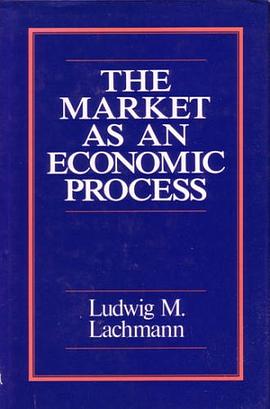
Review Article: The Market as an Economic Process
by Ludwig M. Lachmann.
New York: Basil Blackwell, 1986, pp. xii, 173.
Ludwig M. Lachmann has been writing about markets for half a century. Having received his formal education in Germany by the early 1930s, Lachmann went to England where, along with fellow student G. L. S. Shackle, he studied under Friedrich A. Hayek. After writing and lecturing for some years in London, he settled in at the University of Witwatersrand in Johannesburg, South Africa for several decades of continued scholarship.
Until the mid 1970s Lachmann was known to Americans only through his writings, and his influence on American economics was not great. But in 1974 he was one of three lecturers featured at a conference on Austrian economics held in South Royalton, Vermont and sponsored by the Institute for Humane Studies. Beginning in 1975 and largely as a result of the South Royalton lectures, Professor Lachmann has taught each spring semester at New York University, returning to Johannesburg for the remainder of the year.(1)
The Market as an Economic Process, itself the result of a process that began several years ago, serves as the major focus of this review. A second volume, Subjectivism, Intelligibility, and Economic Understanding: Essays in Honor of Ludwig M. Lachmann on his Eightieth Birthday (New York: New York University Press, 1986), plays a minor role. Because of the diversity of the twenty three papers that make up this birthday offering, no comprehensive account can be undertaken. But two of those papers, one by the reviewer, will aid in linking the arguments in Lachmann's own book to an important issue that has captured the attention of Lachmann and his readers for the last several years: the presence—or absence—in the market process of a tendency toward equilibrium. But before dealing with this or any other substantive issue, let me focus attention on Lachmann's vision (as Joseph Schumpeter used the term) of the market economy.
作者简介
The German economist, Ludwig Lachmann, was a product of the 1930s L.S.E. - but an extreme product. Of the mixed "Continental" fare that the LSE offered, Lachmann took the Austrian School paradigm and ran with it. Devoutly dedicated to Menger's original vision of an entirely subjective economics, Lachmann attempted to detach the Austrian paradigm from its Walrasian and Jevonian companions. His early training at the hands of Werner Sombart and his prediliction for Weber had a methodological effect: Austrian Theory, Lachmann concluded, was to be characterized as a "genetic-causal" approach, a "verstende" view of social science to be wrought against the mathematical-functional, equilibrium, perfect- foresight approach of mainstream Neoclassical economics.
The "fundentalist Austrianism" of Lachmann was unique at the time - none of the then living Austrian economists really acknowledged their work to be as different from the mainstream as Lachmann claimed. But his work stressed all the points he thought distinctive: subjectivism, expectations, uncertainty, the Hayekian cycle, time-defined capital, methodological individualism, alternative cost and, above all, "market process". Although Lachmann was effectively "exiled" from economics while at Witwatersrand in South Africa, his work was highly influential upon the later "American branch" of the Austrian School. His work on capital theory (1956) resonates issues which were soon to be taken up in the Cambridge Capital Controversy.
目录信息
读后感
用户评价
老实说,我拿到这本书时,主要抱着一种探索不同学派思想碰撞的期待。我希望它不是那种只停留在教科书层面的标准阐释,而是能提供一种批判性的审视。尤其是在当前全球贸易保护主义抬头、地缘政治冲突加剧的背景下,市场作为一种“过程”的稳定性受到了前所未有的挑战。作者是否有勇气去质疑那些被奉为圭臬的效率最优假设?我关注他如何处理创新与垄断之间的辩证关系,因为在技术快速迭代的时代,早期的市场先驱往往会迅速形成强大的市场壁垒,这是否违背了初衷?这本书若能提供一些深刻的洞察,比如阐明在哪些关键节点,市场失灵的成本会指数级增长,并提出一些具有前瞻性的政策干预思路,哪怕是极具争议性的,也比平庸的总结要强得多。我更看重其对未来趋势的预测能力,而非对既有理论的复述。
这本书的潜在价值,在我看来,在于它能否超越纯粹的经济学范畴,触及社会学和政治学的交叉领域。市场经济并非悬浮于真空中的抽象概念,它深深植根于特定的法律体系、文化习惯和权力结构之中。因此,一个成熟的论述,必须探讨这些非经济因素如何形塑了市场的“过程”。比如,不同文化背景下的契约精神如何影响了交易成本和市场信任度的建立?政府角色的模糊边界——究竟是市场秩序的维护者,还是潜藏的寻租者——是如何影响资源流动的效率?如果作者能对这些深层次的社会结构性问题进行富有洞察力的探讨,这本书的学术地位无疑会大大提升。我希望它能提供一个多维度的分析框架,而非仅仅局限于新古典或奥地利学派的单一视角。
从阅读体验的角度来说,我最怕的是那种堆砌术语、晦涩难懂的学术著作。虽然主题宏大,但好的经济学著作应当是“可读”的,能够让非专业读者也能领略到市场运作的精妙。我希望作者在构建其论述框架时,能够巧妙地运用比喻和生动的例子来阐释复杂的动态均衡概念。比如,市场价格的形成过程,能不能被描绘成一场永不停歇的、由亿万决策者参与的“电子游戏”?这种描述性的语言,辅以严谨的逻辑推导,能极大地增强读者的代入感。如果能有配套的图表或模型可视化,帮助读者直观理解例如“路径依赖”或“网络外部性”这类概念的演化路径,那简直太棒了。毕竟,理解“过程”本身,比理解某个静态的“结果”要困难得多,需要更具引导性的叙述技巧。
这部作品的书名读起来颇具学术气象,让人联想到对宏观经济运行机制的深入剖析。我期望它能像一位经验丰富的建筑师绘制蓝图一样,细致入微地展现市场这台庞大机器是如何从最基础的供需互动,逐步构建起复杂的价格体系和资源配置网络。我特别关注作者如何处理信息不对称和外部性这些市场失灵的经典问题,是倾向于用更偏向古典学派的“看不见的手”的自洽性来解释,还是会采纳新制度经济学的视角,强调产权和制度设计在优化市场效率中的关键作用。如果能看到一些将抽象理论与当代真实案例相结合的论证,例如对新兴数字市场或全球供应链重塑的分析,那将是极大的加分项。我希望能看到清晰的逻辑链条,它不仅仅是罗列各种经济学模型,而是能将这些模型编织成一个连贯的故事,解释为什么市场在不同的社会背景和监管环境下,会展现出如此多样且动态的“过程”特征。
我特别期待作者能处理好“时间”这个维度在市场过程中的核心地位。经济学往往倾向于简化时间,但在现实中,市场预期、信息滞后和投资决策的不可逆性,都使得“过程”充满了不确定性。这本书如果能着重探讨市场如何消化和整合未来信息,以及这种信息处理机制如何导致了周期性的繁荣与萧条,那将是非常有价值的。我希望能看到关于“企业家精神”和“创造性破坏”在市场动态演进中的驱动作用的深入讨论。这种动态视角,要求作者必须具备极强的历史感和对复杂系统演化的深刻理解。如果最终呈现的是一幅动态的、不断自我修正和进化的市场画卷,那么这本书就真正配得上“过程”这个关键词了。