
具体描述
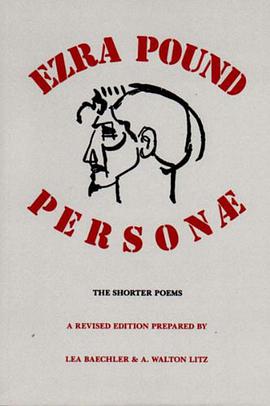
A new edition of Pound's groundbreaking shorter poems.
If the invention of literary modernism is usually attributed to James Joyce, T. S. Eliot and Ezra Pound, it was Pound alone who provided (in Hugh Kenner's words) "the synergetic presence") to convert individual experiment into an international movement. In 1926 Pound carefully sculpted his body of shorter poems into a definitive collection which would best show the concentration of force, the economy of means, and the habit of analysis that were, to him, the hallmarks of the new style.This collection, where Pound presented himself in a variety of characters or "masks," was called Personae. In 1926, Personae's publication gave solidity to a movement today the work stands as one of the classic texts of the twentieth century. Pound scholars Lea Baechler (of Columbia) and A. Walton Litz (Holmes Professor of English Literature at Princeton) have prepared a corrected text and supplied an informative "Note on the Text" explaining both Pound's original criteria for his selection and the volume's subsequent history.
作者简介
Ezra Weston Loomis Pound (30 October 1885 – 1 November 1972) was an expatriate American poet and critic, and a major figure in the early modernist poetry movement. His contribution to poetry began with his development of Imagism, a movement derived from classical Chinese and Japanese poetry, stressing clarity, precision and economy of language. His works include Ripostes (1912), Hugh Selwyn Mauberley (1920) and the unfinished 120-section epic, The Cantos (1917–1969). Pound worked in London during the early 20th century as foreign editor of several American literary magazines, and helped discover and shape the work of contemporaries such as T. S. Eliot, James Joyce, Robert Frost and Ernest Hemingway.[a] Angered by the carnage of World War I, Pound lost faith in Great Britain and blamed the war on usury and international capitalism. He moved to Italy in 1924 and throughout the 1930s and 1940s embraced Benito Mussolini's fascism, expressed support for Adolf Hitler, and wrote for publications owned by the British fascist Sir Oswald Mosley. During World War II, he was paid by the Italian government to make hundreds of radio broadcasts criticizing the United States, Franklin D. Roosevelt and Jews, as a result of which he was arrested in 1945 by American forces in Italy on charges of treason. He spent months in detention in a U.S. military camp in Pisa, including three weeks in a 6-by-6-foot (1.8 by 1.8 m) outdoor steel cage, which he said triggered a mental breakdown: "when the raft broke and the waters went over me". The following year he was deemed unfit to stand trial, and incarcerated in St. Elizabeths psychiatric hospital in Washington, D.C., for over 12 years. Pound began work on sections of The Cantos while in custody in Italy. These parts were published as The Pisan Cantos (1948), for which he was awarded the Bollingen Prize in 1949 by the Library of Congress, leading to enormous controversy. Largely due to a campaign by his fellow writers, he was released from St. Elizabeths in 1958 and returned to live in Italy until his death. His political views ensure that his work remains as controversial now as it was during his lifetime; in 1933 Time magazine called him "a cat that walks by himself, tenaciously unhousebroken and very unsafe for children". Hemingway wrote: "The best of Pound's writing—and it is in the Cantos—will last as long as there is any literature."
目录信息
读后感
用户评价
说实话,最初拿起这本书时,我对其抱持着一丝谨慎的态度,担心它会沦为故作高深的圈内读物。但事实证明,这种担忧是多余的。尽管文学性极强,但它内核的故事性依然非常扎实,人物的命运牵动人心,引人入胜的程度丝毫不亚于最顶级的商业小说。真正令人惊喜的是,它成功地做到了艺术性与可读性的完美平衡。你可以在享受流畅阅读体验的同时,不知不觉地吸收了作者精心编织的复杂信息和深刻见解。这种“润物细无声”的教育意义,远胜过那些说教式的作品。它让你在不知不觉中,完成了精神层面的拓展和升级,读完之后,感觉自己对世界和人性的理解,都拓宽了一个新的维度。
对于那些追求深度阅读体验的读者来说,这本书提供了一个极佳的思考平台。它所探讨的主题宏大而复杂,触及了存在主义、社会结构批判以及个体自由意志等多个哲学层面。作者并不急于给出答案,而是巧妙地设置了多重叙事线索,让读者在追踪故事发展的过程中,不断地被引导去质疑既有的观念。我尤其欣赏作者处理矛盾冲突的方式,不是用简单的二元对立来解决问题,而是呈现出一种灰色地带的模糊美学。每一次看似清晰的结论,都被下一个情节的出现所瓦解,迫使我们不得不审视自己最初的判断是否过于草率。这是一本需要静下心来,带着批判性思维才能真正领略其精妙之处的作品。
这本书的叙事方式实在太引人入胜了,它仿佛不是在讲述一个故事,而是在邀请你亲自走进那个错综复杂的世界。作者对人物内心的细腻刻画,那种抽丝剥茧的心理描写,让我时常停下来反复咀嚼。那些看似微不足道的细节,却在后文产生了巨大的回响,足见作者布局之深远。读到某些转折点时,我甚至能真切地感受到主角内心的撕裂与挣扎,那种情感的冲击力是如此强烈,以至于合上书本后仍久久不能平复。它成功地构建了一个既熟悉又陌生的环境,让我不断地思考,现实与虚构的边界究竟在哪里。阅读的过程更像是一场智力上的探险,每一次翻页都充满了对未知的好奇与期待。这本书毫不留情地揭示了人性深处的幽暗与光辉,没有给予简单的善恶判断,而是将选择的重担压在了读者心头,这种成熟的叙事态度值得称赞。
这本书的结构设计简直可以被视为文学技巧的教科书范例。它打破了传统线性的叙事框架,采用了碎片化、多视角的叙事手法,这种处理方式初看可能会让人有些吃力,需要读者付出额外的注意力去拼凑全局的图景。然而,一旦你适应了这种节奏,就会发现这种“拼图”的过程本身就是阅读乐趣的一部分。各个分散的片段如同散落的宝石,只有在被精心拾起并放置到正确的位置时,才能展现出它们完整的光芒。作者对时间跨度的驾驭能力尤为出色,能够在瞬间完成数十年的跨越,又能在一秒钟的对视中浓缩复杂的情感史。这种高超的叙事控制力,让故事的张力始终保持在一个极高的水准线上。
我必须说,这本书的文笔极其华丽,但这种华丽绝非空洞的辞藻堆砌,而是服务于主题和氛围的精准表达。句子结构的多变性令人惊叹,时而如行云流水般舒展自如,时而又像骤然收紧的弓弦般充满张力。作者对于场景描写的功力,简直到了令人发指的地步,无论是宏大的历史场景,还是狭小空间内的私密对话,都描绘得栩栩如生,仿佛空气中弥漫着那个时代的尘土和气味。这种极具画面感的文字,极大地增强了阅读的沉浸感。更难得的是,在如此精雕细琢的语言之下,故事的节奏感却把握得恰到好处,没有丝毫拖沓之感。它像一首精心编排的交响乐,每一个音符、每一次停顿,都精确地服务于整体的情感释放。
like this: Spring..... Too long...... Gongula.... 太好看了!!!
like this: Spring..... Too long...... Gongula.... 太好看了!!!
like this: Spring..... Too long...... Gongula.... 太好看了!!!
like this: Spring..... Too long...... Gongula.... 太好看了!!!
like this: Spring..... Too long...... Gongula.... 太好看了!!!