
具体描述
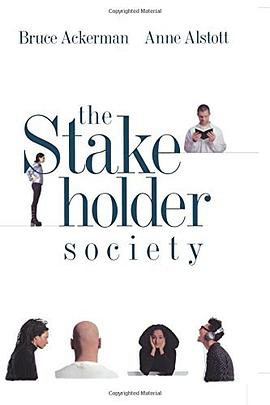
A quarter century of trickle-down economics has failed. Economic inequality in the United States has dramatically increased. Many, alas, seem resigned to this growing chasm between rich and poor. But what would happen, ask Bruce Ackerman and Anne Alstott, if America were to make good on its promise of equal opportunity by granting every qualifying young adult a citizen’s stake of eighty thousand dollars? Ackerman and Alstott argue that every American citizen has the right to share in the wealth accumulated by preceding generations. The distribution of wealth is currently so skewed that the stakeholding fund could be financed by an annual tax of two percent on the property owned by the richest forty percent of Americans.
Ackerman and Alstott analyze their initiative from moral, political, economic, legal, and human perspectives. By summoning the political will to initiate stakeholding, they argue, we can achieve a society that is more democratic, productive, and free. Their simple but realistic plan would enhance each young adultís real ability to shape his or her own future. It is, in short, an idea that should be taken seriously by anyone concerned with citizenship, welfare dependency, or social justice in America today.
作者简介
Bruce Ackerman is Sterling Professor of Law and Political Science at Yale, and the author of fifteen books that have had a broad influence in political philosophy, constitutional law, and public policy. His major works include Social Justice in the Liberal State and his multivolume constitutional history, We the People. His most recent books are The Failure of the Founding Fathers (2005) and Before the Next Attack (2006). His book, The Stakeholder Society (with Anne Alstott), served as a basis for Tony Blair’s recent introduction of child investment accounts in the United Kingdom. Professor Ackerman is a member of the American Law Institute and the American Academy of Arts and Sciences. He is a Commander of the French Order of Merit, and the recipient of the American Philosophical Society’s Henry Phillips Prize for Lifetime Achievement in Jurisprudence. He received his B.A. from Harvard University and his LL.B from Yale Law School.
目录信息
读后感
the stakeholder society: " For a person who will live to age 80 and with a rate of interest of 6 percent, a stake of $80,000 at age 21 is equivalent to an annual demogrant of $5,000 for the rest of one's life." "Our first concern ...
the stakeholder society: " For a person who will live to age 80 and with a rate of interest of 6 percent, a stake of $80,000 at age 21 is equivalent to an annual demogrant of $5,000 for the rest of one's life." "Our first concern ...
the stakeholder society: " For a person who will live to age 80 and with a rate of interest of 6 percent, a stake of $80,000 at age 21 is equivalent to an annual demogrant of $5,000 for the rest of one's life." "Our first concern ...
the stakeholder society: " For a person who will live to age 80 and with a rate of interest of 6 percent, a stake of $80,000 at age 21 is equivalent to an annual demogrant of $5,000 for the rest of one's life." "Our first concern ...
the stakeholder society: " For a person who will live to age 80 and with a rate of interest of 6 percent, a stake of $80,000 at age 21 is equivalent to an annual demogrant of $5,000 for the rest of one's life." "Our first concern ...
用户评价
读完这本书,我的感觉是,它更像是一场酣畅淋漓的智力体操,迫使你不断地跳出舒适区,去审视那些你以为早已了然于胸的概念。这本书的结构设计非常大胆,它没有采用传统的“导论-主体-结论”的线性叙事,而是采取了一种螺旋上升的方式,每当我觉得自己快要抓住核心论点时,作者总会引入一个看似无关的哲学思辨,然后猛地将视角拉回到现实的商业伦理困境中。我尤其欣赏作者对“价值创造”这一词汇的颠覆性诠释。在传统的经济学语境下,价值往往被量化为利润或股东回报,但在这本书里,价值被延展到了生态修复、员工福祉、乃至社区精神层面的提升。这种对定义权的争夺,正是利益相关者博弈的核心所在。我清晰地记得,在某一章讨论跨文化管理时,作者引用了大量来自于非西方语境的案例,这使得全书的讨论摆脱了西方中心主义的窠臼,充满了世界性的张力。尽管部分理论推导略显晦涩,需要反复阅读才能完全领会其深意,但这恰恰是它价值所在——它要求读者付出努力,去换取更高层次的洞察。它不是一本用来放松的读物,而是一本需要你携带笔和笔记本才能“驯服”的经典。
坦白讲,我一开始对这本书是持怀疑态度的,毕竟“利益相关者”这个词已经被用得太泛滥了,很多企业报告里都会拿来充数。然而,这本书的独特之处在于,它将所有看似松散的理论要素,用一种极其坚韧的逻辑丝线串联了起来。它不是在描述“应该”如何做,而是在细致入微地剖析“实际上”是如何被操作的。书中关于“信息不对称性”与“道德风险”在多方利益主体间的传导机制分析,简直是教科书级别的精彩。我特别留意了作者是如何处理那些处于弱势地位的利益相关者,比如供应链末端的劳工,或者被边缘化的本地居民。作者没有使用廉价的同情,而是通过一系列严谨的案例,展示了即便是微弱的声音,在特定的组织和时机下,也能汇聚成足以撼动巨型机构的压力。这本书对“透明度”的讨论也极其深刻,它指出,过度的、不加区分的透明度反而可能成为一种武器,被强势方用来误导或打击弱势方。这种对信息流动复杂性的洞察,让我对未来阅读任何商业新闻时都带上了一层审慎的滤镜。
这本厚重的《利益相关者社会》初捧在手,便被其封面那张复杂交织的图谱所吸引。它似乎在预示着,我们将要踏入的,是一个由无数利益节点构成的迷宫。我最初的期望,是能在这本书中找到一套清晰的框架,用以梳理和解析现代社会中那些错综复杂的关系网。阅读过程中,我最大的感受是作者对“权力边界”这个概念的精妙拆解。他没有采用那种高屋建瓴的宏观叙事,而是深入到具体的企业治理、社区动员乃至跨国谈判的微观场景中,展现了利益相关者们如何通过微妙的博弈,一点点蚕食或重塑着既有的权力结构。书中关于“隐性契约”的论述尤其引人深思,它揭示了许多公开决策背后,那些不被言说的、基于信任和恐惧的动态平衡是如何维系的。我花了相当长的时间去消化那些案例分析,尤其是关于一家老牌制造业公司在面对环保激进主义团体时的策略转变,那不仅仅是公关技巧的较量,更是对“社会责任”这一概念内涵的重新定义。作者的笔触冷静而克制,很少有情绪化的宣泄,更多的是一种近乎人类学家的观察视角,让人在阅读时总能保持一种审视和反思的状态,而不是轻易地被某种单一的意识形态所裹挟。这本书更像是一面镜子,映照出我们日常生活中那些被视为理所当然的社会运作机制的脆弱性和可塑性。
从结构上看,这本书的叙事弧线非常具有张力。它开篇就抛出了一个悖论性的情境,然后用接下来的章节层层递进,不断加深这个悖论的复杂性。我印象最深的是作者对“系统韧性”的论述,这并非仅仅指组织能够承受冲击的能力,更是指系统在面临根本性挑战时,能否自我革新、吸纳异见的能力。书中的理论模型虽然复杂,但作者总能找到恰当的类比来帮助理解,例如将利益相关者关系比作一个不断自我校准的复杂生态系统,而不是一个静态的机械结构。这种有机体的视角,为理解当代社会危机提供了一个强有力的分析工具。阅读过程中,我常常停下来,思考自己作为某个组织的一份子,究竟处于哪个节点,我的行为又会如何影响到那些我甚至从未谋面的“相关者”。这本书的真正价值,不在于它提供了多少明确的答案,而在于它成功地将一个原本模糊、常常被滥用的概念,打磨成了一把锋利无比的分析手术刀,让你有勇气去解剖那些潜藏在光鲜报表之下的真实权力交易和道德权衡。
这本书的阅读体验,用“挑战”二字来形容最为贴切。它的篇幅令人望而生畏,但一旦进入其构建的世界观,便会发现其内部的严密性远超想象。我发现作者在叙事中巧妙地运用了多种文体风格的切换,时而像一个冷静的社会学家,陈列数据和模型;时而像一位富有洞察力的哲学家,探讨责任的本质;偶尔,甚至会穿插一些极其生动的商业轶事,仿佛是为你讲述一个发生在隔壁办公室的秘密谈判。这种文体上的多样性,有效地避免了学术著作可能带来的枯燥感。我个人认为,书中关于“长期主义”的重新界定时点非常具有前瞻性。它不再将长期主义简单地等同于五到十年后的业绩,而是将其与地球生态系统的承载力、代际公平性等宏大尺度挂钩。这使得讨论的维度被无限拓宽,迫使读者必须跳出季度报告的窠臼。如果你期待一本能提供快速解决方案的“管理圣经”,这本书可能会让你失望;但如果你渴望理解现代社会权力运作的底层逻辑,那么它无疑是近十年来最深刻的文本之一。