
具体描述
From Publishers Weekly
Dividing the century into two avant-gardes, the author passes on the one that runs from Picasso to Pollock and lays claim to another that begins with Duchamp and continues through Warhol into the present, a new avant-garde whose praxis will be bound to theory not metaphor. Foster, who teaches art history and comparative literature at Cornell and is an editor of the journal October, claims for his generation of cultural theorists, who came of age in the wake of minimalist and conceptual art, the primacy of ideas with their potential connection to real political time and space over objects. Following the leads of Althusser and Lacan, he urges structuralist re-readings of radical texts (including art) for content that breaks with "our decentered relations to the language of our unconscious" and "humanist problems of alienation." A chapter on recent "abject art" (like Mike Kelley and John Miller) finds interest in its surrealist-style rebellion to be as limited as ever by adolescent anarchical antics. For more productive models, Foster advocates the work of Renee Green, Mary Kelly, Fred Wilson?artists whose interdisciplinary approach bridges art, anthropology and ethnology. Thus as the old academy of the studio is replaced by this new one of the seminar room, reading becomes a primary activity for all, including artists, critics and historians. This book, however, is heavy reading throughout, and not a sentence goes by without linguistic convolution bringing the mind to a halt and forcing a re-reading. It's a brilliant work, but outside the seminar room, most readers will quickly decide to give up the struggle.
Copyright 1996 Reed Business Information, Inc.
From Library Journal
Since the late 1950s, art and critical theory have been increasingly linked, both by artists themselves and by commentators. Editor of the journal October, Foster (art history and comparative literature, Cornell Univ.) discusses here a wide range of artists (including Andy Warhol, Robert Smithson, Barbara Kruger, Mike Kelley, and Cindy Sherman) to explore his ideation of the avant-garde and the regrounding of art in materiality. Focusing on art and artists active after 1960, Foster traces the movement from "art-as-text" in the 1970s, to "art-as-simulacrum" in the 1980s, to contemporary art that is moving more toward materiality. For those not conversant with the language and ideology of contemporary critical theory, Foster's discussion of developments since 1960 will be hard to follow. Recommended only for larger academic collections.?Martin R. Kalfatovic, Smithsonian Inst. Lib., Washington, D.C.
Copyright 1997 Reed Business Information, Inc.
Review
"The Return of the Real is one of the most cogent and theoretically self-aware readings of contemprary art I have seen."
—Howard Singerman, Department of Art History, University of Virginia
This examination of art and theory over the last three decades of avant-garde works considers both history and philosophy, presenting a scholarly and in-depth survey. Black and white reproductions of works by various artists pepper a survey which consider the controversies and issues of avant garde art and theory. -- Midwest Book Review
Product Description
"The Return of the Real is one of the most cogent and theoretically self-aware readings of contemprary art I have seen." -- Howard Singerman, Department of Art History, University of Virginia
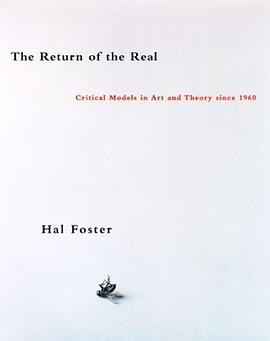
In The Return of the Real Hal Foster discusses the development of art and theory since 1960, and reorders the relation between prewar and postwar avant-gardes. Opposed to the assumption that contemporary art is somehow belated, he argues that the avant-garde returns to us from the future, repositioned by innovative practice in the present. And he poses this retroactive model of art and theory against the reactionary undoing of progressive culture that is pervasive today. After the models of art-as-text in the 1970s and art-as-simulacrum in the 1980s; Foster suggests that we are now witness to a return to the real -- to art and theory grounded in the materiality of actual bodies and social sites: If The Return of the Real begins with a new narrative of the historical avant-garde; it concludes with an original reading of this contemporary situation -- and what it portends for future practices of art and theory, culture and politics.
作者简介
Hal Foster is Professor of Art History and Comparative Literature at Cornell University. He is the author of several books, including The Anti-Aesthetic, Recording, and Compulsive Beauty, and an editor of the journal, October.
目录信息
读后感
用户评价
我对《The Return of the Real》的期待,更多地聚焦于其可能呈现的社会学洞察。在当下,我们见证了社交媒体的崛起,它在很大程度上重塑了人际交往、信息传播甚至自我认同的方式。许多人将自己的生活进行精心包装,呈现出一种理想化、甚至是不真实的形象,以此来获得关注和认同。这种现象是否会模糊真实的自我,甚至侵蚀个体独立思考的能力?我希望这本书能够深入探讨这种“去真实化”的趋势,以及它对个人和社会整体的潜在危害。书名中的“Real”是否代表着一种返璞归真,一种回归到更朴素、更真诚的人际互动模式,或者是一种对虚假繁荣的深刻反思?作者是否会描绘一个被过度消费主义和娱乐至死所裹挟的世界,然后展现出一种打破藩篱、重拾真切情感的力量?我尤其关注书中对于“真实”的衡量标准,是在物质层面,还是精神层面?是在个体选择上,还是集体认同上?我对作者能够描绘出充满张力的情节,以及塑造出能在虚假现实中坚持自我、追寻真实的鲜活人物抱有极大的信心,并渴望通过阅读这本书,获得对当下社会现象更深刻的理解。
《The Return of the Real》这个书名,给我一种强烈的预感,它可能是一本探讨“身份认同”的深刻作品。在如今这个信息碎片化、价值观多元化的时代,很多人都在努力寻找自己的定位,定义自己的“真我”。社交媒体上的“人设”,职业生涯的选择,人际关系的复杂性,都可能让我们感到迷失,甚至怀疑自己是谁。我猜想这本书可能会围绕着一个或一群人物展开,他们可能在某种程度上被迫或主动地去审视自己,去剥离那些被外界附加的标签和期待,最终找回那个最纯粹、最本真的自己,也就是书中所指的“Real”。这种回归是否意味着一种与过去的和解,一种对自我缺点的接纳?是否意味着摆脱了外界的评判,获得了内心的自由?我期待书中能够展现出人物在自我探索过程中的挣扎与成长,他们可能经历痛苦的认知,也可能找到意想不到的答案。这种关于“成为自己”的故事,总是能够引起我的共鸣,因为这本身就是人生中永恒的课题。我会关注书中人物如何处理内心的冲突,如何面对外部的压力,以及最终他们是如何定义和拥抱自己的“Real”的。
读到《The Return of the Real》的书名,我脑海中立刻浮现出一种怀旧的、甚至是有些伤感的画面。在当下的社会,我们似乎越来越依赖于效率、便利和即时满足,而那些需要耐心、需要沉淀、需要付出真挚情感才能获得的东西,却被渐渐遗忘。比如,一封手写的信,一次面对面的深入交谈,或者一次全身心投入的艺术创作。我猜想这本书可能是在某种程度上唤醒我们对这些“老派”价值的重新认知。它或许描绘了一个充斥着快餐文化和浅层交流的世界,然后通过某个契机,让主人公重新接触到那些被遗忘的、充满温度的“Real”。这种回归是否意味着找回了我们内心深处的平静与满足?是否意味着我们能够重新建立起更深刻、更有意义的人际关系?我期待书中能展现出一些充满诗意的细节,那些能够触动人心、唤醒共鸣的瞬间。它不一定需要惊心动魄的情节,但需要有足够的温度和深度,能够让我们在阅读的过程中,重新审视自己的生活方式,并渴望找回那份失落的、触手可及的真实。
《The Return of the Real》这个名字,让我想到了科幻小说中关于虚拟现实与真实世界界限模糊的经典母题。想象一下,如果我们的生活体验,我们的情感,甚至我们的记忆,都可以被编码、被复制,甚至被篡改,那么我们所认知的“真实”又意味着什么?我猜想这本书或许会以一个充满悬念的科幻设定为背景,描绘主人公在高度发达的科技环境中,逐渐质疑自己所处现实的真实性,并踏上一段寻找真相的旅程。这种旅程可能充满了惊险与挑战,需要他们去辨别信息的真伪,对抗强大的虚拟势力,最终找回属于自己的、无可辩驳的“Real”。我好奇作者会如何构建这个科技世界,它的规则是怎样的?人类在其中扮演了怎样的角色?是主宰者,还是被操纵者?而“The Return of the Real”在这个语境下,是否意味着一种对科技过度发展的警示,一种对人性根本需求的回归?我会非常期待书中对科技伦理的探讨,以及主人公在面临选择时所展现出的勇气和智慧。这种带有哲学思辨的科幻故事,往往能引发读者对自身生存状态的深刻反思。
这本书的书名《The Return of the Real》就足以让人产生强烈的联想,它似乎在预示着某种失落事物的回归,或是对当下某种虚假状态的挑战。我一直以来都对那些能够深刻探讨“真实”与“虚幻”边界的叙事充满了好奇。在这个信息爆炸、虚拟现实技术飞速发展的时代,我们身处的现实似乎变得越来越模糊,越来越容易被精心构建的替代品所取代。我尤其感兴趣的是,作者将如何定义这个“Real”,它是在哲学意义上的本体论真实,还是在个体感知层面的主观真实?亦或是两者兼而有之?书名中“Return”这个词也暗示了一种过往的遗忘,一种被现代化进程所掩盖或消解的真实,而现在,它又以某种形式重新浮现。我期待作者能够构建一个引人入胜的故事,通过人物的经历、情节的发展,或者对某个特定领域的深入剖析,来揭示这种“真实”的本质,以及它回归的原因和可能带来的影响。这种回归是积极的,意味着找回了失落的根基,还是带有警示意味,迫使我们正视被忽视的现实?这种开放性的提问,让我迫不及待地想翻开这本书,去寻找属于我自己的答案。
对于当代艺术批评家而言,理论不过是蛋糕上的奶油罢了
对于当代艺术批评家而言,理论不过是蛋糕上的奶油罢了
The Crux of Minimalism
对于当代艺术批评家而言,理论不过是蛋糕上的奶油罢了
The Crux of Minimalism