
具体描述
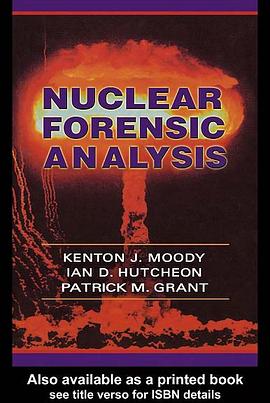
This book provides a primary reference source for nuclear forensic science, including the vastly disciplinary nature of the overall endeavor for questioned weapons of mass-destruction specimens. Nothing like this exists even in the classified material. For the first time, the fundamental principles of radioforensic analysis, all pertinent protocols and procedures, computer modeling development, interpretational insights, and attribution considerations are consolidated into one convenient source. The principles and techniques so developed are then demonstrated and discussed in their applications to real-world investigations and casework conducted over the past several years.
作者简介
Kenton J.Moody earned a bachelor of science degree in physical chemistry from the
University of California at Santa Barbara in 1977. He attended graduate school at UC
Berkeley, where he studied with Nobel Laureate Glenn Seaborg (the discoverer of
plutonium), and received a Ph.D. in 1983 with a specialty in actinide radiochemistry.
Following a two-year stay at the Gesellschaft fuer Schwerionenforschung (a German
accelerator laboratory), he joined the Nuclear Chemistry Division at Lawrence Livermore
National Laboratory (LLNL) in 1985, where he has performed extensive diagnostic
radiochemical measurements in support of various national security programs.
He is currently the technical lead for two research groups at LLNL, one focused on the
radiochemistry of the weapons in the U.S. nuclear stockpile and the other on basic
research on the heaviest elements (the latter in collaboration with physicists at accelerator
laboratories in the former Soviet Union). In addition to numerous classified reports
detailing the performance of nuclear explosive devices, he has co-authored more than
ninety refereed journal publications in the subject areas of the decay properties of the
heaviest elements, nuclear reaction mechanisms, fission, and nuclear structure. He has
co-discovered four chemical elements and more than three dozen heavy-element isotopes.
Ian Hutcheon is currently the deputy director of the Glenn T.Seaborg Institute and the
scientific capability leader for chemical and isotopic signatures in the Chemical Biology
and Nuclear Science Division at the Lawrence Livermore National Laboratory. Prior to
this position, he was a Senior Research Associate in the Division of Geological and
Planetary Science at the California Institute of Technology in Pasadena. His technical
training is in physics and geochemistry: he received an A.B. at Occidental College in
1969 and a Ph.D. in physics from the University of California at Berkeley in 1975. He
then spent two years as a post-doctoral fellow and five years as a senior research
associate in the Enrico Fermi Institute at the University of Chicago.
He has authored over 100 publications in peer-reviewed journals in the areas of
secondary-ion mass spectrometry, the early history of the solar system, and nuclear
forensic analysis. He also serves on the review panels of the NASA Cosmochemistry
Program and the Sample Return Laboratory Instruments and Data Analysis Program. He
is a member of the American Geophysical Union, the Meteoritic Society, and the
Microbeam Analysis Society.
Patrick M.Grant earned B.S. (1967) and Ph.D. (1973) degrees in chemistry from the
University of California. He worked in radiochemistry and nuclear medicine at Los
Alamos National Laboratory for eight years, and was an associate group leader for
medical radioisotope research and production. He then spent two years in the oil, gas, and
minerals industry at Chevron Research Company. He has been a staff member at
Livermore National Laboratory since 1983, serving as the deputy director and special
operations and samples manager of the Forensic Science Center. Pat has also held
positions as a senior nuclear reactor operator and as an adjunct university professor of
chemistry. He has served as a subgroup member of the U.S. National Security Council’s
Coordinating Committee on Terrorism and is a member of Livermore’s Emergency
Response Team. He is also a charter member of the FBI Scientific Working Group on the
Forensic Analysis of Radiological Materials.
In addition to numerous classified and law-enforcement reports, he has authored or co-
authored more than 100 refereed publications in the open literature in the subject areas of
chemistry, physics, nuclear medicine, thermodynamics, spectroscopy, forensic science,
and incident analysis. He has won the Health Physics Society’s Silverman Award in
radiobiology and a Department of Energy Award of Excellence. He is a Fellow of both
the American Academy of Forensic Sciences and the American College of Forensic
Examiners International, and is a member of the editorial board of the Journal of
Forensic Sciences. One of his unclassified investigations, a scientific explanation for the
Riverside Hospital Emergency Room “Mystery Fumes” incident, has been highlighted in
popular magazines and been the subject of world-wide television features.
目录信息
1 Introduction 1
2 Physical Basis of Nuclear Forensic Science 13
3 Engineering Issues 78
4 Chemistry and Nuclear Forensic Science 151
5 Principles of Nuclear Explosive Devices 166
6 Chronometry 178
7 Techniques for Small Signatures 218
8 Collateral Forensic Indicators 251
9 Sample Matrices and Collection 259
10 Radiochemical Procedures 270
11 Inorganic/Isotopic Sample Preparation 279
12 Organic Sample Preparation 284
13 Extraordinary Sample Issues 287
14 Field Collection Kits 289
15 NDA Field Radioactivity Detection 293
16 Laboratory Analyses 299
17 Inferred Production Estimates 325
18 Materials Fingerprinting 333
19 Source and Route Attribution 338
20 Forensic Investigation of a Highly Enriched Uranium Sample 354
Interdicted In Bulgaria
21 Counterforensic Investigation of U.S. Enrichment Plants 373
22 Nuclear Smuggling Hoax—D-38 Counterweight 397
23 Nuclear Smuggling Hoax—Sc Metal 400
24 Fatal “Cold Fusion” Explosion 402
----------------------- Page 18-----------------------
25 Questioned Sample from the U.S. Drug Enforcement Agency 408
Index 421
· · · · · · (收起)
读后感
用户评价
这是一本需要你投入时间和精力的书,但回报绝对是巨大的。它不是那种快速浏览就能掌握的轻松读物,因为它要求读者对分析化学和基础物理有基本的认知,或者至少愿意在阅读过程中停下来查阅相关背景知识。我发现自己经常需要查阅一些关于特定放射性核素的性质,但这反而促使我进行更深层次的学习,形成了一个良性的知识循环。作者在讨论“区分天然铀和人工浓缩铀”的章节中,对中子活化分析和高精度质谱法的对比分析,简直是教科书级别的范例,展示了如何根据不同情景选择最优的分析策略。这本书的行文逻辑如同瑞士钟表般精密,各个章节之间过渡自然流畅,从宏观的政策背景到微观的原子结构,层层递进,让人心悦诚服。它成功地做到了,既满足了专业人士对精确性的要求,又对非专业领域的读者打开了一扇通往高深知识殿堂的大门,是近年来我读到的关于此类主题中最具深度和广度的著作之一。
这本书的结构设计极其巧妙,它不是那种平铺直叙的教科书,更像是精心策划的知识探险地图。从基础的核物理背景介绍开始,逐步深入到对不同类型放射性物质的现场采样技术,再到实验室内部的复杂仪器操作和数据解读。我最欣赏的是它在技术细节和宏观战略之间的平衡掌握。它不会让你迷失在冗长的公式推导中,而是会适时地抛出一个历史案例,说明为什么掌握了某一种特定的同位素分析技术,就可能改变一次重要的国际谈判走向。这种“技术服务于大局”的叙事方式,极大地提升了阅读的趣味性。对于我这种跨学科的学习者来说,这本书提供了一个完美的桥梁,让我得以用通俗易懂的方式理解核材料指纹背后的深层含义。它展现了科学的精确性是如何成为维护全球和平的隐形力量,读起来让人感到一种沉甸甸的责任感和对科学工作者深深的敬意。
说实话,一开始我以为这会是一本晦涩难懂的专业教材,毕竟涉及“核”和“取证”这种高精尖的词汇。没想到,它的叙事方式竟然带着一种引人入胜的悬疑色彩。作者的笔触非常细腻,他没有停留在理论的堆砌上,而是将复杂的分析流程融入到一个个假设性的、但又极其逼真的“场景”之中。比如,书中对早期钚材料的来源识别方法,描述得就像在看一部高智商犯罪片,每一步推理都建立在扎实的物理化学基础之上。我特别欣赏它对分析误差和不确定性的坦诚讨论,这使得整本书的论述显得异常可信和成熟,避免了任何“完美解决方案”的假象。读完后,我感觉自己对“科学证据在法律和政治博弈中的作用”有了更深刻的体会。它教会了我如何批判性地看待那些爆炸性的新闻报道背后的科学依据,真正去追问“这个数据是怎么得来的?”这本书的价值在于,它把顶尖的实验室工作,转化成了一种可以被理性探讨的知识体系,非常值得反复研读,每一遍都会有新的领悟。
这本书简直是本宝典!我最近沉迷于冷战时期的核武器发展史,这本书的内容简直是为我量身定做的。它深入浅出地讲解了核材料的追踪技术,那些复杂的化学分离过程和质谱分析方法,读起来居然一点都不枯燥。作者似乎对这个领域有着百科全书般的知识储备,每一个案例分析都详实得令人咋舌,让我这个门外汉都能大致勾勒出科学家们在实验室里如何抽丝剥茧,锁定核材料来源的整个过程。特别是关于同位素比例的讲解部分,简直是打开了我对原子核世界认知的一扇窗。我甚至能想象出那些研究人员在显微镜前,面对着微小的数据波动,如何从中解读出国家安全层面的重大信息。这本书的写作风格非常扎实,没有太多华丽的辞藻,却充满了专业人士的严谨与洞察力,让人在阅读时感觉自己也在进行一场高精度的科学侦探工作。它不仅仅是一本技术手册,更像是一部关于人类智慧如何对抗核扩散阴谋的史诗。我强烈推荐给所有对国际安全、材料科学以及精密分析技术感兴趣的朋友,读完之后你会发现,你对“证据链”的理解会提升到一个全新的维度。
我对这本书的排版和图表质量印象深刻,这对于一本偏向技术分析的书籍来说至关重要。清晰的流程图和高质量的核谱图简直是雪中送炭,它们将那些抽象的分析步骤具体化、视觉化了。如果仅仅是文字描述,我恐怕很难想象伽马射线谱图上那些尖锐的峰值究竟代表着什么。但有了这些精美的插图辅助,即便是面对涉及到复杂衰变链和半衰期计算的部分,我的理解速度也大大加快了。更棒的是,它似乎还隐晦地暗示了一些未来核侦测技术的发展方向,让我对这个领域保持了持续的关注热情。这本书的严谨程度体现了作者对读者的尊重,他们不满足于“差不多就行”,而是力求将每一个实验步骤的精髓都尽可能清晰地呈现出来。这套书的价值,绝对不是几百页纸张那么简单,它承载着一套严密的、经过实践检验的知识体系。