
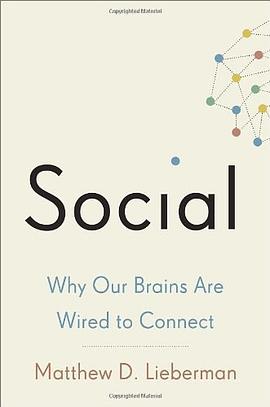

具體描述
We are profoundly social creatures – more than we know.
In Social , renowned psychologist Matthew Lieberman explores groundbreaking research in social neuroscience revealing that our need to connect with other people is even more fundamental, more basic, than our need for food or shelter. Because of this, our brain uses its spare time to learn about the social world – other people and our relation to them. It is believed that we must commit 10,000 hours to master a skill. According to Lieberman, each of us has spent 10,000 hours learning to make sense of people and groups by the time we are ten .
Social argues that our need to reach out to and connect with others is a primary driver behind our behavior. We believe that pain and pleasure alone guide our actions. Yet, new research using fMRI – including a great deal of original research conducted by Lieberman and his UCLA lab -- shows that our brains react to social pain and pleasure in much the same way as they do to physical pain and pleasure. Fortunately, the brain has evolved sophisticated mechanisms for securing our place in the social world. We have a unique ability to read other people’s minds, to figure out their hopes, fears, and motivations, allowing us to effectively coordinate our lives with one another. And our most private sense of who we are is intimately linked to the important people and groups in our lives. This wiring often leads us to restrain our selfish impulses for the greater good. These mechanisms lead to behavior that might seem irrational, but is really just the result of our deep social wiring and necessary for our success as a species.
Based on the latest cutting edge research, the findings in Social have important real-world implications. Our schools and businesses, for example, attempt to minimalize social distractions. But this is exactly the wrong thing to do to encourage engagement and learning, and literally shuts down the social brain, leaving powerful neuro-cognitive resources untapped. The insights revealed in this pioneering book suggest ways to improve learning in schools, make the workplace more productive, and improve our overall well-being.
作者簡介
Mathew D. Lieberman was trained at Harvard University and is a professor in the Departments of Psychology, Psychiatry, and Biobehavioral Sciences at the University of California, Los Angeles, and the founding editor of the journal Social Cognitive and Affective Neuroscience. In 2007, the American Psychological Association awarded him the Distinguished Scientific Award for an Early Career Contribution to Psychology, an award given to one social psychologist every two years. He is one of the foremost authorities in the world on the study of Social Neuroscience.
目錄資訊
讀後感
就像观察一个人要看ta的脸那样,了解一本书的主要内容就要翻看书的目录。当翻看这本书目录时,我瞥到了这个小标题:“为什么智商越高的人越不好相处”。我立刻被它吸引了——因为我的人际关系就没有那么理想,同时我也有志于学术,爱看书。 作者对那个小标题提出的问题所做出的...
評分本书集中探讨人类大脑的三种主要的适应,它们促使我们与社交圈联系得更加紧密,并且使我们能够更好地利用社会连接去建立更具凝聚力的团体和组织。简单的说,就是社交痛苦等同于物理痛苦、社交推理完全不同于非社交类型的推理、自我容易受到社会环境的强烈影响。 1. 我们天生就...
評分1、本来想一天读完三本书,没想到两天才读完这一本。被这本书吸引住了,读完很有收获。同时在阅读过程中,也有很多滞碍,主要是在速度与知识获取之间的平衡怎么来做?读书的技巧还需要再磨练。 2、这本书从大脑结构层面揭示了人类具有社会性的根源。大脑的结构是我比较感兴趣的...
評分1、本来想一天读完三本书,没想到两天才读完这一本。被这本书吸引住了,读完很有收获。同时在阅读过程中,也有很多滞碍,主要是在速度与知识获取之间的平衡怎么来做?读书的技巧还需要再磨练。 2、这本书从大脑结构层面揭示了人类具有社会性的根源。大脑的结构是我比较感兴趣的...
用戶評價
@2017-08-05 16:08:47
评分本書harmonize那一章寫得最齣色 覺得心理學隻要注意不被自己的局限性綁架 分析起來也是個很好玩的東西。雖然考試倒黴有段時間肚子難受得打顫沒有靜下心迴答問題…感覺自己看的知識都沒有很好的寫齣來…
评分too neuroscience for me
评分讓自己孤立著,比吸煙還要壞好多
评分我是很不愛社交的,看這本書大概是為瞭自虐吧。平心而論,還是給我帶來瞭很多新知,有瞭一些新角度看問題。雖然有些研究看瞭也撇嘴……
相關圖書







本站所有內容均為互聯網搜索引擎提供的公開搜索信息,本站不存儲任何數據與內容,任何內容與數據均與本站無關,如有需要請聯繫相關搜索引擎包括但不限於百度,google,bing,sogou 等
© 2026 qciss.net All Rights Reserved. 小哈圖書下載中心 版权所有