
具体描述
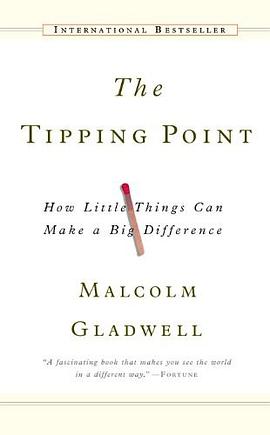
Book Description
This celebrated New York Times bestsellernow poised to reach an even wider audience in paperbackis a book that is changing the way North Americans think about selling products and disseminating ideas. Gladwells new afterword to this edition describes how readers can constructively apply the tipping point principle in their own lives and work. Widely hailed as an important work that offers not only a road map to business success but also a profoundly encouraging approach to solving social problems.
Amazon.com
"The best way to understand the dramatic transformation of unknown books into bestsellers, or the rise of teenage smoking, or the phenomena of word of mouth or any number of the other mysterious changes that mark everyday life," writes Malcolm Gladwell, "is to think of them as epidemics. Ideas and products and messages and behaviors spread just like viruses do." Although anyone familiar with the theory of memetics will recognize this concept, Gladwell's The Tipping Point has quite a few interesting twists on the subject.
For example, Paul Revere was able to galvanize the forces of resistance so effectively in part because he was what Gladwell calls a "Connector": he knew just about everybody, particularly the revolutionary leaders in each of the towns that he rode through. But Revere "wasn't just the man with the biggest Rolodex in colonial Boston," he was also a "Maven" who gathered extensive information about the British. He knew what was going on and he knew exactly whom to tell. The phenomenon continues to this day--think of how often you've received information in an e-mail message that had been forwarded at least half a dozen times before reaching you.
Gladwell develops these and other concepts (such as the "stickiness" of ideas or the effect of population size on information dispersal) through simple, clear explanations and entertainingly illustrative anecdotes, such as comparing the pedagogical methods of Sesame Street and Blue's Clues, or explaining why it would be even easier to play Six Degrees of Kevin Bacon with the actor Rod Steiger. Although some readers may find the transitional passages between chapters hold their hands a little too tightly, and Gladwell's closing invocation of the possibilities of social engineering sketchy, even chilling, The Tipping Point is one of the most effective books on science for a general audience in ages. It seems inevitable that "tipping point," like "future shock" or "chaos theory," will soon become one of those ideas that everybody knows--or at least knows by name.
--Ron Hogan
From Publishers Weekly
The premise of this facile piece of pop sociology has built-in appeal: little changes can have big effects; when small numbers of people start behaving differently, that behavior can ripple outward until a critical mass or "tipping point" is reached, changing the world. Gladwell's thesis that ideas, products, messages and behaviors "spread just like viruses do" remains a metaphor as he follows the growth of "word-of-mouth epidemics" triggered with the help of three pivotal types. These are Connectors, sociable personalities who bring people together; Mavens, who like to pass along knowledge; and Salesmen, adept at persuading the unenlightened. (Paul Revere, for example, was a Maven and a Connector). Gladwell's applications of his "tipping point" concept to current phenomena--such as the drop in violent crime in New York, the rebirth of Hush Puppies suede shoes as a suburban mall favorite, teenage suicide patterns and the efficiency of small work units--may arouse controversy. For example, many parents may be alarmed at his advice on drugs: since teenagers' experimentation with drugs, including cocaine, seldom leads to hardcore use, he contends, "We have to stop fighting this kind of experimentation. We have to accept it and even embrace it." While it offers a smorgasbord of intriguing snippets summarizing research on topics such as conversational patterns, infants' crib talk, judging other people's character, cheating habits in schoolchildren, memory sharing among families or couples, and the dehumanizing effects of prisons, this volume betrays its roots as a series of articles for the New Yorker, where Gladwell is a staff writer: his trendy material feels bloated and insubstantial in book form. Agent, Tina Bennett of Janklow & Nesbit. Major ad/promo. (Mar.)
From Library Journal
This genial book by New Yorker contributor Gladwell considers the elements needed to make a particular idea take hold. The "tipping point" (not a new phrase) occurs when something that began small (e.g., a few funky kids in New York's East Village wearing Hush Puppies) turns into something very large indeed (millions of Hush Puppies are sold). It depends on three rules: the Law of the Few, the Stickiness Factor, and the Power of Context. Episodes subjected to this paradigm here include Paul Revere's ride, the creation of the children's TV program Sesame Street, and the influence of subway shooter Bernie Goetz. The book has something of a pieced-together feel (reflecting, perhaps, the author's experience writing shorter pieces) and is definitely not the stuff of deep sociological thought. It is, however, an entertaining read that promises to be well publicized. Recommended for public libraries.
-Ellen Gilbert, Rutgers Univ. Lib., New Brunswick, NJ
From Booklist
Gladwell, a New Yorker staff writer, offers an incisive and piquant theory of social dynamics that is bound to provoke a paradigm shift in our understanding of mass behavioral change. Defining such dramatic turnarounds as the abrupt drop in crime on New York's subways, or the unexpected popularity of a novel, as epidemics, Gladwell searches for catalysts that precipitate the "tipping point," or critical mass, that generates those events. What he finds, after analyzing a number of fascinating psychological studies, is that tipping points are attributable to minor alterations in the environment, such as the eradication of graffiti, and the actions of a surprisingly small number of people, who fit the profiles of personality types that he terms connectors, mavens, and salesmen. As he applies his strikingly counterintuitive hypotheses to everything from the "stickiness," or popularity, of certain children's television shows to the spread of sexually transmitted diseases, Gladwell reveals that our cherished belief in the autonomy of the self is based in great part on wishful thinking.
Donna Seaman
From AudioFile
Why is it that fashion trends change the way we dress? Why do various TV shows, movies, and books become so popular? Malcolm Gladwell provides a diagram of our society, along with an analysis of the strategies people apply to influence and mold its direction. Gladwell describes the personality types that create trends and those that influence others by "spreading the word." History takes on a whole new perspective as he describes events of early America that specifically follow his theories of "selling the public on an idea" and "social epidemics." Feedback from market mavericks further substantiates Gladwell's viewpoints. B.J.P.
Book Dimension
length: (cm)17.2 width:(cm)10.8
点击链接进入中文版:
引爆点
作者简介
Malcolm Gladwell is a United Kingdom-born, Canadian-raised journalist now based in New York City. He is a former business and science writer at the Washington Post. He has been a staff writer for The New Yorker since 1996. He is best known as the author of the books The Tipping Point: How Little Things Can Make a Big Difference (2000), Blink: The Power of Thinking Without Thinking (2005), Outliers: The Story of Success (2008) and David and Goliath: Underdogs, Misfits and the Art of Battling Giants (2013)..
目录信息
读后感
用户评价
这本书的语言具有一种独特的、近乎冷酷的精确性。它没有过多的煽情或空泛的口号,而是直接将复杂的社会动力学剖析得淋漓尽致。我最欣赏的是作者对待“非线性”思维的坚持。在充斥着“线性增长”和“稳步发展”概念的主流叙事中,这本书提供了一种颠覆性的视角,强调了在特定条件下,微小的输入可以导致巨大的、不可预测的产出。这种视角对那些习惯于墨守成规的人来说,无疑是一剂强心针,也可能是一记警钟。我阅读时经常需要停下来,仔细思考作者给出的定义和模型,尤其是在讨论“少数人影响多数人”的机制时,那些复杂的社会传染模型被阐释得清晰易懂,如同观看一场精心编排的微观舞蹈。这本书的结构设计非常巧妙,每一章都在为下一章的论点做坚实的铺垫,使得整体逻辑链条无懈可击,读起来有一种极度畅快和过瘾的感觉。
这本书的行文风格极其鲜活,充满了各种生动的案例,让人感觉不像是在读一本理论专著,更像是在听一位经验极其丰富的朋友,绘声绘色地讲述他观察到的世界奇观。作者的笔触时而幽默,时而又带着一丝严肃的警示意味,这种张弛有度的表达方式,极大地提升了阅读的愉悦感。我特别喜欢他引用的一些看似毫不相干的例子,比如某种特定类型的时尚潮流如何在一夜之间席卷全球,或者某个不为人知的社区如何突然成为文化热点。这些故事被巧妙地串联起来,形成了一种强大的说服力。读到后面,我发现自己已经完全沉浸在作者构建的逻辑框架里,开始用他的方式去分析周围发生的一切。每一次翻页,都像是在揭开一个新的谜团,满足了我内心深处对“为什么会这样”的好奇心。这本书的价值在于,它成功地将高深的社会学理论“平民化”,让每一个普通读者都能从中找到共鸣点,并意识到自己也身处这些巨大社会变迁的网络之中。
这本书的封面设计真是直击人心,那种简洁中蕴含着某种爆炸性的力量感,让人忍不住想立刻翻开它。我第一次在书店的角落里看到它时,就被那种独特的排版吸引了。作者的叙事节奏把握得炉火纯青,简直像是在编织一张巨大的、密不透风的网,你一旦被卷入,就很难抽身。他似乎拥有一种魔力,能将那些我们习以为常、却从未深究过的社会现象,用一种近乎冷峻的科学视角重新解构。我尤其欣赏他对于“临界点”这种概念的深入探讨,它不是一个模糊的哲学概念,而是被赋予了清晰的、可被观察的脉络。阅读过程中,我不断地在脑海中进行着自我反思,发现生活中的许多“突然”的转变,其实早已有迹可循。这本书的论证过程严谨得如同数学证明,但读起来却丝毫没有枯燥感,反而有一种抽丝剥茧的畅快淋漓。它提供的不仅仅是信息,更是一种观察世界的全新透镜,让我开始重新审视那些看似微不足道的小事,因为它们可能正是引发巨大变革的扳机。
坦白说,这本书的深度和广度让我感到有些敬畏。它不是那种读完就束之高阁的消遣读物,而更像是工具书,我时不时会翻回去重读其中的某一个章节,因为每次重读都会有新的体会。作者对数据和案例的筛选标准极为苛刻,每一个被选中的例子都像是经过了无数次试验验证的完美标本,清晰地展示了“量变到质变”的那个微妙瞬间。我发现自己对那些传统媒体常常忽略的“边缘”信息开始产生了浓厚的兴趣,因为这本书让我明白,真正的趋势往往是从边缘开始酝酿的。这种阅读体验是渐进式的,它不像烟花那样瞬间爆发,而更像是地壳缓慢的板块运动,在你毫无察觉的时候,已经完成了深层结构的重塑。对我个人而言,这本书最大的贡献是教会了我如何识别和培养那些看似微弱但潜力巨大的“连接点”,这在我的工作决策中起到了关键的指导作用。
这本书的阅读体验更像是一次智力上的探险,作者似乎是一位经验丰富的向导,带领我们穿梭于看似混乱的社会现象丛林之中,指引我们找到隐藏在表象之下的清晰路径。我特别喜欢书中对于“粘性”和“环境因素”的深入剖析,这些概念的提出,彻底改变了我对“成功”和“传播”的传统认知。它不再仅仅是关于信息质量本身,而更多地关乎信息如何被“包装”和“投放”到最合适的“容器”里。我感觉自己仿佛被赋予了一种新的解码能力,能够更敏锐地捕捉到周围世界中那些即将爆发的信号。这本书的文字简练有力,很少有冗余的词句,每一个段落都像是一个精密校准过的齿轮,推动着整个论述向前发展。它不是那种读完会让你感到轻松愉快的书,但它绝对是那种会让你读完后,对世界运行的底层逻辑产生深刻敬畏和理解的杰作。
过誉了
不错,说得很真实。
流行制造的方法论,说易行难。
三四年前读过的,最近决定二刷,社交媒体,尤其是微信的流行,使得一个观点、一种事物甚至一个地区的瞬间大热成为可能,互联网使得这本书在如今比之前任何时候都更具现实意义。
朋友送的圣诞礼物,是对社会现象的解释,在看。但是我更关注内心的成长。