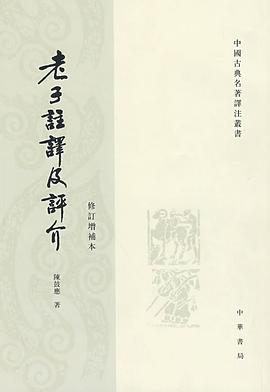

具体描述
著名学者陈鼓应的这部《老子注译及评介》自1984年由中华书局出版大陆版本以来,一直不断印行。本书不但是文献整理的杰作,也是中国哲学和哲学史研究的重要著作。作者吸取历代研究“老子”的成果,尤其是帛书《老子》出土以来的诸家成果,参以己见,从而成为新时期诸子学的经典著作之一。
作者简介
陈鼓应,一九三五年生,福建长汀人。台湾大学哲学系及哲学研究所毕业。曾任台湾大学哲学系和北京大学哲学系教授,主编穴道家文化研究X学刊。着有穴悲剧哲学家尼釆》、《尼采新论》、《存在主义》、《庄子哲学》、《老子注译及评介》、《庄子今注今译》、《黄帝四经今注今译》、《老庄新论》、《易传与道家思想》、《道家易学建构》、《管子四篇诠释》及《耶稣新画像》等书。
目录信息
增订重排本序
修订版序
误解的澄清――代序
老子哲学系统的形成
注释今译与引述
历代老子注书评介
附录一 帛书老子甲乙本释文
附录二 老子校定文
附录三 参考书目
· · · · · · (收起)
读后感
各种解释老子的书好多好多 解释的方法也多的数不清。 老子的无为智慧理解了,过一段再看看,似乎还没理解。 又看看,又好像理解了。 太有意思了
老子到底怎么注才合适,也许仁者见仁,智者见智吧。 陈鼓应先生是哲学大家,从其注文中阐发的道论中,解开了许多我不曾明白的问题。讲起老子的道、德云云,总能如经似纬,有条不紊,将老子前后对道的概括、对道体的描述云云,贯通勾连,疏讲精深,让我足足摸到许多我从王注中未...
老子到底怎么注才合适,也许仁者见仁,智者见智吧。 陈鼓应先生是哲学大家,从其注文中阐发的道论中,解开了许多我不曾明白的问题。讲起老子的道、德云云,总能如经似纬,有条不紊,将老子前后对道的概括、对道体的描述云云,贯通勾连,疏讲精深,让我足足摸到许多我从王注中未...
“北京大学收藏的西汉竹书,是目前所见战国秦汉古书类竹简中数量最大、保存质量最好的一批,是继上世纪发现的马王堆帛书、银雀山汉简、郭店楚简、上博楚简,以及2008年入藏清华大学的战国竹简之后,问世的又一座出土典籍宝库。” 据介绍,竹书中最引人注目的文献当首推《老...
其实这本书还行,是一部比较好的入门读物,感兴趣者皆可拿来一观,做些许了解,可以避免很多问题。 对于这些写原典,我们读它,有个显而易见的好处就是可以避免“成心”的左右。读过便知其所以然,防止人云亦云,随大流而无己见。 记得以前,许多人皆言《老子》...
用户评价
Having spent considerable time with *Lao Tzu: Annotated and Critically Reviewed*, I am left with a profound sense of appreciation for the author's meticulous craftsmanship and insightful scholarship. This is a work that transcends mere academic exposition; it is an invitation to a deeper philosophical journey. The annotations are exceptionally thorough, providing not only accurate translations but also illuminating explanations of the historical, cultural, and philosophical contexts that shaped Lao Tzu's thought. I was particularly struck by the author's careful deconstruction of the concept of "虚," highlighting its role not as emptiness, but as potentiality and receptivity. This nuanced understanding of a seemingly simple term opened up new avenues of thought for me. The critical review section is equally robust, offering a balanced and nuanced assessment of Lao Tzu's enduring influence across various disciplines and civilizations. The author masterfully connects the dots between ancient philosophical principles and contemporary challenges, demonstrating the timeless applicability of these profound insights. The discussion on how Lao Tzu's advocacy for simplicity and naturalness can serve as a powerful antidote to the excesses and complexities of modern life was particularly resonant. It is a book that rewards patient engagement, prompting the reader to pause, ponder, and integrate the wisdom presented into their own understanding of the world. The author's command of the subject matter is evident on every page, and their ability to convey complex ideas with clarity and elegance is truly commendable.
When I first encountered *Lao Tzu: Annotated and Critically Reviewed*, I was immediately struck by the author's erudition and the depth of their engagement with the text. The annotations are not merely translations; they are thorough explorations of the semantic and philosophical nuances of each passage. The author meticulously traces the etymological roots of key terms and consults a wide range of scholarly interpretations, offering a rich tapestry of understanding. I found the author's approach to explaining the concept of "柔弱" particularly illuminating. Instead of simply presenting it as weakness, the author delves into its strategic advantage, its ability to overcome rigidity and force. This perspective shifted my understanding of strength from mere physical power to a more subtle, adaptive resilience. The critical review section is equally impressive, presenting a balanced and insightful analysis of Lao Tzu's enduring legacy. The author skillfully navigates the complexities of the philosophical tradition, highlighting both the continuities and the points of divergence in various interpretations. I was particularly captivated by the discussion on how the principles of *Tao Te Ching* can inform contemporary approaches to environmental sustainability and harmonious coexistence. The author doesn't present Lao Tzu as a relic of the past but as a vital source of wisdom for navigating the challenges of the 21st century. The integration of historical context and philosophical argumentation creates a compelling narrative that educates and inspires. It's a book that invites contemplation and encourages a deeper appreciation for the profound insights of ancient Chinese thought.
这本书《老子注译及评介》,让我仿佛走进了一座古老的智慧殿堂。作者的注译部分,用一种极其耐心细致的方式,将《道德经》的每一个字、每一个词都进行了深入的解读。他不仅解释了字面意思,更深入挖掘了词语背后的哲学含义,并且还会引经据典,让我们看到老子思想的来龙去脉。我特别喜欢作者在解释“无名”时,没有简单地将其理解为“没有名字”,而是将其阐释为超越具体事物、不可言说的宇宙本源,这种解读让我对“道”的理解又上升了一个层次。评介部分更是精彩绝伦,作者不仅仅是对《道德经》进行简单的解读,而是将其置于更广阔的思想史背景下进行审视,并且提出了自己独到的见解。他将老子思想与中国传统文化的方方面面进行联系,让我看到《道德经》并非仅仅是一部哲学著作,更是塑造了中国人心灵和行为方式的重要思想源泉。书中对于“不争”的阐释,就让我印象深刻,作者将其引申到人际关系和团队合作的层面,让我们看到“不争”并非消极避世,而是一种高明的智慧。这本书的语言风格严谨而不失生动,让我感觉既在接受知识的洗礼,也在享受一场精神的盛宴。
The sheer depth of scholarship and thoughtful articulation within *Lao Tzu: Annotated and Critically Reviewed* is truly remarkable. This is not a book for the casual reader seeking superficial explanations; it demands a willingness to engage with complex ideas and a dedication to thoughtful reflection. The author's annotations are a masterclass in textual exegesis, meticulously dissecting each phrase and concept with a profound understanding of classical Chinese literature and philosophy. I found the author's treatment of the concept of "玄德" particularly insightful. Rather than a simple understanding of virtue, the author explores its inherent mystery and its manifestation in selfless, unacknowledged actions. This nuanced interpretation elevated my appreciation for a concept that often eludes straightforward definition. The critical review section is equally compelling, offering a sophisticated analysis of Lao Tzu's impact on various cultural and intellectual traditions. The author skillfully draws connections between ancient wisdom and contemporary societal issues, demonstrating the enduring relevance of these philosophical tenets. The discussion on how Lao Tzu's emphasis on naturalness and spontaneity can offer an antidote to the pressures of modern artificiality was particularly striking. It’s a book that doesn’t just present information; it cultivates a deeper understanding and fosters a genuine appreciation for the profound insights that have shaped human thought for millennia. The author’s prose is both erudite and engaging, making even the most abstract philosophical concepts accessible without sacrificing their intellectual rigor.
《老子注译及评介》这本书,在我看来,不仅仅是一部解读经典的作品,更像是一场与古圣先贤的思想对话。作者在进行注译时,展现了极高的学术严谨性和对文本的敬畏之心。他 painstaking ground-uped the nuances of each character and phrase, going beyond superficial meanings to uncover the deeper layers of philosophical intent. I found myself particularly impressed by his ability to connect seemingly disparate verses, revealing the underlying thematic coherence of the entire work. The commentary section is where the author truly shines, offering insights that are both intellectually stimulating and personally resonant. He doesn't shy away from tackling the most complex and abstract concepts, but he does so with remarkable clarity and accessibility. His exploration of "道" as an ineffable, fundamental principle that underlies all existence was particularly profound. The way he weaves in contemporary examples and analogies to illustrate these ancient ideas made the philosophy feel relevant and applicable to modern life. I especially appreciated his discussion on the concept of "上善若水," illustrating how water's yielding nature embodies a form of strength and resilience that is often overlooked. This perspective offered a valuable counterpoint to more aggressive, assertive approaches to problem-solving. The book’s structure is also commendable, with the annotations and commentaries seamlessly integrated, allowing for a natural flow of understanding. It’s a book that rewards slow, deliberate reading, and I found myself frequently pausing to reflect on the profound implications of the ideas presented. This is not a book to be skimmed; it demands engagement and invites introspection.
初次捧读《老子注译及评介》,便被其深邃的哲学内涵和精妙的语言艺术深深吸引。这本书并非简单地将《道德经》的原文罗列,而是以一种极其细致入微的态度,将古老的智慧重新展现在我眼前。作者的注译部分,对于每一个字、每一句话都进行了深入的剖析,不放过任何一个可能被忽略的细微之处。我尤其欣赏的是,作者并非生硬地给出断语,而是通过追溯词源、考证古代文献、参照不同版本的异同,层层递进地揭示了老子思想的根源和演变。在阅读过程中,我仿佛置身于一个古代的书斋,与作者一同探寻那超越时空的真理。作者的评介部分更是点睛之笔,他不仅梳理了历代对《道德经》的解读,更提出了自己独到的见解。他善于将抽象的哲学概念与现实生活中的种种现象相结合,使那些看似遥不可及的“道”变得鲜活起来。例如,在谈到“无为”时,作者并没有将其简单地理解为“什么都不做”,而是深入阐释了“无为而无不为”的精髓,即顺应自然规律,以最小的力实现最大的效用。这种解读让我对许多日常的决策和行为有了全新的认识,也开始反思自己过去的一些“有所为”是否反而走了弯路。书中穿插的许多历史典故和人物故事,也为枯燥的哲学讨论增添了不少趣味,使得整个阅读过程既烧脑又充满乐趣。我曾几何时以为自己对老子思想已有一定的了解,但阅读完这本书后,我才发现,之前的理解不过是冰山一角,这本书为我打开了一扇通往更广阔哲学领域的大门,让我对人生的意义和世界的运行规律有了更深刻的体悟。
我拿到《老子注译及评介》这本书时,其实抱着一种既期待又略带忐忑的心情。期待的是能通过它更深入地理解老子这位伟大的思想家,忐忑的是担心内容过于艰涩,难以消化。然而,这本书完全打消了我的顾虑。作者的注译部分,如同循循善诱的良师,将那些晦涩难懂的古文,通过清晰流畅的白话文解释得淋漓尽致。他不仅解释了字面意思,更深入挖掘了词语在当时语境下的哲学含义,甚至还会引经据典,让我们看到老子思想的源头活水。我尤其喜欢作者在解读“道可道,非常道”时,没有陷入文字游戏,而是从“道”作为宇宙本源的不可言说性出发,辅以各种比喻,让我这个哲学门外汉也能大致领会其精妙之处。而评介部分,更是让我惊喜连连。作者没有停留在对《道德经》的字面理解,而是上升到了对老子哲学体系的宏观把握,并将其置于更广阔的思想史背景下进行审视。他讨论了老子思想对中国传统文化、政治、艺术乃至日常生活的深远影响,这让我对《道德经》的价值有了全新的认识。书中对“治大国如烹小鲜”的解读,就非常生动,作者将其引申到现代管理的各种场景,让人拍案叫绝。这本书让我感受到,哲学并非高高在上,而是与我们的生活息息相关。作者的文字充满智慧,也饱含人文关怀,读来令人心生敬意,也仿佛醍醐灌顶。
这本书《老子注译及评介》,犹如一场甘霖,滋润了我长期以来对《道德经》的困惑。作者的注译部分,真的做到了“解衣磅礴”,将老子那充满象征意义和哲理深度的语言,一层层拨开,展现在我们面前。我尤其欣赏作者在处理“道”这个核心概念时的审慎和耐心。他并没有试图给“道”下一个绝对的定义,而是通过种种角度的阐释,让我们体会到“道”作为一种不可捉摸、却又无处不在的本源力量。在注译“上善若水”时,作者不仅解释了水的特性,更将其升华为一种处世哲学,让我看到了一种以柔克刚、顺势而为的智慧。评介部分,更是让我看到了作者的真知灼见。他不像有些评论那样空泛议论,而是能够精准地抓住老子思想的精髓,并将其与现实社会进行深刻的对照。例如,在谈到“知足不辱,知止不殆”时,作者将其与当下社会普遍存在的“消费主义”和“不择手段的追求”进行了鲜明的对比,让我深刻反思了“欲望”与“幸福”之间的关系。这本书没有故弄玄虚,也没有哗众取宠,它以一种朴实而深刻的方式,引导读者去体悟老子思想的真谛。读完之后,我感到心灵得到了净化,思维也变得更加开阔。我仿佛被注入了一股清流,看待事物的方式都有了新的视角。
The experience of delving into *Lao Tzu: Annotated and Critically Reviewed* has been nothing short of transformative. This is a book that doesn't just present information; it invites a profound re-evaluation of one's own perspective. The author's annotations are a testament to their deep understanding of the classical Chinese language and their unwavering commitment to intellectual honesty. They meticulously unpack the layers of meaning within each verse, offering insights that are both historically grounded and philosophically illuminating. I found the author's explanation of "无为" to be particularly revelatory. Instead of a passive resignation, the author elucidates its active, strategic dimension – acting in accordance with natural principles to achieve optimal outcomes. This redefinition alone has significantly altered my approach to problem-solving. The critical review section is equally outstanding, providing a comprehensive and nuanced exploration of Lao Tzu's enduring impact on human thought and culture. The author skillfully navigates the complexities of interpretation, offering original perspectives that enrich our understanding of this seminal work. The discussion on how the principles of *Tao Te Ching* can inform modern leadership and governance was particularly compelling, demonstrating the timeless relevance of these ancient philosophies. It is a book that demands careful consideration and encourages a deeper engagement with the fundamental questions of existence. The author's prose is both authoritative and accessible, making this profound philosophical text a truly rewarding read.
一本《老子注译及评介》,读完之后,我感觉自己像是走过了一片迷雾,眼前豁然开朗。作者在注译部分,真的是“解其惑,释其疑”,把那些常常让我望而却步的古文,变得平易近人。他不仅仅是翻译,更是深入浅出地讲解,把每一个字的来龙去脉,每一个词在不同语境下的含义都说得清清楚楚。我尤其赞赏作者在解读“上士闻道,勤而行之;中士闻道,若存若亡;下士闻道,大笑之”时,没有简单地进行道德评判,而是从不同层次的人对“道”的不同认知和接受程度进行了细致的分析,让我看到了老子思想的普遍性和人性的复杂性。评介部分更是让我受益匪浅。作者不仅仅是复述前人的观点,而是提出了自己独到的见解,并且将老子思想与我们当今社会的各种现象进行了生动的联系。比如,作者在谈到“知者不言,言者不知”时,就将其引申到我们日常交流中的“沉默的智慧”,以及在信息爆炸时代如何辨别真伪。这种联系方式,让我觉得《道德经》并非遥不可及的古老经典,而是与我们的生活息息相关的智慧宝典。这本书的语言风格朴实无华,但字里行间都透露着作者深厚的学养和对老子思想的深刻领悟。读这本书,我不仅学到了知识,更得到了心灵的启迪。
虽然是繁体字竖排版 但依然精彩 注释没怎么太看 所以当然是还得重新看的 我还打算再买本不是繁体字竖排版的先看了
老子的哲学理论基础是由“道”这个观念展现出来的,而道的问题事实上是一个虚拟的问题。道所具有的种种特性和作用,都是老子所预设的。老子所预设的道实际上就是 他经验世界所体悟的道理,而把这些所体悟的道理,统统付托给所谓的道,以作为它的特性和作用。道是老子哲学上一个最高的范畴,在老子的书上有几种意义:1构成世界的实体。2创造宇宙的动力。3促使万物运动的规律。4作为人类行为的准则。一切物都由道所形成,内在于万物的道,在一切事物中表现它的属性,也即表现它的德。
很现代化,不少征引实无必要
。真是详细得累赘。 总算看完了。
第四十六章 天下有道,却走马以粪。天下无道,戎马生于郊。 祸莫大于不知足;咎莫大于欲得。故知足之足,常足矣。