
具体描述
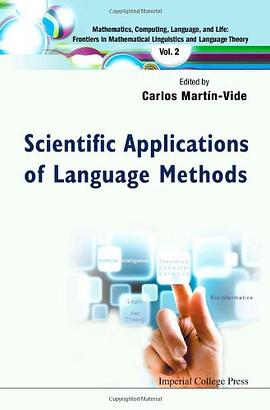
Presenting interdisciplinary research at the forefront of present advances in information technologies and their foundations, "Scientific Applications of Language Methods" is a multi-author volume containing pieces of work (either original research or surveys) exemplifying the application of formal language tools in several fields, including logic and discrete mathematics, natural language processing, artificial intelligence, natural computing and bioinformatics.
作者简介
目录信息
1.1. 1 Introduction 1
1.2. 1 Descriptional Systems and Complexity Measures 3
1.3. 1 Measuring Sizes 6
1.4. 1 Measuring Resources 33
1.5. 1 Non-Recursive Trade-Offs 39
1 References 51
2. 1 Classifying All Avoidable Sets of Partial Words of Size Two, E. Weissenstein 59
2.1. 1 Introduction 60
2.2. 1 Preliminaries 62
2.3. 1 Unavoidable Sets of Partial Words of Size Two 64
2.4. 1 Canonical Forms 70
2.5. 1 The Answer to the Conjectures 74
2.6. 1 The Classification 95
2.7. 1 Conclusion 99
1 References 100
3. 1 On Glushkov K-graphs, M. Flouret 103
3.1. 1 Introduction 103
3.2. 1 Definitions 105
3.3. 1 Acyclic Glushkov WFA Properties 114
3.4. 1 Glushkov K-graph with Orbits 124
3.5. 1 Algorithm for Orbit Reduction 127
3.6. 1 Conclusion 131
1 References 131
4. 1 Natural Language Dictionaries Implemented as Finite Automata, S. Ristov 133
4.1. 1 Dictionaries as Finite Automata 133
4.2. 1 Automata as Mappings 149
4.3. 1 Construction Methods 165
4.4. 1 Internal Structure and Compression 187
1 References 200
5. 1 Tree-Language Based Querying of Hierarchically Structured and Semi-Structured Data, A. Berlea 205
5.1. 1 Introduction 205
5.2. 1 Preliminaries 207
5.3. 1 Regular Forest Languages 217
5.4. 1 Grammar Queries 230
5.5. 1 Practical Application: A Pattern Language for XML Querying 259
5.6. 1 Online Querying 275
5.7. 1 Summary and Outlook 294
5.8. 1 Proofs of Theorems 295
1 References 306
6. 1 Quotient Monoids and Concurrent Behaviours, M. Koutny 313
6.1. 1 Introduction 314
6.2. 1 Preliminaries 318
6.3. 1 Partial Orders and Order Structures 326
6.4. 1 Mazurkiewicz Traces 334
6.5. 1 Comtraces 337
6.6. 1 Generalised Comtraces 354
6.7. 1 Elementary Net Systems 360
6.8. 1 EN-systems with Inhibitor and Mutex Arcs 372
6.9. 1 Concluding Remarks 382
1 References 383
7. 1 Correction Queries in Active Learning, C. Tirnauca 387
7.1. 1 Introduction 387
7.2. 1 Preliminaries 389
7.3. 1 Learning Models 391
7.4. 1 Learning with Correction Queries 393
7.5. 1 Polynomial Time Learning with Correction Queries 403
1 References 416
8. 1 Applications of Grammatical Inference in Software Engineering: Domain Specific Language Development, F. Javed 421
8.1. 1 Introduction 422
8.2. 1 Analysis Phase of DSL Development 424
8.3. 1 Design Phase of DSL Development 426
8.4. 1 Grammatical Inference and Language Design 429
8.5. 1 Case Study 445
8.6. 1 Related Work 448
8.7. 1 Conclusion 452
1 References 453
9. 1 Small Size Insertion and Deletion Systems, S. Verlan 459
9.1. 1 Introduction 459
9.2. 1 Definitions 461
9.3. 1 Basic Simulation Principles 466
9.4. 1 Insertion-Deletion Systems with Rules of Small Size 470
9.5. 1 Context-Free Insertion-Deletion Systems 472
9.6. 1 One-Sided Contextual Insertion-Deletion Systems 481
9.7. 1 Pure Insertion Systems 497
9.8. 1 Graph-Controlled Insertion-Deletion Systems 503
9.9. 1 Graph-Controlled Insertion-Deletion Systems with Priorities 514
9.10. 1 Bibliographical Remarks 520
1 References 521
10. 1 Accepting Networks of Evolutionary Word and Picture Processors: A Survey, V. Mitrana 525
10.1. 1 Introduction 525
10.2. 1 Basic Definitions 527
10.3. 1 Computational Power 536
10.4. 1 Universal ANEPs and ANEPFCs 541
10.5. 1 A Direct Simulation 544
10.6. 1 Accepting Networks of Splicing Processors 545
10.7. 1 Problem Solving with ANEPs/ANEPFCs 548
10.8. 1 Accepting Networks of Picture Processors 549
1 References 558
11. 1 Quantum Automata and Periodic Events, B. Palano 563
11.1. 1 Introduction 563
11.2. 1 Preliminaries 566
11.3. 1 Testing Periodicity on Unary Iqfa's 570
11.4. 1 Synthesis of Iqfa's Inducing Periodic Events 572
11.5. 1 Application to Periodic Languages 580
1 References 582
12. 1 Soliton Circuits and Network-Based Automata: Review and Perspectives, M. Kresz 585
12.1. 1 Introduction 586
12.2. 1 Basic Concepts 588
12.3. 1 Soliton Graphs and Automata 593
12.4. 1 Elementary Decomposition of Soliton Graphs and Automata 597
12.5. 1 Characterizing Soliton Automata 600
12.6. 1 Complete Systems of Soliton Automata 610
12.7. 1 Algorithms for Soliton Automata 615
12.8. 1 Extensions of the Model and Further Research 623
12.9. 1 Summary 627
1 References 628
13. 1 Inferring Leadership Structure from Data on a Syntax Change in English, W. Garrett Mitchener 633
13.1. 1 Introduction 634
13.2. 1 The Available Data 639
13.3. 1 Formulation of the Variable Influence Model 640
13.4. 1 Fitting the Do-support Data 644
13.5. 1 Results and Discussion 650
13.6. 1 Future Directions 652
13.7. 1 Conclusion 656
1 References 658
14. 1 Weighted Automata Modeling for High Density Linkage Disequilibrium Mapping, T. Trang 663
14.1. 1 Introduction 664
14.2. 1 Biological Problem and Formulation 667
14.3. 1 Fundamentals of Discrete Structures 676
14.4. 1 Variable Length Finite Automata (VLFA) 682
14.5. 1 Experimental Results on SNP Data 706
14.6. 1 Conclusion 719
1 References 720
1 Author Index 723
1 Subject Index
· · · · · · (收起)
读后感
用户评价
说实话,我是在一个朋友的极力推荐下才开始阅读这本巨著的,起初我还有些疑虑,毕竟现在市面上充斥着太多包装华丽但内容空洞的作品。然而,这本书彻底颠覆了我的固有印象。它的叙事方式极其独特,不像传统的学术著作那样刻板,反而带有一种强烈的、近乎侦探小说般的探究欲。作者在构建论点时,总是不遗余力地展现出那些被主流学界忽略的“边缘视角”和“次要证据”,并通过严密的逻辑链条,将它们整合进一个更具包容性的理论体系中。这给我一种强烈的震撼感——原来知识的构建可以如此充满张力和创造力!我在阅读过程中,不得不频繁地停下来,不是因为看不懂,而是因为被作者某些独到的见解深深触动,需要时间去消化和反思。这本书对于那些习惯于线性思维的人来说,无疑是一次挑战,但对于愿意接受思维重塑的读者,它提供的回报是巨大的。
从一个纯粹的体验者的角度来看,阅读这本书的过程本身就是一种智力上的冒险。作者并不把读者当成被动的接收者,而是积极地邀请我们参与到知识的建构过程中来。在某些章节,作者会故意设置一些看似矛盾的论述,然后引导读者去寻找那个隐藏在表象之下的统一原则,这种互动式的阅读体验,极大地提高了我的参与感和批判性思维能力。更难能可贵的是,这本书没有陷入任何一种固定的意识形态窠臼,它展现出高度的学术诚实性,敢于指出自身理论的局限性,并明确列出未来可能的研究方向。这种坦荡和开放的态度,在当代学术著作中是相当罕见的。它让我深切体会到,真正的科学精神并非是寻求最终答案,而是在不断质疑和探索中前行。这本书带给我的远不止知识本身,更是一种对待求知态度的全新视角。
我必须说,这本书的结构安排简直是教科书级别的典范,每一个章节的过渡都如同精心编排的交响乐章,层层递进,毫不拖泥带水。我特别欣赏作者在处理那些高度专业化的内容时所采取的“螺旋式上升”的教学方法。它不是简单地罗列事实,而是先给出一个宏观的框架,然后在后续的章节中不断地、在更深的层次上重新审视和丰富这些概念。这使得即便是对相关领域只有初步了解的读者,也能逐步跟上作者的思路,最终领悟到最核心的洞见。书中对于案例的选择也极其精妙,每一个案例都不仅仅是理论的佐证,更像是一个独立的、引人入胜的小故事,充满了戏剧张力和逻辑美感。我曾尝试过阅读一些同类题材的著作,但往往在第三章后就因晦涩难懂而放弃,但这本则让我保持了全程的高度专注,它成功地在严谨性和可读性之间找到了一个近乎完美的平衡点。
这本书的排版和装帧设计也值得称赞,它体现出对读者体验的极致重视。纸张的质感温润而不反光,字体大小适中,长时间阅读下来眼睛也不会感到疲劳。但这只是表面的赞美,真正让我折服的是其内部信息的密度和清晰度。作者似乎有一种魔力,能够将复杂的信息压缩到最精炼的形式,但又不失必要的阐释。我尤其喜欢书中那些手绘的、概念性的插图,它们不是为了美观而存在,而是精准地捕捉了抽象概念的核心结构,起到了画龙点睛的作用,比冗长的文字描述更为直观有效。我将这本书带到了几次学术研讨会上,每一次的翻阅,都能发现新的细节和新的联系,这说明作者在内容上做到了多层次的深度挖掘。它不像快餐读物,更像是一坛需要时间慢慢品味的陈年佳酿,每次开启都能带来新的芬芳。
这本书简直是为我这种对知识的边界充满好奇心的人量身定做的!我原本以为它会是那种枯燥的理论堆砌,没想到,作者以一种近乎诗意的笔触,将那些晦涩难懂的科学概念化为了生动的图景。尤其是在描述那些复杂的数学模型时,作者并没有直接抛出公式,而是巧妙地融入了大量的历史背景和哲学思考,让我仿佛置身于一个思想的迷宫中,每一步都充满了探索的乐趣。最让我印象深刻的是它对“涌现性”的探讨,作者通过对不同学科交叉点的观察,构建了一个宏大而又精密的理论框架,让我对我们所处的这个世界有了全新的认知。读完之后,我感觉自己的思维维度被极大地拓宽了,不再局限于单一学科的视角,而是能够从更广阔的背景下去审视问题。这本书的深度和广度都令人惊叹,它不仅仅是一本知识的载体,更像是一场思维的洗礼,强烈推荐给所有不满足于现状、渴望深度思考的读者。它的语言风格流畅而富有洞察力,每一次翻页都伴随着“原来如此”的惊叹。