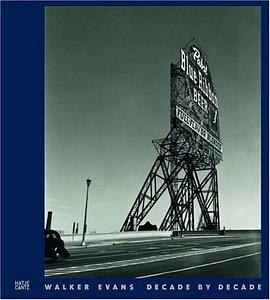
Walker Evans (1903-1975) is, without doubt, one of the most influential American photographers ever, and many of his images have become fixed in the collective memory. But while Evans' uncompromising depiction of poverty during the Great Depression of the 1930s, the subject of a series commissioned by the Farm Security Administration, has become a key chapter in the history of photography, his equally innovative images from later decades have generally commanded less attention. This exciting new monograph attempts to redress the balance by examining Evans' complete body of work, and features many rarely seen photographs, including his final works, a sequence of Polaroids shot in the early 1970s (a sequence made possible by an unlimited supply of film from its manufacturer). Evans' re-ascendancy in the 1970s, and his close relationship with legendary Museum of Modern Art curator John Szarkowski, are also closely examined, in this essential and definitive volume on a great photographer who certainly achieved his aim to produce pictures that were "literate, authoritative, transcendent."Born in St. Louis, Missouri, Walker Evans (1903-1975) took up photography in 1928. His book collaboration with James Agee, Let Us Now Praise Famous Men (1941), which portrayed the lives of three white tenant families in southern Alabama during the Depression, has become one of that era's most defining documents. Evans joined the staff of Time magazine in 1945, and shortly after moved to Fortune magazine, where he stayed until 1965. That year, he became a professor of photography at the Yale University School of Art. Evans died at his home in Old Lyme, Connecticut, in 1975.
Walker Evans’ photographic legacy stands as a defining force in American documentary photography, particularly through his starkly precise visual chronicles of Depression-era life. Born in 1903 and active primarily during the 1930s, Evans captured the raw textures and unvarnished realities of rural and urban America with an almost clinical eye. His most celebrated work, Let Us Now Praise Famous Men (co-authored with James Agee), emerged from a collaboration that blended Evans’ documentary vision with Agee’s poetic text to depict the existence of sharecroppers in Alabama. This project remains a landmark not only for its technical rigor but also as a profound social document, revealing dignity amid hardship through unembellished imagery. Evans’ approach diverged sharply from the romanticized or staged photography prevalent at the time. He favored large-format cameras and natural light, seeking clarity and precision in framing that emphasized form, gesture, and environment without manipulation. His portraits—whether of a weather-worn hand, a crooked fence, or a modest home—reflect an acute sensitivity to detail and context. These images do not seek drama but invite contemplation, allowing viewers to engage directly with the subject’s presence and circumstance. Beyond Let Us Now Praise Famous Men, Evans’ body of work encompasses extensive street photography in New York City during the 1930s, marked by spare compositions and an observational stillness that captures fleeting urban moments. His photographs of sidewalks, storefronts, and passersby convey a quiet narrative of public life, defined by anonymity and rhythm rather than individuality. These images reveal Evans’ fascination with architecture and human interaction within the cityscape—spaces shaped by time, use, and necessity. Stylistically, Evans’ photography is anchored in minimalism. He avoids dramatic contrasts or overt emotional cues, preferring a restrained aesthetic that draws attention to structure, pattern, and texture. The interplay of light and shadow is handled with precision, enhancing spatial depth without theatricality. His framing often centers on ordinary objects—doors, windows, furniture—as symbolic anchors of human experience, transforming them into vessels of broader cultural meaning. Evans’ influence extends well beyond his own era. His commitment to truth-telling through imagery informed generations of photojournalists and documentarians who followed. His work challenged the boundaries between art and reportage, insisting that beauty and significance could coexist in the mundane, the overlooked, the everyday. By refusing sentimentality, Evans invited viewers into a deeper, more sustained engagement with the realities of his time—a practice that continues to resonate in contemporary visual culture. In essence, Walker Evans’ photography is not merely a record but an enduring dialogue between observer and observed. His images remain vital for their formal discipline and moral clarity, offering a vision grounded in empathy and precision. Through his lens, the quiet strength of everyday life emerges with uncompromising honesty—making his work essential not only as historical testimony but as lasting artistic achievement.