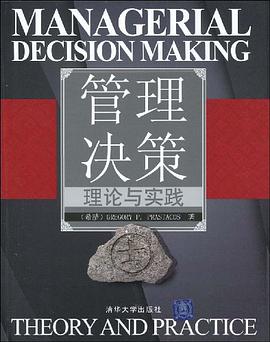

具体描述
《管理决策:理论与实践》内容简介:Management Science is of paramount importance in this effort. It provides decision makers with an extensive range of methodologies, skills, models and software tools that are necessary in order to effectively address a wide range of decision problems. More specifically, Management Science has been very helpful in management and decision making by contributing: a) A rational, systematic and robust methodology that can be followed when addressing a decision problem, b) A rich set of models, techniques and tools that can be used to structure, understand and solve the problem, and c ) A rich interface environment that helps the decision maker understand a solution, evaluate alternative solutions and come up with the preferred one. In all of these steps, the decision maker is supported by specialized easy-to-use software, which often come as additions (add-ins) to popular software like Excel, or are part of corporate Business Intelligence Systems or Decision Support Systems.
作者简介
目录信息
CHAFFER 1 INTRODUCTION TO MANAGEMENT SCIENCE
1.1 Introduction to Managerial Decision Making
1.2 Trends Affecting Decision Making Today
1.3 Key Characteristics of Management Science for Decision Making
1.4 The Use of Models for Making Decisions
1.5 The Use of Software in Decision Making
1.6 Applications of Management Science in Business
References
CHAFFER 2 AVOIDING BAD DECISIONS: The Methodology of
Decision Making
2.1 Introduction
2.2 Decision Making Traps
2.3 Decision Making Tips
2.4 The Rational Methodology for Decision Making
2.5 Identification of the Problem
2.6 Analysis of the System
2.7 Formulation of the Objectives
2.8 Initial System Design
2.9 Detailed System Design
2.10 Solution Implementation and Monitoring
References
PAPTⅡ MODELS IN MANAGERIAL DECISION MAKING
CHAPTER 3 LINEAR PROGRAMMING
3.1 Introduction
3.2 Characteristics of LP Problems
3.3 A Maximization Problem
3.4 A Trial-and-Error Approach in Solving LP Problems
3.5 Graphical Solution of a LP Problem
3.6 A Minimization Problem
3.7 General Formulation and Assumptions of LP Models
3.8 Solving LP Problems
Problems
References
CHAPTER 4 USING SOLVER TO SOLVE LINEAR PROGRAMMING
PROBLEMS
4. 1 Introduction
4.2 Introducing the Model in Excel
4.3 Solving the Problem
4.4 Understanding and Analyzing the Solution-SOLVER Reports
4.5 Solving Integer Programming Problems with SOLVER
4.6 Solving Non-Linear Programming Problems with SOLVER
4.7 Conclusions
Problems
References
CHAPTER 5 SENSITIVITY ANALYSIS IN LINEAR
PROGRAMMING
5.1 Introduction
5.2 An Example
5.3 Dual Prices in LP
5.4 Reduced Costs in LP
5.5 Changes in the Objective Functions Coefficients
5.6 Changes in the Right Hand Sides (RHS) of the Constraints
5.7 Evaluation of a New Activity
5.8 Conclusions
Problems
References
CHAPTER 6 INTEGER PROGRAMMING
6.1 Introduction
6.2 Formulating IP Problems with Binary Variables
6.3 An Investment Example
6.4 Formulating IP Problems with Fixed Costs and/or Discounts
6.5 Solving IP Problems
6.6 Heuristic Methods to Solve IP Problems
6.7 Conclusions
Problems
References
CHAPTER 7 MULTI-CRITERIA DECISION MAKING
7. I Introduction
7.2 Empirical Methods
7.3 Goal Programming
7.4 The Analytical Hierarchy Process
7.5 Using Expert Choice to Solve Multicriteria Problems
Problems
References
CHAPTER 8 STATISTICAL METHODS IN DECISION
MAKING
8.1 Introduction to Forecasting
8.2 Key Concepts about Forecasting
8.3 The Moving Averages Forecasting Method
8.4 Exponential Smoothing Forecasting Method
8.5 Other Forecasting Methods
8.6 Linear Regression
8.7 Multiple Regression
8.8 Discriminant Analysis
8.9 Using SPSS for Statistical Analysis
Problems
References
CHAPTER 9 DECISION ANALYSIS
9.1 Introduction
9.2 Key Concepts about Decision Analysis
9.3 Criteria for Making Decisions under Uncertainty
9.4 The Expected Value of Perfect Information
9.5 Introduction to Decision Trees
9.6 Calculating the Risk Profile a Strategy
9.7 Sensitivity Analysis
9.8 Using Precision Tree to Solve Decision Analysis Problems
Problems
References
CHAPTER 10 SIMULATION
10.1 Introduction
10.2 Key Characteristics of Simulation
10.3 Implementation of Simulation under Conditions of Uncertainty
10.4 Simulation of Queuing Systems
10.5 Simulation of an Inventory System
10.6 Analysis of Simulation Results
10.7 Using Simulation for Risk Management
10.8 Using Simulation for Business Process Reengineering
Problems
References
PAPTⅢ IMPLEMENTING MANAGEMENT SCIENCE IN PRACTICE
CHAPTER 11 GETTING TO KNOW YOUR CUSTOMER
11.1 Introduction
11.2 Determining Customer Satisfaction
11.3 Designing New Products
11.4 Sales-Advertising Response Analysis
11.5 Forecasting Sales of New Products
11.6 Identifying Areas of Improvement
11.7 Studying Product Positioning
11.8 Identifying Market Segments
11.9 Identifying Prospect Customers
Problems
References
CHAPTER 12 MARKETING AND SALES MANAGEMENT
12.1 Introduction
12.2 A Product Selection Problem
12.3 Design of Sales Network
12.4 Selection of Communication Media
12.5 Selection of Location
12.6 Design of New Product Marketing Strategy
12.7 Design of Promotion Strategy
12.8 Sales Strategy
12.9 Evaluation of Customer Value for CRM Implementation
……
CHAPTER 13 PRODUCTION AND INVENTORY MANAGEMT
CHAPTER 14 NETWORKS AND TRANSPORT PROBLEMS
CHAPTER 15 LOGISTICS AND SUPPLY CHAIN MANAGEMENT
· · · · · · (收起)
读后感
用户评价
这本《管理决策》初次拿到手时,我并没有抱太高的期望,毕竟市面上关于管理类的书籍琳琅满目,很多都大同小异,充斥着空洞的理论和陈旧的案例。然而,当我翻开第一页,便被它独特的视角所吸引。它并没有一上来就罗列各种决策模型和工具,而是花了相当大的篇幅去探讨决策的“人性”层面。书中大量引用了心理学、行为经济学以及神经科学的最新研究成果,深入剖析了人在决策过程中会受到哪些认知偏差、情感因素以及社会压力的影响。例如,在描述“锚定效应”时,作者并非简单地给出定义,而是通过一个发生在真实商业谈判中的案例,生动地展现了最初的数字如何像一块“锚”一样,牢牢地将决策者固定住,即使后续信息表明这个“锚”并不合理。这种从人类认知机制出发的解读,让我对过往很多看似“理性”的决策过程产生了深刻的反思。我开始意识到,很多时候,我们以为自己是在进行严谨的逻辑推导,实际上却可能早已被潜意识的陷阱所左右。书中的一些实验设计和思考题也颇具启发性,引导读者去审视自身在做决定时的思维盲点,并尝试去克服它们。这对于我在日常工作中处理复杂问题,尤其是在面对不确定性时,提供了全新的思考维度和实用指导。
让我对《管理决策》这本书印象尤为深刻的是其对“评估决策效果”的详细阐述。很多时候,我们关注如何做出一个“好”的决定,却忽略了如何去衡量这个决定的“好”与“坏”,以及如何从过去的决策中学习。书中并没有给出一些笼统的“复盘”建议,而是系统地提出了“决策后评估”的框架。它强调,评估决策效果,不仅仅是看最终的结果是否如预期,更重要的是去分析决策过程本身是否存在问题。作者列举了多种评估指标,从定性的反馈到定量的分析,并且指导读者如何在信息不完整的情况下进行相对客观的评估。我尤其对“反事实思维”(Counterfactual Thinking)的运用感到惊讶。书中解释了如何通过设想“如果当时做了另一个选择会怎样”,来更深入地理解当前决策的优劣。此外,它还探讨了如何建立一个“学习型组织”的决策文化,鼓励员工分享决策经验,无论成功与否,都能从中汲取养分。这对于一个希望不断进步的组织来说,至关重要。这本书让我明白,决策的价值,不仅在于当下,更在于其长远的学习和迭代效应。
《管理决策》一书中关于“道德困境与决策”的章节,让我对管理者在做决定时所承担的责任有了全新的认识。这部分内容并非是简单的道德说教,而是深入探讨了在复杂的商业环境中,管理者如何面对和处理那些涉及伦理道德的棘手问题。作者并没有提供一套“标准答案”,因为他明白,很多道德困境是没有绝对正确的解决方案的。相反,他通过一系列真实案例,展示了不同管理者在面对相似困境时所做出的不同选择,以及这些选择所带来的深远影响。我特别欣赏书中对于“功利主义”、“义务论”等伦理学理论在管理决策中的应用的分析,并将其与实际的商业场景相结合。书中提出的“利益相关者分析”模型,让我意识到,在做出任何一项重大决策时,都需要审慎考虑其对公司内部员工、外部客户、合作伙伴、社区乃至整个社会可能产生的影响。此外,书中还强调了建立一种“道德勇气”的重要性,鼓励管理者在必要时能够坚持原则,即使这可能意味着要承受短期内的压力或损失。这本书记载的不仅仅是决策的方法,更是关于管理者应有的担当和智慧。
读完《管理决策》的某个章节,我脑海中浮现出公司近期的一次重要项目评估。书中对于“情景分析”的阐述,让我对当时的操作有了新的理解。它并没有简单地教你如何制作一个“情景分析报告”,而是深入探讨了如何构建不同“情景”,以及在不确定性极高的环境中,如何评估这些情景发生的可能性。作者强调,情景分析并非是预测未来,而是通过描绘一系列可能的未来,来帮助决策者准备应对各种情况,从而降低意外发生的风险。我回想起我们当时的项目,虽然也考虑了几个潜在的风险,但更多的是一种基于经验的“直觉”,而非系统性的、多角度的推演。书中提出的“驱动因素分析”以及“情景逻辑链”的概念,为我打开了新的思路。它教导我们,在构建情景时,需要识别那些最可能影响结果的关键变量,并理解它们之间是如何相互作用的。同时,书中还强调了在信息有限的情况下,如何利用“类比推理”和“专家访谈”来填充情景中的不确定性。这让我意识到,很多时候,管理者需要具备一种“战略性想象力”,能够跳出现有的框架,去预见那些尚未发生但可能发生的事件。这本书让我对如何更有效地进行战略规划和风险管理有了更深的认识。
《管理决策》这本书的某个部分,给我留下了极其深刻的印象,那是在探讨“群体决策”的挑战时。我常常觉得,人多力量大,集思广益总能做出更好的决定。然而,书中却用严谨的论证和生动的案例,揭示了群体决策中潜藏的各种危机。我尤其对“群体思维”(Groupthink)和“意见极化”(Polarization)的分析感到警醒。书中描绘了一系列典型的群体思维场景,比如团队成员为了追求和谐而压抑不同意见,导致最终决策出现重大失误。作者并没有止步于理论描述,而是详细剖析了导致群体思维的心理机制,以及如何通过一些外部干预和流程设计来规避。例如,书中提出的“红队演练”(Red Teaming)概念,即设立一个专门负责挑战主流观点的团队,这让我眼前一亮。此外,对于如何在群体中鼓励多元化意见的提出,以及如何处理意见不合的冲突,书中也给出了一些具体的技巧和方法。这对于我来说,极具实践价值,因为在我的工作中,很多决策都需要团队协作来完成。这本书让我意识到,管理好一个团队的决策过程,并不比一个人做出艰难的决定来得容易,甚至更需要精妙的设计和有效的引导。