
具体描述
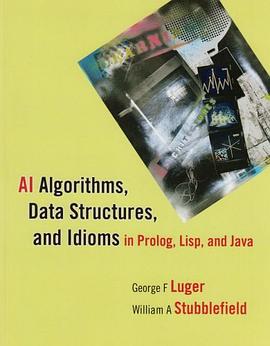
This book is designed for three primary purposes. The first is as a programming language component of a general class in Artificial Intelligence. From this viewpoint, the authors see as essential that the AI student build the significant algorithms that support the practice of AI. This book is designed to present exactly these algorithms. However, in the normal lecture/lab approach taken to teaching Artificial Intelligence at the University level, we have often found that it is difficult to cover more than one language per quarter or semester course. Therefore we expect that the various parts of this material, those dedicated to either Lisp, Prolog, or Java, would be used individually to support programming the data structures and algorithms presented in the AI course itself. In a more advanced course in AI it would be expected that the class cover more than one of these programming paradigms.
The second use of this book is for university classes exploring programming paradigms themselves. Many modern computer science departments offer a final year course in comparative programming environments. The three languages covered in our book offer excellent examples on these paradigms. We also feel that a paradigms course should not be based on a rapid survey of a large number of languages while doing a few “finger exercises” in each. Our philosophy for a paradigms course is to get the student more deeply involved in fewer languages, and these typically representing the declarative, functional, and object-oriented approaches to programming. We also feel that the study of idiom and design patterns in different environments can greatly expand the skill set of the graduating student. Thus, our philosophy of programming is built around the language idioms and design patterns presented in Part I and summarized in Part V. We see these as an exciting opportunity for students to appreciate the wealth and diversity of modern computing environments. We feel this book offers exactly this opportunity.
The third intent of this book is to offer the professional programmer the chance to continue their education through the exploration of multiple programming idioms, patterns, and paradigms. For these readers we also feel the discussion of programming idioms and design patterns presented throughout our book is important. We are all struggling to achieve the status of the master programmer.
作者简介
目录信息
Prolog: Representation
Abstract Data Types and Search
Depth- Breadth-, and Best-First Search
Meta-Linguistic Abstraction, Types, and Meta-Interpreters
Machine Learning Algorithms in Prolog
Natural Language Processing in Prolog
Dynamic Programming and the Earley Parser
Prolog: Final Thoughts
S-Expressions, the Syntax of Lisp
Lists and Recursive Search
Variables, Datratypes, and Search
Higher-Order Functions and Flexible Search
Unification and Embedded Languages in Lisp
Logic programming in Lisp
Lisp-shell: An Expert System Shell in Lisp
Semantic Networks, Inheritance, and CLOS
Machine Learning in Lisp
Lisp: Final Thoughts
Java, Representation and Object-Oriented Programming
Problem Spaces and Search
Java Representation for Predicate Calculus and Unification
A Logic-Based Reasoning System
An Expert System Shell
Case Studies: JESS and other Expert System Shells in Java
ID3: Learning from Examples
Genetic and Evolutionary Computing
Case Studies: Java Machine Learning Software Available on the Web
The Earley Parser: Dynamic Programming in Java
Case Studies: Java Natural Language Tools on the Web
Conclusion: The Master Programmer
· · · · · · (收起)
读后感
用户评价
令人惊喜的是,这本书在“代码规范与惯用法”这一块的内容,远比书名暗示的要丰富和实用得多。通常,涉及 Prolog 和 Lisp 的书籍往往停留在学术讨论层面,很少关注实际工程中的“风格”问题。然而,这本书用相当大的篇幅讨论了在 Java 环境中如何优雅地实现 Prolog 式的模式匹配,以及如何利用 Lisp 式的元编程思想来创建 DSL(领域特定语言)。我特别关注了其中关于“非侵入式异常处理”的章节,作者提出了一种基于 Prolog 回溯机制的替代方案,用以优化复杂业务流程中的状态管理。这对我目前负责的一个金融风控系统的重构工作提供了极大的启发。书中展示的那些代码片段,虽然简洁到近乎晦涩,但当你停下来细细品味其背后的逻辑流时,会发现它完美地平衡了表达力和可维护性。这是一种在面向对象世界中罕见的、对清晰逻辑的极致追求。
这本书的封面设计确实引人注目,那种深邃的蓝色调和简约的字体排版,立刻给我一种专业而又不失深度的感觉。当我翻开扉页,首先映入眼帘的是作者对这三个看似风马牛不相及的编程范式——Prolog、Lisp 和 Java——进行深入探讨的决心。我个人一直是函数式编程和逻辑编程的爱好者,但总觉得在实际应用中,如何将这些理论模型与面向对象的主流语言(比如 Java)的工程实践完美结合,常常是个令人头疼的问题。这本书的开篇就着眼于这个问题,它没有陷入纯粹的理论推导,而是很务实地探讨了如何将 Prolog 的约束求解思想融入 Java 的设计模式中。特别是书中关于“惰性求值在并发控制中的应用”那几章,虽然文字不多,但其蕴含的设计哲学却非常深刻。我记得有一段比较了 Lisp 的宏系统与 Java 8 之后流 API 在代码抽象层次上的差异,这种跨语言的视角让我对这三种语言有了全新的认识,远超我原先对它们各自局限性的刻板印象。整体阅读体验是,它像一位经验丰富的架构师在引导你思考代码的本质结构,而非简单罗列语法。
这本书最让我感到价值非凡的地方,在于它对“编程哲学”的探讨,而不是简单的技术栈介绍。它成功地搭建了一座桥梁,连接了面向过程、面向对象、函数式和逻辑编程这四大编程范式中那些最精髓的“思想火花”。比如,书中详细分析了为什么在某些复杂的搜索问题上,直接将 Lisp 的闭包机制与 Prolog 的变量绑定进行类比思考,能帮助 Java 开发者绕开传统递归的性能陷阱。这种深层次的哲学探讨,并非空谈,而是紧密结合着具体的代码示例和性能考量。读完后,我感觉自己看待软件架构的方式都发生了一些微妙的变化——不再只是关注技术选型,而是更加注重逻辑的纯粹性和表达的效率。这本书就像是一次对计算机科学核心思想的深度洗礼,让那些沉睡在不同语言框架下的优秀思想重新焕发出活力。
这本书的阅读过程就像在攀登一座信息密度极高的山峰,需要极大的专注力。它绝不是那种可以随便翻阅的“速成指南”。我尤其欣赏作者在处理数据结构部分时所采取的独特方法。当涉及到 Lisp 语言中的列表操作时,它不仅仅是展示如何用 `car` 和 `cdr` 来分解结构,而是进一步将其抽象化,与 Prolog 中基于规则的知识表示进行对比。这种对比揭示了不同语言在处理递归和自引用数据结构时的根本差异。我发现,作者巧妙地利用了 Prolog 的事实和规则来构建一个虚拟的、可推理的内存模型,然后展示 Java 如何通过更显式的对象引用和封装来实现类似(但本质不同)的功能。这种“对比-融合-升华”的叙述方式,极大地增强了读者的抽象思维能力。对于那些希望从“知道语法”跃升到“理解范式”的资深开发者来说,这本书提供的思维工具箱是非常宝贵的。它迫使你重新审视自己日常使用的 Java 代码,思考哪些部分本可以用更优雅的逻辑编程方式来表达。
我必须承认,这本书对读者的背景知识要求较高。如果读者对任何一种语言——尤其是 Lisp 或 Prolog——只有初级的了解,那么阅读起来会非常吃力。它不是一本“入门读物”。作者行文风格非常严谨,几乎没有冗余的铺垫,直接切入问题的核心。例如,在讨论类型系统时,它直接对比了 Lisp 的动态类型与 Java 的静态类型,随后迅速过渡到如何使用 Prolog 的类型检查机制来增强 Java 编译器的静态分析能力。这种高度浓缩的信息流,要求读者必须跟上作者的思维节奏。不过,一旦你跨越了最初的门槛,你会发现它极大地拓宽了你解决问题的视角。它不再是教你“如何用 Java 写代码”,而是教你“如何用更强大的思维模型来指导你的代码设计”,这种转变是渐进的,但一旦发生,影响是深远的。
Prolog、LISP、还有Java,AI领域的3大编程语言。哈哈
Prolog、LISP、还有Java,AI领域的3大编程语言。哈哈
Prolog、LISP、还有Java,AI领域的3大编程语言。哈哈
Prolog、LISP、还有Java,AI领域的3大编程语言。哈哈
Prolog、LISP、还有Java,AI领域的3大编程语言。哈哈