
具体描述
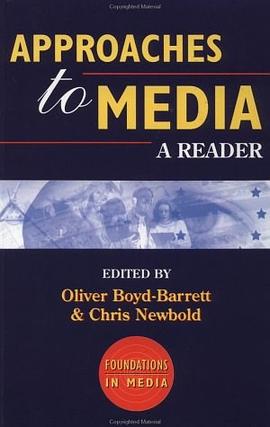
This book is one of a series of five Readers which provide a comprehensive series of resources for media studies courses. This volume illustrates and exemplifies the variety of ways in which the mass media have been researched over the past fifty or more years. It provides extracts from seminal works and relates them to developments in the field as a whole and to later works. The volume identifies the major divisions within the field, including mass society theory, the media effects tradition, political economy, the public sphere, media occupations and professionals, cultural hegemony, feminism and 'new' audience research.
作者简介
Oliver Boyd-Barrett and Chris Newbold are both at University of Leicester.
目录信息
Editor's introduction: approaching the media, Oliver Boyd-Barrett Chris Newbold
Acknowledgements
1 Defining the field, Oliver Boyd-Barrett Chris Newbold 2
2 On ignoring history: mass communication research and the critique of society, Hanno Hardt 8
3 Media sociology: the dominant paradigm, Todd Gitlin 21
4 The context of mass communications research, James D. Halloran 33
5 Mass communication research in Europe: some origins and prospects, Jay G. Blumler 43
6 Mass communication and modern culture: contribution to a critical theory of ideology, John B. Thompson 54
7 Early theories in media research, Oliver Boyd-Barrett 68
8 The culture industry: enlightenment as mass deception, Theodor W. Adorno Max Horkheimer 77
9 Mass society and its culture, Edward Shils 81
10 Mass society and mass culture: interdependence or independence?, Harold L. Wilensky 87
11 The structure and function of communication in society, Harold D. Lasswell 93
12 Functional analysis and mass communication revisited, Charles R. Wright 95
13 The study of the media: theoretical approaches, James Curran Michael Gurevitch Janet Woollacott 103
14 Politicians and the press: an essay on role relationships, Jay G. Blumler Michael Gurevitch 108
15 The media effects tradition, Chris Newbold 118
16 Between media and mass/the part played by people/the two-step flow of mass communication, Elihu Katz Paul T. Lazarsfeld 124
17 The effects of mass communication, Joseph T. Klapper 135
18 Toward 'cultural indicators': the analysis of mass mediated public message systems, George Gerbner 144
19 The agenda-setting function of mass media, Maxwell E. McCombs Donald I. Shaw 153
20 Utilization of mass communication by the individual, Elihu Katz Jay G. Blumler Michael Gurevitch 164
21 Five traditions in search of the audience, Klaus Bruhn Jensen Karl Erik Rosengren 174
22 The political economy approach, Oliver Boyd-Barrett 186
23 The international commercialization of broadcasting, Herbert I. Schiller 193
24 For a political economy of mass communications, Graham Murdock Peter Golding 201
25 Contribution to a political economy of mass communication, Nicholas Garnham 216
26 On the audience commodity and its work, Dallas Smythe 222
27 Conceptualizing the 'public sphere', Oliver Boyd-Barrett 230
28 Institutions of the public sphere, Jurgen Habermas 235
29 The media and the public sphere, Nicholas Garnham 245
30 The theory of the public sphere, John B. Thompson 252
31 Intellectuals, the 'information society' and the disappearance of the public sphere, Philip Elliott 260
32 Democracy and media: without foundations, John Keane 263
33 The analysis of media occupations and professionals, Oliver Boyd-Barrett 270
34 Social control in the newsroom: a functional analysis, Warren Breed 277
35 'Mr Gates' revisited: a 1966 version of the 1949 case study, Paul B. Snider 283
36 Specialist correspondents: goals, careers, roles, Jeremy Tunstall 287
37 The news net, Gaye Tuchman 294
38 News departments and broadcasting organizations - the institutionalization of objectivity, Peter Golding Philip Elliot 300
39 How content is produced, Muriel G. Cantor 306
40 Journalists at war (introduction), David E. Morrison Howard Tumber 313
41 The national culture, Paddy Scannell David Cardiff 319
42 Approaches to cultural hegemony within cultural studies, Chris Newbold 328
43 The analysis of culture, Raymond Williams 332
44 Cultural studies: two paradigms, Stuart Hall 338
45 Popular culture and 'the turn to Gramsci', Tony Bennett 348
46 The rediscovery of 'ideology': return of the repressed in media studies, Stuart Hall 354
47 Mass communication and cultural studies, James W. Carey 365
48 Populism and ordinary culture, Jim McGuigan 374
49 Feminist studies of the media, Chris Newbold 388
50 Feminist theories and media studies, H. Leslie Steeves 392
51 Feminist cultural television criticism - culture, theory and practice, Mary Ellen Brown 401
52 The symbolic annihilation of women by the mass media, Gaye Tuchman 406
53 Women and the cultural industries, Michele Mattelart 411
54 Class and gender in the hegemonic process: class differences in women's perceptions of television realism and identification with television characters, Andrea Press 420
55 The pleasure machine, Annette Kuhn 430
56 Analysing the moving image, Chris Newbold 442
57 Myth and meaning, Will Wright 446
58 Defining genre/genre and popular culture, Stanley J. Solomon 453
59 Questions of genre, Steve Neale 460
60 Morphology of the folktale, Vladimir Propp 473
61 Story and discourse (introduction), Seymour Chatman 477
62 Principles of narration, David Bordwell 485
63 Narrative form in American network television, Jane Feuer 493
64 Approaches to 'new audience research', Oliver Boyd-Barrett 498
65 The new revisionism in mass communication research: a reappraisal, James Curran 505
66 Reading: Reading the romance, Janice A. Radway 512
67 Television and gender, David Morley 518
68 Dallas and the ideology of mass culture, Ien Ang 525
69 Patterns of involvement in television fiction: a comparative analysis, Tamar Liebes Elihu Katz 531
70 Media, technology and daily life, Hermann Bausinger 536
71 Relocating the site of the audience, Martin Allor 543
Author index 555
Subject index 558
· · · · · · (收起)
读后感
用户评价
坦白讲,初次翻开这本书时,我略微有些担忧,怕它会是一部晦涩难懂的学术专著。然而,一旦沉浸其中,我发现作者的文字功底和叙事节奏掌控得炉火纯青。它成功地在学术的严谨性和大众的可读性之间找到了一个绝妙的平衡点。书中的语言风格是内敛而有力的,没有华丽的辞藻堆砌,但每一个论断都建立在扎实的观察之上。我特别关注到作者对于“注意力经济”的批判性反思,这种反思并非简单的道德谴责,而是基于技术演进和社会结构变化的深刻洞察。他没有给出简单的“是”或“否”的答案,而是鼓励读者去构建更具批判性的思维框架。对我个人而言,它像是一面镜子,映照出我在接触和处理信息时存在的盲点与偏见。书中引用的几项跨文化传播的对比研究,极大地拓宽了我的视野,让我意识到不同文化背景下,媒体的“默认设置”是多么地千差万别。这本书的价值在于,它提供的不是一套固定不变的公式,而是一套能够应对未来不确定性的思考工具箱。
这本书读起来的感觉,就像是进行了一次高强度的思维拉力赛。它不断地挑战你既有的认知舒适区,迫使你对那些被视为“理所当然”的媒体现象进行重新审视。我欣赏作者那种近乎于偏执的细节打磨,比如在描述特定传播节点的运作效率时,他所援引的数据和模型,精确得令人咋舌。这本书的深度是毋庸置疑的,它超越了表层的现象描述,直抵驱动这些现象背后的权力结构与经济逻辑。我发现自己花了大量时间在某些章节上反复推敲,尤其是在探讨算法推荐机制对信息茧房的固化作用时,作者提出的几种潜在的“结构性干预”路径,极具前瞻性和讨论价值。这不是一本能让你轻松读完并合上的书,它会持续地在你脑海中发酵。它成功地将复杂的系统理论,通过生动的案例和清晰的图解(如果有的话,此处是我的主观想象,并非指书中真有),变得触手可及。对于那些希望在媒体领域寻求突破,而不是仅仅维持现状的从业者来说,这本书无疑是一剂强心针。
这部关于媒体实践的著作,着实让人眼前一亮。它没有落入那些老生常谈的理论窠臼,而是以一种近乎田野调查的视角,深入剖析了当代信息传播的肌理。作者显然是一位深谙行业脉络的资深人士,他笔下的案例分析栩栩如生,充满了烟火气。我特别欣赏他对于“碎片化叙事”的解构,那种将复杂的社会现象抽丝剥茧,还原为一个个生动微观场景的处理手法,极具启发性。阅读过程中,我不断地在思考,我们日常接触的海量信息,究竟是以何种潜规则在塑造我们的认知边界?书中的章节布局逻辑清晰,从内容生产的源头讲起,逐步过渡到分发机制的演变,最后落脚于受众的接受心理。它不是一本空洞的教科书,而更像是一位经验丰富的导师,手把手地带领读者穿梭于媒体生态的迷宫之中。对于那些渴望理解“媒体如何工作”而非仅仅停留在“媒体是什么”的读者来说,这本书无疑提供了一个极佳的切入口。我尤其对其中关于跨平台内容迁移策略的讨论印象深刻,那部分内容对于任何从事内容创意或策略制定的人来说,都具有极强的实操价值,它提供了不同于传统路径的创新思路。
我必须说,这本书在方法论上展现出一种令人耳目一新的跨学科气质。作者似乎毫不费力地从社会学、认知心理学乃至经济学的视角切入媒体议题,使得整部作品的厚度和广度都得到了极大的提升。最让我感到惊喜的是其对“新媒介伦理”的探讨。在当下,伦理讨论往往流于空泛的口号,但这本书却将其具体化到每一次点击、每一次推送的决策层面。它引导读者思考,在效率与责任之间,我们究竟愿意让渡多少自主权?书中关于媒体素养培养的章节,尤其值得教育界和政策制定者深思。它提出的模型不是教人如何“识别假新闻”,而是教人如何构建一种更具韧性的信息环境。这种由内而外的建设思路,比任何外部监管都来得更为根本有效。阅读此书,我感受到的不是知识的灌输,而是一种思维模式的重塑,一种对信息时代的深刻敬畏与审慎。
这本书的叙述节奏极富张力,读起来有一种追赶潮流的紧迫感,但这种紧迫感并非来自焦虑,而是源于对即将发生变化的预见。作者似乎拥有对行业风向的精准嗅觉,总能在关键节点提出极具洞察力的论断。我深感此书在处理“技术中立性”这一老生常谈的议题时,采用了非常成熟且不失温度的笔法。它不妖魔化技术,也不盲目崇拜技术,而是将技术视为权力关系和文化表达的延伸载体。其中关于地方性媒体在数字化转型中的困境与突围策略的论述,尤其让我这个关注基层传播生态的人士感同身受。作者没有回避现实的残酷性,但同时也指出了那些尚未被充分发掘的创新空间。这本书的语言风格是那种非常“当代”的——简洁、直接,充满了面向未来的行动力。它不是为了阐释过去,而是为了指导我们如何更好地应对未来媒体环境的剧变。
读本,牛们的文章都收录了
本书为教科书写作提供了多少便利
reading list
reading list
本书为教科书写作提供了多少便利