具体描述
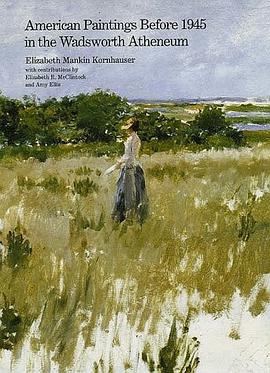
Founded in Hartford, Connecticut, more than 150 years ago, the Wadsworth Atheneum is the oldest continuously operating public art museum in the United States, and it contains one of the most important collections of American art anywhere. Each work in its world-renowned collection of American paintings is reproduced in this gorgeously illustrated two-volume set, including masterworks by nearly every leading artist of the seventeenth through twentieth centuries. Elizabeth Mankin Kornhauser tells the extraordinary history of the museum, offers informative biographies of both famous and obscure artists, and provides comprehensive entries on each painting. The story of the nineteenth-century private collectors who established the public collections, the contemporary artists who influenced the selection of paintings, and the unusual acquisitions in the first half of the twentieth century renders a fascinating profile of cultural development in the United States. The Atheneum's holdings of more than 550 American paintings, with outstanding Hudson River school landscapes and an especially rich representation of Connecticut artists, began with museum founder Daniel Wadsworth's donation of his private collection of American landscapes. Later gifts included the post-Civil War picture gallery left by Elizabeth Hart Jarvis Colt, widow of the inventor-manufacturer Samuel Colt. This beautiful catalogue enables even those who cannot visit the museum to enjoy the fine collection of the American wing.
A Chronicle of American Art: From Colonial Beginnings to Mid-Century Transformations This volume offers an expansive and meticulously researched journey through the evolution of American painting, tracing its development from the earliest European encounters with the New World through the seismic shifts that defined art in the first half of the twentieth century, specifically concluding with the pivotal year of 1945. It is a narrative anchored by profound institutional support, offering readers deep access to the treasures and pivotal moments that shaped the visual identity of a rapidly modernizing nation. The exploration commences not with established masters, but with the tentative, often pragmatic portraiture and landscape sketches that accompanied colonial settlement. Here, the focus is on the earliest documented exchanges between European artistic traditions—particularly Dutch, English, and later, French influences—and the unique environmental and social realities of the burgeoning colonies. We examine the work of itinerant limners whose anonymous canvases captured the stern dignity and nascent aspirations of early American elites. These initial chapters illuminate how necessity dictated style, resulting in an art form that was functional, commemorative, and often deeply intertwined with mercantile success and burgeoning political identities. The challenges of securing proper materials and training in a geographically disparate and politically volatile setting are given due consideration, setting the stage for the eventual professionalization of the American art world. The transition into the Federal period marks a significant turning point. As the young republic sought cultural legitimacy on the world stage, artists consciously sought to forge an ‘American’ aesthetic capable of rivaling the established academies of Europe. This section delves into the rise of the pioneering portraitists who defined the visual iconography of the revolutionary and early national heroes. Close analyses are dedicated to the meticulous detail, psychological penetration, and strategic public image construction inherent in these works. Furthermore, the burgeoning interest in history painting—albeit often on a smaller scale due to limited patronage—is explored, examining how artists wrestled with depicting historical narratives that supported republican virtue and national mythology. The nineteenth century unfolds with a dramatic embrace of Romanticism and, subsequently, a powerful drive toward an authentically American landscape tradition. The early chapters dedicated to this era focus heavily on the Hudson River School. This is not merely a cataloging of magnificent vistas; rather, it is an investigation into the theological, philosophical, and ecological underpinnings of this movement. These painters were not just recording scenery; they were interpreting the wilderness as a manifestation of divine providence and national destiny. The sheer scale and spiritual ambition of these canvases—from the luminous clarity of the Catskills to the untamed grandeur of the West—are examined in detail, contextualizing the movement within the era's fascination with Manifest Destiny and the sublime. Contemporaneously, the mid-century saw the growth of genre painting, which offered a vital counterpoint to the epic scope of landscape. This section analyzes the emergence of scenes depicting everyday American life: the bustling city, the quiet domestic interior, the agricultural labors of the farm. These artists focused on capturing the texture of ordinary existence, developing a visual vernacular that resonated with a middle class increasingly defined by its consumer habits and social norms. The influence of European realism, particularly the Dutch tradition, is acknowledged, but the focus remains on how American practitioners adapted these techniques to document their own specific social milieu, often with a subtle undercurrent of satire or sentimentality. As the century matured, the challenges posed by the Civil War and the subsequent industrial boom necessitated new visual languages. The volume addresses the complex transition away from strictly idealized narratives. We investigate the initial attempts to bring European academic realism and impressionistic techniques back to American shores, often through artists trained extensively in Paris. The arrival of Impressionism in America is treated as a distinct phenomenon, one adapted to the softer light and different social rhythms of East Coast cities and resort towns. This adaptation, often characterized by a slightly more reserved palette and a continued emphasis on narrative clarity compared to its European counterparts, set the stage for the final, most radical transformations. The final section tackles the turbulent period spanning the two World Wars and leading up to 1945. This era marks the definitive break with nineteenth-century traditions and the aggressive importation and adaptation of Modernism. We chart the impact of Post-Impressionism, Cubism, and other avant-garde movements filtered through American sensibilities. This includes a deep dive into the Ashcan School’s gritty urban realism, which provided a vital link between the nineteenth-century genre painters and the burgeoning social realism of the Depression era. The exploration culminates in the diverse artistic responses to the crises of the 1930s and early 1940s. From the Regionalist impulse that sought to create a distinctly non-European, rooted American art—celebrating the heartland and its traditions—to the concurrent rise of Surrealism and the nascent stirrings of Abstract Expressionism, this period is presented as a crucible. The volume concludes by assessing how the trauma of global conflict forced American painters to confront existential questions, setting the coordinates for the subsequent ascendancy of New York as the center of the art world in the post-war years. Throughout, the book maintains a commitment to contextualizing the visual evidence within the broader socio-political, economic, and intellectual currents that shaped artistic production across three centuries.