
具体描述
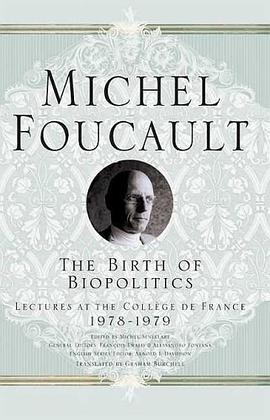
Picador is proud to publish the sixth volume in Foucault's prestigious, groundbreaking series of lectures at the Collège de France from 1970 to 1984
.
The Birth of Biopolitics continues to pursue the themes of Foucault's lectures from Security, Territory, Population. Having shown how eighteenth-century political economy marks the birth of a new governmental rationality--seeking maximum effectiveness by governing less and in accordance with the naturalness of the phenomena to be governed--Michel Foucault undertakes a detailed analysis of the forms of this liberal governmentality. In a direct and conversational tone, this book raises questions of political philosophy and social policy that are at the heart of current debates about the role and status of neo-liberalism in twentieth century politics.
作者简介
MICHEL FOUCAULT, acknowledged as the preeminent philosopher of France in the 1970s and 1980s, continues to have enormous impact throughout the world in many disciplines. Translated by Graham Burchell.
目录信息
.
One: 10 January 1979
Questions of method. — Suppose universals do not exist. — Summary of the previous year's lectures: the limited objective of the government raison d'État (external politics) and unlimited objective of the police state (internal politics). — Law as principle of the external limitation raison d'État. — Perspective of this year's lectures: political economy as principle of the internal limitation of governmental reason. — What is at stake in this research: the coupling of a set of practices and a regime of truth and the effects of its inscription in reality. — What is liberalism.
.
Two: 17 January 1979
Liberalism and the implementation of a new art of government in the eighteenth century. — Specific features of the liberal art of government ( I ): ( 1 ) The constitution of the market as site of the formation of truth and not just as domain of jurisdiction. — Questions of method. The stakes of research undertaken around madness, the penal order, and sexuality: sketch of a history of “regimes of verdiction.” — The nature of a political critique of knowledge (savoir). — ( 2 ) The problem of limiting the exercise of power by public authorities. Two types of solution: French juridical radicalism and English utilitarianism. — The question of “utility” and limiting the exercise of power by public authorities. — Comment on the status of heterogeneity in history: strategic against dialectical logic. — The notion of “interest” as operator (opérateur) of the new art of government.
.
Three: 24 January 1979
Specific features of the liberal art of government ( II ): ( 3 ) The problem of European balance and international relations. — Economic and political calculation in mercantilism. The principle of freedom of the market according to the physiocrats and Adam Smith: birth of a new European model. — Appearance of a governmental rationality extended to a world scale. Examples: the question of maritime law; the projects of perpetual peace in the eighteenth century. — Principles of the new liberal art of government: a “governmental naturalism”; the production of freedom. — The problem of liberal arbitration. Its instruments: ( 1 ) the management of dangers and the implementation of mechanisms of security; ( 2 ) disciplinary controls (Bentham’s panopticism); ( 3 ) inverventionist policies. — The management of liberty and its crises.
.
Four: 31 January 1979
Phobia of the state. — Questions of method: sense and stakes of the bracketing off of a theory of the state in the analysis of mechanisms of power. — Neo-liberal governmental practices: German liberalism from 1948 to 1962; American neo-liberalism. — German neo-liberalism ( I ). Its political-economic context. — The scientific council brought together by Erhard in 1947. Its program: abolition of price controls and limitation of governmental interventions. — The middle way defined by Erhard in 1948 between anarchy and the “termite state”. — Its double meaning: ( a ) respect for economic freedom as condition of the state’s political representativity; ( b) the institution of economic freedom as basis for the formation of political sovereignty. — Fundamental characteristic of contemporary German governmentality: economic freedom, the source of juridical legitimacy and political consensus. — Economic growth, axis of a new historical consciousness enabling the break with the past. — Rallying of Christian Democracy and the SPD to liberal politics. — The principles of liberal government and the absence of a socialist governmental rationality.
.
Five: 7 February 1979
German neo-liberalism ( II ). — Its problem: how can economic freedom both found and limit the state at the same time? — The neo-liberal theorists: W. Eucken, F. Böhm, A. Müller-Armack, F. von Hayek. — Max Weber and the problem of the irrational rationality of capitalism. The answers of the Frankfurt School and the Freiburg School. — Nazism as necessary field of adversity to the definition of the neo-liberal critique of National Socialism on the basis of these different elements of German history. — Theoretical consequences: extension of this critique to the New Deal and to the Beveridge plans; interventionism and the growth of the power of the state; massification and uniformization, effects of state control. — The stake of neo-liberalism: its novelty in comparison with classical liberalism. The theory of pure competition.
.
Six: 14 February 1979
German neo-liberalism ( III ). — Usefulness of historical analyses for the present. — How is neo-liberalism distinguished from classical liberalism? — Its specific stake: how to model the global exercise of political power on the principles of a market economy, and the transformations that derive from this. — The decoupling of the market economy and policies of laissez-faire. — The Walter Lippmann colloquium ( 26 to 30 August 1938 ). — The problem of the style of governmental action. Three examples: ( a ) the question of monopolies; ( b ) the question of “conformable actions ( actions conformes ).” The bases of economic policy according to W. Eucken. Regulatory actions and organizing actions ( actions ordonnatrices ); ( c ) social policy. The ordoliberal critique of the welfare economy. — Society as the point of application of governmental interventions. The “policy of society” ( Gesellschaftspolitik ). — First aspect of this policy: the formalization of society on the model of the enterprise. — Enterprise society and judicial society; two faces of a single phenomenon.
.
Seven: 21 February 1979
Second aspect of the “policy of society” according to the neo-liberals: the problem of law in a society regulated according to the model of the competitive market economy. — Return of Walter Lippmann colloquium. — Reflections based on a text by Louis Rougier. — ( 1 ) The idea of a juridical-economic order. Reciprocity of relations between economic processes and institutional framework. — Political stake: the problem of the survival of capitalism. — ( 2 ) The question of legal interventionism. — Historical reminder: the Rule of law ( l’État de droit ) in the eighteenth century, in opposition to despotism and the police state. Re-elaboration of the notion in the nineteenth century: the question of arbitration between citizens and public authorities. The problem of administrative courts. — The neo-liberal project: to introduce the principles of the Rule of law into the economic order. — Rule of law and planning according to Hayek. — ( 3 ) Growth of judicial demand. — General conclusion: the specificity of the neo-liberal art of government in Germany. Ordoliberalism faced with the pessimism of Schumpeter.
.
Eight: 7 March 1979
General remarks: ( 1 ) The methodological scope of the analysis of micro-powers. ( 2 ) The inflationism of state phobia. Its links with ordoliberalism. — Two theses on the totalitarian state and the decline of state governmentality in the twentieth century. — Remarks on the spread of the German model, in France and in the United States. — The German neo-liberal model and the French project of a “social market economy.” — The French context of the transition to a neo-liberal economics. — French social policy: the example of social security. — The separation of the economic and the social according to Giscard d’Estaing. — The project of a “negative tax” and its social and political stakes. “Relative” and “absolute” poverty. Abandonment of the policy of full employment.
.
Nine: 14 March 1979
American neo-liberalism ( I ). Its context. — The difference between American and European neo-liberalism. — American neo-liberalism as a global claim, utopian focus, and method of thought. — Aspects of this neo-liberalism: ( 1 ) The theory of human capital. The two processes that it represents: ( a ) an extension of economic analysis within its own domain: criticism of the classical analysis of labor in terms of the time factor; ( b ) an extension of economic analysis to domains previously considered to be non-economic. — The epistemological transformation produced by neo-liberal analysis: from the analysis of economic processes to the analysis of the internal rationality of human behavior. — Work as economic conduct. — Its division into capital, abilities, and income. — The redefinition of homo oeconomicus as entrepreneur of himself. — The notion of “human capital.” Its constitutive elements: ( a ) innate elements and the question of the improvement of genetic human capital; ( b ) acquired elements and the problem of the formation of human capital (education, health, etcetera). — The interest of these analyses: resumption of the problem of social and economic innovation ( Schumpeter ). A new conception of the policy of growth.
.
Ten: 21 March 1979
American neo-liberalism ( II ). — The application of the economic grid to social phenomena. — Return to the ordoliberal problematic: the ambiguities of the Gesellschaftspolitik. The generalization of the “enterprise” form in the social field. Economic policy and Vitalpolitik: a society for the market and against the market. — The unlimited generalization of the economic form of the market in American neo-liberalism: principle of the intelligibility of individual behavior and critical principle of governmental interventions. — Aspects of American neo-liberalism: ( 2 ) Delinquency and penal policy. — Historical reminder: the problem of the reform of penal law at the end of the eighteenth century. Economic calculation and principle of legality. The parasitic invasion of the law by the norm in the nineteenth century and the birth of criminal anthropology. — The neo-liberal analysis: ( 1 ) the definition of crime; ( 2 ) the description of the criminal subject as homo oeconomicus; ( 3 ) the status of the penalty as instrument of law “enforcement.” The example of the drugs market. — Consequences of this analysis: ( a ) anthropological erasure of the criminal; ( b ) putting the disciplinary model out of play.
.
Eleven: 28 March 1979
The model of homo oeconomicus. — Its generalization to every form of behavior in American neo-liberalism. — Economic analysis and behavioral techniques. — Homo oeconomicus as the basic element of the new governmental reason appeared in the eighteenth century. — Elements for a history of the notion of homo oeconomicus before Walras and Pareto. — The subject of interest in English empiricist philosophy ( Hume ). — The heterogeneity of the subject of interest and the legal subject: ( 1 ) The irreducible nature of interest in comparison with juridical will. ( 2 ) The contrasting logics of the market and the contract. — Second innovation with regard to the juridical model: the economic subject’s relationship with political power. Condorcet. Adam Smith’s “invisible hand”: invisibility of the link between the individual’s pursuit of profit and the growth of collective wealth. The non-totalizable nature of the economic world. The sovereign’s necessary ignorance. — Political economy as critique of governmental reason: rejection of the possibility of an economic sovereign in its two, mercantilist and physiocratic, forms. — Political economy as a science lateral to the art of government.
.
Twelve: 4 April 1979
Elements for a history of the notion of homo oeconomicus ( II ). —Return to the problem of the limitation of sovereign power by economic activity. — The emergence of a new field, the correlate of the liberal art of government: civil society. — Homo oeconomicus and civil society: inseparable elements of liberal governmental technology. — Analysis of the notion of “civil society”: its evolution from Locke to Ferguson. Ferguson’s An Essay on the History of Civil Society (1787). The four essential characteristics of civil society according to Ferguson: ( 1 ) it is an historical-natural constant; ( 2 ) it assures the spontaneous synthesis of individuals. Paradox of the economic bond; ( 3 ) it is a permanent matrix of political power; ( 4 ) it is the motor of history. — Appearance of a new system of political thought. — Theoretical consequences: ( a ) the question of the relations between state and society. The German, English, and French problematics; ( b ) the regulation of political power: from the wisdom of the prince to the rational calculations of the governed. — General conclusion.
.
Course Summary
Course Context
Index of Names
Index of Concepts and Notions
· · · · · · (收起)
读后感
虽然书名暗示着生命政治是全书主题,但是直到最后这个概念也没浮现出来。或许是由于时间所限,这一年福柯的讲演集中于自由主义/新自由主义作为一种governmental rationality的历史。 Although the Chinese translation of 'governmentality' somehow implies that the power ...
虽然书名暗示着生命政治是全书主题,但是直到最后这个概念也没浮现出来。或许是由于时间所限,这一年福柯的讲演集中于自由主义/新自由主义作为一种governmental rationality的历史。 Although the Chinese translation of 'governmentality' somehow implies that the power ...
虽然书名暗示着生命政治是全书主题,但是直到最后这个概念也没浮现出来。或许是由于时间所限,这一年福柯的讲演集中于自由主义/新自由主义作为一种governmental rationality的历史。 Although the Chinese translation of 'governmentality' somehow implies that the power ...
虽然书名暗示着生命政治是全书主题,但是直到最后这个概念也没浮现出来。或许是由于时间所限,这一年福柯的讲演集中于自由主义/新自由主义作为一种governmental rationality的历史。 Although the Chinese translation of 'governmentality' somehow implies that the power ...
虽然书名暗示着生命政治是全书主题,但是直到最后这个概念也没浮现出来。或许是由于时间所限,这一年福柯的讲演集中于自由主义/新自由主义作为一种governmental rationality的历史。 Although the Chinese translation of 'governmentality' somehow implies that the power ...
用户评价
说实话,我最初是冲着某个具体议题来找这本书的,但读完之后,我发现它的价值远超我的初始预期。这本书的魅力在于其难以被简单归类的跨学科性。它巧妙地融合了历史学、社会学、政治哲学乃至人口学的元素,构建了一个极其丰富的分析场域。作者的写作节奏是缓慢而坚定的,仿佛一位经验丰富的老船长,精确地带领读者穿越知识的迷雾。对于那些对权力如何从“君主”的身体转移到“民众”的生命肌理中进行运作感兴趣的读者来说,这本书简直是宝藏。我欣赏其对概念界定的极端审慎态度,每一个核心词汇的引入都伴随着对前人论述的细致辨析和批判性继承。读这本书的过程,与其说是吸收信息,不如说是一种思维模式的重塑。它没有提供简单的答案,而是提出了一系列深刻的问题,这些问题会像种子一样在你脑海中生根发芽,让你在未来很长一段时间内,都会不自觉地用书中的视角去审视周遭的一切。这是一部需要耐心,但回报丰厚的大部头。
这本书的文学性和思想性达到了罕见的平衡。它的文本质量极高,那种德语哲学体系特有的精密感和逻辑推演的强度被作者用一种非常清晰、甚至可以说优雅的方式表达了出来。虽然涉及的主题宏大且复杂,但作者总是能找到最恰当的切入点,将宏观的历史变迁与微观的个体经验联系起来,使得那些高深的理论不至于脱离现实。我特别欣赏作者在论述中展现出的那种对人类境况的深刻关怀,尽管其分析工具是冰冷的理性,但其最终指向却是对人类自由和生存状态的深刻追问。这本书读完后留下的不是知识点的堆砌,而是一种长久的、挥之不去的“震撼感”。你开始意识到,我们习以为常的许多社会管理方式,并非历史的终点,而仅仅是漫长技术演进中的某一个阶段。它成功地将一个复杂的历史哲学命题,转化成了一部引人入胜的思想史诗。对于任何严肃的社会科学爱好者来说,这本书都是不可绕过的一座里程碑式的存在,它会彻底改变你理解“现代性”的方式。
这本书简直是一场思想的盛宴,读起来让人欲罢不能。作者的叙述逻辑严密得像一张精密编织的网,每一个论点都像是经过千锤百炼的宝石,在不同的光线下折射出复杂而迷人的光芒。我尤其欣赏他对历史脉络的梳理,那种将看似无关的事件串联起来,揭示出背后深层结构运作的洞察力,着实令人惊叹。阅读过程中,我不断地停下来,不是因为晦涩难懂,而是因为作者提出的观点太具颠覆性,需要时间去消化和反刍。他对于权力运作模式的剖析,远超出了我们日常经验的表层认知,直击社会组织形态的核心机制。这本书的文字风格是那种古典而有力的,用词考究,句子结构富有节奏感,读起来有一种庄严的历史厚重感。它不是那种读完就扔在床头的消遣读物,而是那种需要反复翻阅,每次都能发现新层次理解的案头书。那些复杂的概念,在他的笔下仿佛被赋予了生命,不再是冰冷的学术术语,而是鲜活的社会现象的缩影。这本书的价值,在于它提供了一种全新的思维框架,去审视我们身处的这个世界的构建方式,那种被赋予的“常识”是如何一步步被建构起来的。我感觉自己像是在攀登一座知识的高峰,视野豁然开朗,但每一步都需要扎实的思考作为支撑。
我得说,这本书的行文风格相当独特,带着一股子难以言喻的法国知识分子式的冷峻和犀利。它不是那种试图迎合大众口味的普及读物,更像是一场对既有观念的公开审判。作者的论证过程充满了大量的引用和细致的文本分析,对于习惯了快节奏叙事的读者来说,可能会觉得有些“慢热”。但一旦你沉浸进去,就会发现这种细致入微的考证恰恰是其力量的源泉。他似乎总是在挖掘那些被主流叙事所忽略的角落,然后用一把手术刀般精确的语言,解剖出其中隐藏的张力。我特别喜欢他处理那些看似微不足道的历史细节的方式,他能从中提炼出宏大的理论意义,这种能力简直出神入化。不过,坦白说,这本书对读者的背景知识有一定的要求,如果对相关的哲学和历史背景不熟悉,初读时可能会感到吃力,需要时不时地查阅注释。但坚持下去的回报是巨大的,它会重塑你对“治理”和“个体”之间关系的理解。整体来看,这是一部非常“硬核”的作品,适合那些渴望深入探究知识腹地的探索者,而不是只想在知识的表层泛舟的人。
这本书的结构安排简直是教科书级别的示范——层层递进,滴水不漏。它不像是一本书,更像是一栋精心设计的建筑,每一章节都是支撑整体框架的关键部分,缺少任何一环都会导致整体的坍塌。我发现作者在平衡宏大叙事与具体案例方面做得非常出色。他不会陷于纯粹的抽象思辨,而是总能及时地拉回到具体的历史案例中,用铁一般的事实来佐证其理论推演的有效性。这种“理论与实践”的完美结合,使得他的论述既有高度,又有落地性。我个人的阅读体验是,它提供了一种看待现代社会组织的新型“透镜”。以前我以为某些社会现象是自然而然形成的,但在读完此书后,我开始质疑这些“自然性”的根源。作者的语言虽然严谨,但并不枯燥,他偶尔会使用一些极富张力的比喻,像闪电一样照亮复杂的论点。这本书真正打动我的地方在于它的“批判性”——它不是在描述,而是在解构和挑战。它迫使你跳出自己舒适的认知圈,去审视那些支撑我们日常生活的无形规则是如何被设计和执行的。这是一次令人兴奋的思想冒险。
逻辑的力量。
无因无果,却可以在假设没有「统一」的情况下分析。
Chapter 6, 9-12 on neoliberalism (American, German) and entrepreneurial self
逻辑的力量。
你说,老大哥在看着我;拉康说,不,那是慢性妄想;福柯说,不,那是生命政治