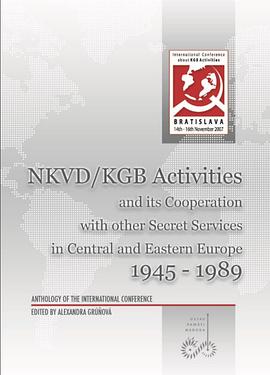

具体描述
http://www.upn.gov.sk/publikacie_web/zbornik-nkvd-EN.pdf 官网下载
作者简介
目录信息
and its Cooperation with other Secret Services in Central
and Eastern Europe 1945 – 1989 .................................................................. 9
Conference opening
František Mikloško ...................................................................................... 13
Jiří Liška ....................................................................................................... 15
Ivan A. Petranský ......................................................................................... 17
Panel I (14 November 2007)
Security Archives as Sources of NKVD/KGB Activities
Stefan Karner (Austria) – Panel moderator ................................................. 21
Ladislav Bukovszky (Slovakia): The Archive of the Nation´s Memory
Institute in the Capacity of Resources for KGB Activities ............................ 24
Petr Blažek (Czechia) ................................................................................... 32
Gergö Bendegúz Cseh (Hungary): Documents of the Historical Archives .. 36
Nikita V. Petrov (Russia) .............................................................................. 41
Ralf Blum (Germany): References to the Soviet Secret Service in the
Archives of the Federal Commissioner for the Records of the State Security
Service of the Former GDR (BStU) ............................................................... 45
Panel II (14 November 2007)
From Soviet Advisors in Satellite States to Soviet Security Schools
János M. Rainer (Hungary) – Panel moderator ........................................... 53
Rafaeł Wnuk (Poland): Soviet Supporters of the Polish Communist Security
Apparatus. The Role of NKVD in Fighting Against the Anti-Communist
Underground in Poland (1944 – 1945) .......................................................... 54
Radek Schovánek (Czechia): Soviet Ears in Communist Prague ................ 73
Ladislau – Antoniu Csendes (Romania): NKVD/ KGB Approaches
and Party Control in Romanian Secret Services and Army
between 1948 – 1964 ..................................................................................... 79
6
Magdolna Baráth (Hungary): Soviet Counsellors at the Hungarian State
Security Organs .............................................................................................. 87
Jan Kalous (Czechia): Štěpán Plaček – His Vision for the Czechoslovak
Security and the Soviet Intelligence Service Agents (1945 – 1948)
– the Arrival of Soviet Advisors into Czechoslovakia – Background
and Circumstances ....................................................................................... 100
Panel III (15 November 2007)
Central and Eastern Europe as a Base for Espionage against the West
Petr Kopal (Czechia) – Panel moderator .................................................... 121
Christopher Adam (Canada): Eyes across the Atlantic – Hungary’s State
Security and Canada’s Hungarians, 1956 – 1989 ........................................ 122
Arvydas Anušauskas (Lithuania): Economic Restructuring Period
(Perestroika) and Technological Intelligence. The Lithuanian Factor ......... 142
Stefano Bottoni (Italy): A Special Relationship. Hungarian Intelligence
and the Vatican, 1961 – 1978 ....................................................................... 147
Andrzej Grajewski (Poland): Security Services of the Polish People’s
Republic against the Vatican in 1956 – 1978 ................................................ 177
Sławomir Łukasiewicz (Poland): Polish Communist Intelligence Service
against the European Economic Community (EEC) ................................... 198
Walter Süß (Germany): KBSE as Seen by State Security of the German
Democratic Republic in the 70s ................................................................... 210
Peter Rendek (Slovakia): Operation ALAN – Mutual Cooperation
of the Czechoslovak Intelligence Service and the Soviet KGB as Given
in One of the Largest Leakage Cases of NATO Security Data
in the Years 1982 – 1986 .............................................................................. 223
Panel IV (15 November 2007)
NKVD/KGB´s Co-operation with Satellite State Security Services
Władysław Bułhak (Poland) – Panel moderator ........................................ 247
László Ritter (Hungary): The Soviet – Hungarian Intelligence Co-operation
in the Early Cold War Period (abstract) ....................................................... 248
Petr Blažek (Czechia): Residency of the Federal Ministry of the Interior
in the Soviet Union. Position, Activities and Staffing in 1989 .................... 250
7
Prokop Tomek (Czechia): SOUD and its Utilization in Czechoslovak
Conditions .................................................................................................... 275
Bernd-Rainer Barth (Germany): Noel Field Affair (abstract) ................... 286
Georg Herbstritt (Germany): Refused Cooperation: The Relation
Stasi – Securitate and Romania’s Aspirations to Independence .................. 287
Panel V (16 November 2007)
NKVD/KGB Activities in Occupied East Germany and Austria
Roger Engelmann (Germany) – Panel moderator ...................................... 301
Jörg Morré (Germany): The Creation of a Hostile Picture. Arrests
Made by the NKVD as an Example Set to Carry Out Political Police
Operations in the Soviet Occupation Zone – GDR ...................................... 302
Barbara Stelzl–Marx (Austria): Soviet Espionage in Austria. Arrests,
Sentences and Executions in 1950 – 1953 ................................................... 316
Dieter Bacher (Austria): Communist „Intelligence Internationale”?
Contacts Between KGB and the KPÖ at the Beginning of the Cold War .... 335
Jan Foitzik (Germany) – Nikita V. Petrov (Russia): The Soviet Security
Apparatus in the Soviet Occupation Zone of the GDR (1945 – 1953).
Structure, Tasks, and Cooperation with the East-Germany Authorities ....... 350
Panel VI (16 November 2007)
Final conclusions
Miroslav Lehký (Czechia) .......................................................................... 377
Walter Süß (Germany) ................................................................................ 381
Nikita V. Petrov (Russia) ............................................................................ 383
Łukasz Kamiński (Poland) ......................................................................... 384
An accompanying events of the conference
Radoslav Ragač, Ondrej Krajňák ............................................................ 386
Information about Conference Partners and Donors ................................... 395
Afterword
Alexandra Grúňová ................................................................................... 402
· · · · · · (收起)
读后感
用户评价
阅读这本书的过程,就像是逐步解开一个庞大而精密的钟表结构,每一个齿轮、每一个发条的运动都关系到整个时代的走向。作者叙事节奏的把控堪称大师级,他并没有一味地堆砌枯燥的官方文件或事件时间线,而是巧妙地将宏大的地缘政治变动与微观的特工行动穿插叙述。比如,在描述某次关键的外交斡旋时,作者会瞬间切换到某位驻外情报官在咖啡馆角落里紧张地交换微缩胶卷的场景,这种手法极大地增强了故事的张力和代入感。读者仿佛能闻到那个时代特有的烟草味和紧张的气氛,感受到信息流通的艰难与重要性。更令人称服的是,作者在处理跨国合作这一复杂议题时,展现出惊人的平衡感,他既没有美化这些合作的暗黑本质,也没有陷入简单的道德批判,而是基于详实的证据链,冷静地剖析了不同意识形态下,情报机构如何为了共同的战略目标而进行利益交换和信息共享的现实考量。这种叙事上的张弛有度,使得厚重的历史题材读起来也充满了悬念和吸引力。
这本书在方法论上的创新性,是其超越同类研究的一个显著标志。它不仅仅是简单地对既有档案进行梳理和解读,更重要的是,作者似乎开创性地引入了一种“网络化分析模型”来考察情报合作的动态关系。他不再将中东欧各国的情报系统视为孤立的点,而是将其视为一个不断变化的情报流动的网络节点。通过绘制复杂的合作路径图和权力渗透图,读者可以直观地看到,某个看似不起眼的支部,在特定历史时期,是如何通过秘密渠道影响到莫斯科的决策核心,或是如何在柏林墙倒塌前夕,与西方情报机构进行试探性的接触。这种将结构主义与历史叙事相结合的尝试,为研究冷战时期的非国家行为体提供了全新的视角和有力的工具。对于希望深入理解情报战“幕后运作逻辑”的研究人员而言,书中呈现的分析框架本身就具有极高的参考价值,它提供了一种新的“看世界”的镜头,而不是仅仅陈述“发生了什么”。
这本书最让人印象深刻的,是其中对“人员变动与政策延续性”这一主题的深刻洞察。许多关于情报机构的历史研究,往往聚焦于重大的政治事件或标志性的间谍丑闻,而这本书却将目光投向了那些在机构内部默默晋升、并在几十年间担任关键职务的“常青树”官员。作者通过对大量不为人知的传记资料进行细致比对,揭示了即便在赫鲁晓夫解冻、勃列日涅夫停滞,乃至戈尔巴乔夫改革的剧烈变动中,某些深植于体系内部的“操作惯性”和“专业思维定式”是如何顽强地延续下来的。这些官员,他们的升迁路径、他们的人脉网络、他们对权力的理解方式,构成了情报机器运行的“底层代码”。这种对机构文化和人员代际传承的关注,使得本书超越了单纯的政治史范畴,触及到了权力运作的社会学层面,让人清晰地认识到,制度的惯性往往比公开的政治口号更具持久的决定性力量。
这本书的装帧设计非常引人注目,硬壳封面采用了深沉的墨绿色,那种老旧的、略带磨损的质感,仿佛直接从历史的尘封中被挖掘出来,立刻让人联想到冷战时期那些秘密档案的厚重感。特别是封面上烫金的标题,字体选择得非常考究,既有苏维埃时代的庄严气息,又不失专业研究的严谨性。内页的纸张质量也令人称道,厚实且不反光,阅读体验极佳,即便是长时间沉浸在复杂的历史脉络中,眼睛也不会感到疲劳。排版布局清晰明了,章节标题和脚注的设置都体现了作者对学术规范的尊重。从书籍的物理呈现来看,它显然不是一本匆忙付梓的流行读物,而是一部经过精心打磨、旨在成为案头参考工具的严肃著作。这种对细节的关注,让读者在接触内容之前,就已经建立起一种高度的期待:这本书的内容必然也同样扎实可靠,如同其外壳一般坚不可摧。封面上的那个模糊的徽章图案,更是引发了无限的遐想,让人忍不住想要立刻翻开,探究其背后所隐藏的那些不为人知的秘密行动与权谋斗争。
读完此书,我有一种强烈的智力上的满足感,因为它成功地填补了我对于特定历史时期和特定地理区域之间“隐性连接”的认知空白。以往的许多著作,要么只关注苏联本土的运作,要么只侧重于某一特定东欧国家的反抗活动,往往忽略了这些活动背后,由莫斯科统一协调,通过不同伙伴机构执行的复杂任务链。这本书就像是提供了一套完整的解码器,使得那些散落在不同历史语境下的碎片信息,终于能够串联成一个完整且逻辑自洽的叙事。它清晰地描绘出,在“钢铁洪流”之下,情报合作是如何渗透到文化交流、经济渗透乃至意识形态灌输的每一个细节中去的。这种对系统内部协同机制的详尽剖析,不仅是对历史事实的还原,更是一种对理解现代权力结构运作模式的深刻教育。合上书本时,感觉自己对那个时代冷峻的现实政治有了更深刻、也更“接地气”的理解,仿佛亲身参与了那场漫长而隐秘的博弈。