
具体描述
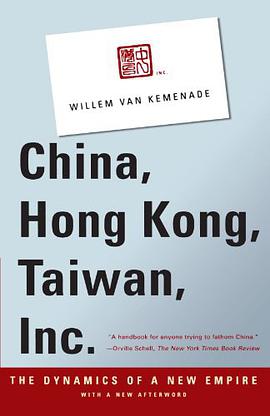
CHINA, HONG KONG, TAIWAN, INC. The Dynamics of a New Empire
By Willem van Kemenade. Translated from Dutch by Diane Webb. 448 pages. $27.50. Alfred A. Knopf.
ASIA'S WEALTH CLUB
By Geoff Hiscock. 312 pages. £16.99. Nicholas Brealey Publishing, London; Allen & Unwin, Australia.
THE themes of these two books might seem to have been totally exhausted. Can there really be anything more to be said about about topics that have been in publishing vogue for the last four years, at least?
Perhaps not. But Willem van Kemenade and (less ambitiously) Geoff Hiscock say things uncommonly well and with a dispassion that has become unusual. The former is worth half a shelf of other recent China books, and Hiscock is concise about a subject — Asia's megamillionaires — that is normally dealt with in terms more gushing than accurate.
Both authors are journalists, and both write from the perspective of many years' experience in their subjects and a clear desire to inform rather than to shock, argue or attract the attention of buyers of movie rights.
Van Kemenade's book has two main strengths. It looks at Hong Kong and Taiwan as well as the mainland, and thus at how these three very different Chinese social and political cultures may interact in the future. Second, by leading the reader through the evolution of the three entities, he brings out the complexities of today's situation and the uncertainty — particularly now that Deng Xiaoping is gone — over the future. Contrary to Deng's expectations, cross-straits trade and investment have boomed, along with karaoke bars, and the political gulf has widened while China's sense of restored military might has altered its perceptions of resolving the Taiwan issue.
Van Kemenade mostly lets the facts speak for themselves. In the process he reveals a China that, for all its internal problems, retains a clear sense of its national objectives, even when interests conflict.
On the other hand, the West comes across as cynical or pompous. China's ability to buy the Western business elites with baubles and flattery may be well known in Hong Kong and Beijing but is perhaps less appreciated in the home countries. Europe is cynical. The United States is preachy, vacillating between condemnation and desire to covert China to the American way.
If van Kemenade has committed one major fault, its with the title of the book, which makes it sound like an investment bankers' prospectus extolling the imminent juncture of mainland size, Taiwanese manufacturing prowess and Hong Kong capital and service industries in one giant economic bloc. This is certainly not the conclusion to be drawn from the book as a whole.
And though the author rightly sees Hong Kong's reversion as weakening Taiwan's position, he overstates Taipei's dependence on the mainland, and the business pressures on government for direct links.
Indeed, van Kemenade's grasp of economic issues is less firm than his grasp of politics. In particular he gives inadequate attention to the interlinked questions of private ownership, state enterprise reform and the role of the party. Will the nomenklatura privatize to its own advantage? Or keep the state sector and a centralized banking system as levers of political power?
But contemporary China is so diverse that no book can handle past, present and future in all aspects. Van Kemenade has done a fine job in making the complexities comprehensible to newcomers to the subject, and reminding older hands of the origins of the current issues.
Hiscock has rather more limited objectives. "Asia's Wealth Club" is defined by its subtitle: "Who's Really Who in Business — the top 100 billionaires in Asia." The brief, two- to three-page portraits of leading business figures and their companies range from Japan to India.
The book may be overfocused on Southeast Asian Chinese. But it is a useful primer, even if the information is basic and many of the numbers must be treated as best guesstimates. You will not find here much inquiry as to how some of these men got to be superrich. In a few cases it may be dangerous even to ask such questions, let alone provide the answers. But if Hiscock lacks investigative spirit, he is free of hyperbole. This is the best current reference work on its subject.