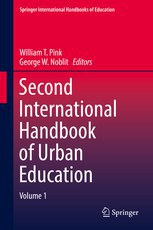

具体描述
This second handbook offers all new content in which readers will find a thoughtful and measured interrogation of significant contemporary thinking and practice in urban education. Each chapter reflects contemporary cutting-edge issues in urban education as defined by their local context. One important theme that runs throughout this handbook is how urban is defined, and under what conditions the marginalized are served by the schools they attend.
Schooling continues to hold a special place both as a means to achieve social mobility and as a mechanism for supporting the economy of nations. This second handbook focuses on factors such as social stratification, segmentation, segregation, racialization, urbanization, class formation and maintenance, and patriarchy. The central concern is to explore how equity plays out for those traditionally marginalized in urban schools in different locations around the globe. Researchers will find an analysis framework that will make the current practice and outcomes of urban education, and their alternatives, more transparent, and in turn this will lead to solutions that can help improve the life-options for students historically underserved by urban schools.
作者简介
William T. Pink is Professor Emeritus of Educational Policy and Leadership studies in the College of Education at Marquette University, where he has served as both department chair and as director of the doctoral program. He has published widely in the areas of delinquency, sociology of education, and educational reform. He has been the co-editor of The Urban Review (Springer) since 1978, co-editor of a book series entitled, Understanding Education, Social Justice, and Policy (Hampton Press), and co-editor of the book series entitled Education, Equity, Economy (Springer), both with George Noblit. He was recently appointed as Associate Editor of The Oxford Research Encyclopedia of Education (Oxford University Press). His most recent books are Cultural Matters: Lessons Learned from Field Studies of Several Leading School Reform Strategies (Hampton Press, 2005), the International Handbook of Urban Education (Springer, 2007), and Schools for Marginalized Youth: An International Perspective (Hampton Press, 2012).
George W. Noblit is Joseph R. Neikirk Distinguished Professor of Education at the University of North Carolina at Chapel Hill. His research has focused on urban education, race and equitable schooling, and qualitative research methods. He is an award winning scholar, most recently of the Mary Anne Raywid Award for Distinguished Scholarship from the Society of Professors of Education. His most recent books are School desegregation: Oral histories toward the understanding the effects of White domination (Sense Publishers, 2015) and (co-edited with William Pink) Education, equity and economy: Crafting a new intersection (Springer, 2016). He is the co-editor of The Urban Review. He was also co-editor of the International Handbook of Urban Education (Springer, 2007) which was the predecessor to this volume. Most recently, he is founding Editor-in-Chief of the Oxford Research Encyclopedia of Education, a global, online, continually revisable repository of education research.
目录信息
读后感
用户评价
作为一名长久关注城市规划与社会发展交叉领域的读者,我发现这部手册的价值远超教育学科本身。它更像是一部关于现代城市治理的教科书,只不过将焦点聚焦在了下一代的塑造之上。最让我印象深刻的是它对于“记忆”与“地方感”在城市教育中的作用的探讨。书中有一系列关于历史创伤如何通过教育体系被“消毒”或“重写”的案例研究,这揭示了教育系统在维护城市主流叙事方面的隐形权力。例如,在讨论后工业城市转型时,书中对比了两种截然不同的课程设置:一种强调“技能适应性”以满足新兴产业需求,另一种则致力于保留地方手工艺与社区叙事。这两种路径的张力,精确地捕捉了现代城市教育面临的核心困境——是培养可替换的“人力资本”,还是培育有根基的“公民主体”?作者们巧妙地运用了大量的城市地理学和社会学理论,使讨论的维度得以极大地拓宽,让人在阅读时,不仅是在思考“如何教”,更是在反思“我们希望城市成为一个什么样的共同体”。
坦率地说,这本书的学术密度非常高,初次阅读时需要反复咀嚼才能完全领会其精妙之处。我尤其欣赏其在方法论上的大胆尝试,它似乎有意识地打破了定性与定量研究的壁垒。书中既有对大型教育调查数据的严谨统计分析,展示宏观趋势的不可逆转性,紧接着又会插入一小段极具画面感的口述史,讲述某个城市角落里一个家庭为争取优质教育资源所付出的心酸努力。这种宏观与微观、冰冷数据与滚烫人性之间的频繁切换,极大地增强了文本的感染力与说服力。我感觉作者们仿佛是一位经验丰富的交响乐指挥,将来自不同领域的声音、理论和数据编织成一首复杂而和谐的乐章。对于那些习惯于单一学科视角来理解复杂社会现象的读者来说,这本书无疑是一次震撼教育,它强迫你必须从多重视角去审视“城市”这个动态的、充满矛盾的教育场域。
这本书最让我感到惊喜的,是它对“未来”的想象力,而不是仅仅停留在对现有问题的修修补补上。它没有将城市教育视为一个需要修复的“问题集合”,而是将其视为一个不断演进的“创新实验室”。其中关于“去中心化学习网络”的构想,尤其引人入胜。作者们设想了一种基于城市社区节点的、灵活互联的学习生态系统,在这个系统中,传统的学校机构可能退居二线,而社区空间、专业机构和数字平台将协同运作。这听起来有些理想主义,但书中详尽阐述了实现这一愿景所需要的政策变革、技术支撑和社会信任基础。这种前瞻性,使得整部著作充满了建设性的能量,而不是沉溺于对衰败和不公的控诉。它提供了一种强有力的论据,即解决城市教育困境的钥匙,不在于简单地增加对现有学校的投入,而在于重塑教育与城市生活本身的连接方式。读完之后,我感觉自己对未来几年城市教育政策的发展方向有了一种清晰的预判和期待。
这部厚重的文集,汇集了全球城市教育领域最前沿的思考与实践,着实让人眼前一亮。它不像某些学术著作那样故作高深,而是以一种近乎田野调查的扎实感,将我们带入那些光怪陆离、充满张力的城市教育现场。我特别欣赏它对“城市”这个概念的解构,不再仅仅是钢筋水泥的集合,而是作为一种复杂的社会生态系统,渗透到每一个学生的学习经验之中。书中的案例跨越了从曼哈顿的高端私立学校到里约热内卢贫民窟的临时课堂,这种全球视野的并置,使得即便是对城市教育议题相对熟悉的读者,也能从中汲取到新的视角。例如,其中一篇关于数据驱动决策如何无意中加剧了特定族裔社区边缘化的分析,其逻辑链条之严密,论据之充分,简直令人拍案叫绝。它没有提供简单的“灵丹妙药”,而是精确地指出了系统内部的结构性矛盾,这种批判性的深度,才是真正有价值的学术贡献。读完感觉像是完成了一次高强度的智力马拉松,需要时间去消化其中蕴含的丰富信息和深刻洞见。
翻开这本书,首先扑面而来的是一种蓬勃的、充满实验精神的气息。它似乎在挑战传统教育学中那些根深蒂固的假设,尤其是在谈论“公平”与“效率”的平衡时,其论述角度极其刁钻且富有启发性。我注意到它对“非正式学习空间”的强调,不再局限于传统意义上的学校建筑,而是将博物馆、公共图书馆、甚至是城市交通系统都纳入了教育的范畴进行审视。这种对环境的整体性关注,体现了作者们敏锐的洞察力——在现代城市环境中,教育早已溢出了教室的四壁。其中有一章探讨了数字鸿沟在垂直城市化进程中的新表现形式,观点非常尖锐:技术本应是连接的桥梁,但在资源分配不均的现实下,它反而可能固化了原有的阶层壁垒。作者们没有停留在简单的描述层面,而是深入剖析了政策制定者在模糊的“创新”口号下,如何无意识地成为了维护既得利益的帮凶。整本书的语言风格,虽然学术性毋庸置疑,但其叙事节奏却掌控得极好,总能在关键时刻插入引人深思的诘问,让人无法停止阅读。
所谓“写过”
所谓“写过”
所谓“写过”
所谓“写过”
所谓“写过”