
具体描述
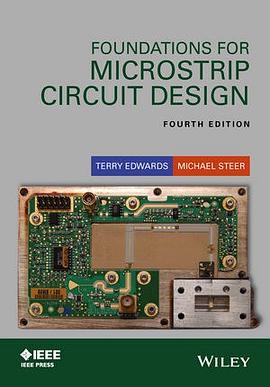
Building on the success of the previous three editions, Foundations for Microstrip Circuit Design offers extensive new, updated and revised material based upon the latest research. Strongly design-oriented, this fourth edition provides the reader with a fundamental understanding of this fast expanding field making it a definitive source for professional engineers and researchers and an indispensable reference for senior students in electronic engineering.
Topics new to this edition: microwave substrates, multilayer transmission line structures, modern EM tools and techniques, microstrip and planar transmision line design, transmission line theory, substrates for planar transmission lines, Vias, wirebonds, 3D integrated interposer structures, computer-aided design, microstrip and power-dependent effects, circuit models, microwave network analysis, microstrip passive elements, and slotline design fundamentals.
作者简介
Mr Terence Edwards, Engalco Research, UK
Terry Edwards gained a Diploma in Technology (Eng.) at what is now London South Bank University. During his early career he was a senior development engineer for Ultra Electronics. This carried the responsibility for the microminiaturisation of electronics on the control system for the Concorde jet engine. Technology has been a constant theme for his career and he moved into lecturing basic electrical engineering and electronics at High Wycombe College of Technology & Arts. He took on a landmark role of senior lecturer at La Trobe University in Melbourne, Australia that involved him launching and teaching solid state microwave technology. Until recently he was Executive Director of Engalco Research, a strategic commercial and military industrial consultancy and research organization. Engalco is well known for providing industry and market data reports in the field of microwave products for defense and SATCOM applications. From January 2014 Terry has been leading a new management and technology venture names Edwards Research Associates.
Professor Michael B Steer, North Carolina State University, USA
Michael Steer is the Lampe Distinguished Professor of Electrical and Computer Engineering at North Carolina State University (NC State). He is a Fellow of the IEEE (the Institute of Electrical and Electronics Engineers). He was Secretary of the IEEE Microwave Theory and Techniques Society (MTT-S) in 1997 and was a member of the MTT-S Administrative Committee from 1998 to 2001, and from 2003 to 2006. He received a Service Recognition Awards from the Society in 1998 and 2001.
目录信息
Preface xxiii
Acknowledgements xxv
1 Introduction to Design Using Microstrip and Planar Lines 1
1.1 Introduction 1
1.2 Origins of Microstrip 2
1.3 RF and Microwave Modules 4
1.4 Interconnections on RF and Microwave Integrated Circuits 13
1.5 High-speed Digital Interconnections 15
1.6 Summary 18
References 18
2 Fundamentals of Signal Transmission on Interconnects 19
2.1 Introduction 19
2.2 Transmission Lines and Interconnects 19
2.3 Interconnects as Part of a Packaging Hierarchy 20
2.4 The Physical Basis of Interconnects 21
2.5 The Physics, a Guided Wave 23
2.6 When an Interconnect Should be Treated as a Transmission Line 32
2.7 The Concept of RF Transmission Lines 34
2.8 Primary Transmission Line Constants 34
2.9 Secondary Constants for Transmission Lines 35
2.10 Transmission Line Impedances 37
2.11 Reflection 38
2.12 Multiple Conductors 41
2.13 Return Currents 44
2.14 Modeling of Interconnects 47
2.15 Summary 49
References 50
3 Microwave Network Analysis 51
3.1 Introduction 51
3.2 Two-port Networks 51
3.3 Scattering Parameter Theory 55
3.4 Signal-flow Graph Techniques and S Parameters 70
3.5 Summary 74
References 74
4 Transmission Line Theory 76
4.1 Introduction 76
4.2 Transmission Line Theory 76
4.3 Chain (ABCD) Parameters for a Uniform Length of Loss-free Transmission Line 81
4.4 Change in Reference Plane 82
4.5 Working With a Complex Characteristic Impedance 83
4.6 Summary 87
References 88
5 Planar Interconnect Technologies 89
5.1 Introductory Remarks 89
5.2 Microwave Frequencies and Applications 89
5.3 Transmission Line Structures 91
5.4 Substrates for Planar Transmission Lines 98
5.5 Thin-film Modules 102
5.6 Thick-film Modules 104
5.7 Monolithic Technology 105
5.8 Printed Circuit Boards 108
5.9 Multichip Modules 111
5.10 Summary 116
References 117
6 Microstrip Design at Low Frequencies 120
6.1 The Microstrip Design Problem 120
6.2 The Quasi-TEM Mode of Propagation 122
6.3 Static-TEM Parameters 124
6.4 Effective Permittivity and Characteristic Impedance of Microstrip 127
6.5 Filling Factor 132
6.6 Approximate Graphically Based Synthesis 134
6.7 Formulas for Accurate Static-TEM Design Calculations 137
6.8 Electromagnetic Analysis-based Techniques 139
6.9 A Worked Example of Static-TEM Synthesis 140
6.10 Microstrip on a Dielectrically Anisotropic Substrate 141
6.11 Microstrip and Magnetic Materials 146
6.12 Effects of Finite Strip Thickness, Metallic Enclosure, and Manufacturing
Tolerances 147
6.13 Pulse Propagation along Microstrip Lines 151
6.14 Recommendations Relating to the Static-TEM Approaches 152
6.15 Summary 154
References 155
7 Microstrip at High Frequencies 157
7.1 Introduction 157
7.2 Frequency-dependent Effects 157
7.3 Approximate Calculations Accounting for Dispersion 169
7.4 Accurate Design Formulas 173
7.5 Effects due to Ferrite and to Dielectrically Anisotropic Substrates 182
7.6 Field Solutions 183
7.7 Frequency Dependence of Microstrip Characteristic Impedance 186
7.8 Multimoding and Limitations on Operating Frequency 190
7.9 Design Recommendations 194
7.10 Summary 196
References 196
8 Loss and Power-dependent Effects in Microstrip 200
8.1 Introduction 200
8.2 Q Factor as a Measure of Loss 200
8.3 Power Losses and Parasitic Effects 208
8.4 Superconducting Microstrip Lines 216
8.5 Power-handling Capabilities 219
8.6 Passive Intermodulation Distortion 221
8.7 Summary 224
References 224
9 Discontinuities in Microstrip 227
9.1 Introduction 227
9.2 The Main Discontinuities 228
9.3 Bends in Microstrip 236
9.3.1 The Right-angled Bend or “Corner” 236
9.3.2 Mitered or “Matched” Microstrip Bends, Compensation Techniques 238
9.4 Step Changes in Width (Impedance Step) 241
9.4.1 The Symmetrical Microstrip Step 241
9.4.2 The Asymmetrical Step in Microstrip 243
9.5 The Narrow Transverse Slit 243
9.6 Microstrip Junctions 245
9.7 Recommendations for the Calculation of Discontinuities 261
9.8 Summary 266
References 266
10 Parallel-coupled Microstrip Lines 268
10.1 Introduction 268
10.2 Coupled Transmission Line Theory 269
10.3 Formulas for Characteristic Impedance of Coupled Lines 278
10.4 Semi-empirical Analysis Formulas as a Design Aid 290
10.5 An Approximate Synthesis Technique 301
10.6 Summary 304
References 304
11 Applications of Parallel-coupled Microstrip Lines 306
11.1 Introduction 306
11.2 Directional Couplers 306
11.3 Design Example: Design of a 10 dB Microstrip Coupler 308
11.4 Frequency- and Length-Dependent Characteristics of Directional Couplers 310
11.5 Special Coupler Designs with Improved Performance 315
11.6 Thickness Effects, Power Losses, and Fabrication Tolerances 329
11.7 Choice of Structure and Design Recommendations 331
11.8 Summary 336
References 337
12 Microstrip Passive Elements 339
12.1 Introduction 339
12.2 Lumped Elements 339
12.3 Terminations and Attenuators 343
12.4 Microstrip Stubs 345
12.5 Hybrids and Couplers 348
12.6 Power Combiners and Dividers 355
12.7 Baluns 357
12.8 Integrated Components 359
12.9 Summary 365
References 365
13 Stripline Design 369
13.1 Introduction 369
13.2 Symmetrical Stripline 370
13.3 Asymmetrical Stripline 373
13.4 Suspended Stripline 375
13.5 Coupled Stripline 375
13.6 Double-sided Stripline 379
13.7 Discontinuities 380
13.8 Design Recommendations 381
13.9 Summary 382
References 382
14 CPW Design Fundamentals 384
14.1 Introduction to Properties of Coplanar Waveguide 384
14.2 Modeling CPWs 389
14.3 Formulas for Accurate Calculations 391
14.4 Loss Mechanisms 393
14.5 Dispersion 397
14.6 Discontinuities 408
14.7 Circuit Elements 421
14.8 Variants on the Basic CPW Structure 430
14.9 Summary 439
References 439
15 Slotline 443
15.1 Introduction 443
15.2 Basic Concept and Structure 444
15.3 Operating Principles and Modes 444
15.4 Propagation and Dispersion Characteristics 447
15.5 Evaluation of Guide Wavelength and Characteristic Impedance 451
15.6 Losses 453
15.7 End-effects: Open Circuits and Short Circuits 455
15.8 Summary 463
References 463
16 Slotline Applications 465
16.1 Introduction 465
16.2 Comparators and Couplers 465
16.3 Filter Applications 472
16.4 Magic T 474
16.5 The Marchand Balun 477
16.6 Phase Shifters 480
16.7 Isolators and Circulators 481
16.8 A Double-sided, Balanced Microwave Circuit 486
16.9 Summary 486
References 486
17 Transitions 488
17.1 Introduction 488
17.2 Coaxial-to-microstrip Transitions 488
17.3 Waveguide-to-microstrip Transitions 490
17.4 Transitions between CPW and other Mediums 495
17.5 Slotline Transitions 498
17.6 Other Microstrip Transitions 510
17.7 Summary 511
References 511
18 Measurements of Planar Transmission Line Structures 514
18.1 Introduction 514
18.2 Instrumentation Systems for Microstrip Measurements 514
18.3 Measurement of Scattering Parameters 515
18.4 Measurement of Substrate Properties 519
18.5 Microstrip Resonator Methods 523
18.6 Q Factor Measurements 533
18.7 Measurements of Parallel-coupled Microstrips 535
18.8 Time-domain Reflectometry Techniques 537
18.9 Summary 539
References 539
19 Filters Using Planar Transmission Lines 541
19.1 Introduction 541
19.2 Filter Prototypes 541
19.2.7 Moderate Bandwidth Transmission Line Stub Model of an Inverter 550
19.3 Microstrip Filters 554
19.4 Microstrip Bandpass Filters 559
19.5 Parallel-coupled Line Bandpass Filters 561
19.6 Filter Design Accounting for Losses 572
19.7 Dielectric Resonators and Filters Using Them 572
19.8 Spurline Bandstop Filters 573
19.9 Summary 575
References 575
20 Magnetic Materials and Planar Transmission Lines 576
20.1 Introduction 576
20.2 Microwave Magnetic Materials 577
20.3 Effective Permeability of Magnetic Materials 587
20.4 Microstrip on a Ferrite Substrate 589
20.5 Isolators and Circulators 592
20.6 Transmission Lines Using Metaconductors 595
20.7 Frequency Selective Limiter 606
20.8 Summary 607
References 607
21 Interconnects for Digital Systems 610
21.1 Introduction 610
21.2 Overview of On-chip Interconnects 610
21.3 RC Modeling of On-chip Interconnects 613
21.4 Modeling Inductance 619
21.5 Clock Distribution 622
21.6 Resonant Clock Distribution 625
21.7 Summary 626
References 627
A Physical and Mathematical Properties 629
A.1 SI Units 629
A.2 SI Prefixes 629
A.3 Physical and Mathematical Constants 631
A.4 Basis of Electromagnetic SI Units 631
A.5 Relationship of SI Units to CGS Units 632
B Material Properties 635
References 642
C RF and Microwave Substrates 643
C.1 Hard substrates 643
C.2 Soft Substrates 644
Index 647
· · · · · · (收起)
读后感
用户评价
我一直对那些能够将抽象的物理概念转化为实际可行设计方法的书籍情有独钟,而这本书恰恰满足了我的这种需求。它没有回避微带电路设计中的复杂性,而是以一种非常务实的方式,带领读者一步步攻克难关。书中关于无源滤波器的设计部分,是我最感兴趣的部分之一。无论是基于微带线的低通、高通、带通滤波器,还是耦合线滤波器,作者都提供了清晰的设计流程和详细的参数计算方法。特别是在讨论如何实现高Q值和宽带特性时,作者给出了一些非常巧妙的设计技巧,这让我受益匪浅。此外,书中对于微带天线的设计也进行了初步的介绍,虽然不是本书的重点,但为我对微带技术在天线领域的应用打开了新的思路。我喜欢书中那种“授人以渔”的教学方式,它不仅仅告诉我们“怎么做”,更重要的是解释了“为什么这样做”。这种对原理的深刻理解,比死记硬背公式要重要得多。总的来说,这本书是一本极其实用的设计参考书,可以帮助你从零开始构建一个微带电路,或者在你遇到设计瓶颈时,提供有效的解决方案。
如果你正在寻找一本能够让你在微带电路设计领域“融会贯通”的书籍,那么这本书绝对是你的不二之选。它不像某些技术书籍那样枯燥乏味,而是将复杂的理论与实际应用紧密结合,让读者在学习中感受到乐趣。书中对于各种微带器件的详细分析,例如匹配网络、衰减器、移相器等,都提供了清晰的设计指导和计算公式。我尤其喜欢关于S参数分析的部分,它对于理解微带电路的性能至关重要,而这本书的讲解非常透彻。书中还涉及了一些关于PCB制造工艺的讨论,例如蚀刻精度、介质损耗等,这些都是影响微带电路性能的关键因素,而这些内容往往在其他基础书籍中被忽略。我曾与一些在射频领域工作多年的工程师交流过,他们都对这本书赞不绝口。他们认为,这本书不仅适合初学者,对于有经验的设计师来说,也是一本极具价值的参考书,能够帮助他们解决设计中遇到的各种疑难杂症。总而言之,这本书是一本集理论深度、实用性、以及前沿技术讨论于一体的杰作,绝对值得每一位微带电路设计从业者拥有。
坦白说,当我第一次拿起这本书时,我对微带电路设计的了解还比较浅显。但随着阅读的深入,我发现这本书以一种非常循序渐进的方式,将我带入了微带电路设计的奇妙世界。从传输线的特性阻抗如何影响信号的传输,到如何通过匹配网络来最小化信号反射,这本书都用生动形象的比喻和清晰的数学推导,将这些概念解释得淋漓尽致。我特别欣赏的是,作者在介绍各种无源器件时,都考虑到了它们在微带电路中的实际布局和连接方式,以及由此产生的寄生效应。这对于实际的电路实现至关重要。书中关于功率分配器和耦合器的设计部分,也非常具有启发性。它不仅展示了如何设计这些基本的射频构建模块,还探讨了如何优化它们的性能,例如插入损耗和隔离度。我曾经尝试过根据书中的例子来设计一个简单的功率分配器,结果非常令人满意。这本书的语言风格也很容易理解,即使是对于非专业背景的读者,也能从中获得很多启示。总的来说,这是一本能够让你快速入门并建立起坚实微带电路设计基础的优秀读物。
这本书绝对是射频微带电路设计领域的瑰宝。我一直对微带技术如何将复杂的电子功能集成到如此小的空间内感到着迷,而这本书则以一种极其清晰且系统的方式揭示了其中的奥秘。从最基础的微带线传输线理论,到复杂的阻抗匹配网络设计,再到各种无源和有源器件在微带电路中的应用,作者都进行了深入浅出的讲解。书中大量的图示和公式推导,更是帮助我这种动手能力更强的读者,能够迅速理解理论知识并将其转化为实际的设计思路。我尤其欣赏的是,作者并没有仅仅停留在理论层面,而是花了很大篇幅来讨论实际的设计考量,例如寄生效应、损耗分析、以及不同制造工艺对性能的影响。这些贴近实际经验的指导,对于初学者来说至关重要,可以避免许多常见的陷阱。我曾尝试过独立设计一些简单的微带电路,但总是遇到各种问题,而阅读了这本书后,我才意识到之前忽略了多少细节。它不仅是教科书,更像是一位经验丰富的设计导师,在你迷茫时为你指点迷津。即使是对已经有一定基础的设计者,这本书也能提供许多新的视角和更深入的理解,帮助提升设计水平。
对于任何想要深入理解微带电路设计原理的人来说,这本书都是一个不二之选。它以一种非常扎实和严谨的方式,构建了整个知识体系。从电磁场理论在微带线中的应用出发,逐步引入了诸如集肤效应、介电损耗等关键概念,这些都是理解微带电路性能限制的基石。书中对不同类型微带结构的分析,例如阶跃阻抗微带线、耦合微带线等,及其各自的特点和应用场景,都讲解得非常到位。最让我印象深刻的是,作者对于微带电路仿真和建模的论述。在现代电子设计中,仿真工具是不可或缺的,而理解仿真背后的理论原理,才能更好地利用它们。这本书详细介绍了如何将物理模型转化为仿真模型,以及如何解释仿真结果,这对于优化设计和排除故障至关重要。我尤其喜欢作者在讨论多层微带结构时,所提供的详细分析方法,这对于设计复杂的射频前端模块非常有帮助。总而言之,这本书的内容密度很高,信息量巨大,需要耐心和细致地阅读,但付出的努力绝对是值得的,因为它能为你打下坚实的理论基础,让你在未来的设计道路上更加自信。