
具体描述
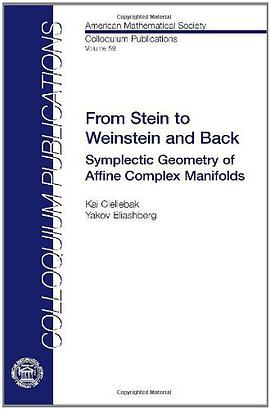
This excellent book gives a detailed, clear, and wonderfully written treatment of the interplay between the world of Stein manifolds and the more topological and flexible world of Weinstein manifolds. Devoted to this subject with a long history, the book serves as a superb introduction to this area and also contains the authors' new results.
--Tomasz Mrowka, MIT
作者简介
目录信息
Preface xi
Chapter 1. Introduction 1
1.1. An overview 1
1.2. Plan of the book 6
Part 1. J-Convexity 9
Chapter 2. J-Convex Functions and Hypersurfaces 11
2.1. Linear algebra 11
2.2. J-convex functions 13
2.3. The Levi form of a hypersurface 15
2.4. Completeness 18
2.5. J-convexity and geometric convexity 19
2.6. Normalized Levi form and mean normal curvature 20
2.7. Examples of J-convex functions and hypersurfaces 22
2.8. Symplectic properties of J-convex functions 25
2.9. Computations in C
n 27
Chapter 3. Smoothing 31
3.1. J-convexity and plurisubharmonicity 31
3.2. Smoothing of J-convex functions 34
3.3. Critical points of J-convex functions 37
3.4. From families of hypersurfaces to J-convex functions 40
3.5. J-convex functions near totally real submanifolds 42
3.6. Functions with J-convex level sets 48
3.7. Normalized modulus of J-convexity 50
Chapter 4. Shapes for i-Convex Hypersurfaces 57
4.1. Main models 57
4.2. Shapes for i-convex hypersurfaces 59
4.3. Properties of i-convex shapes 64
4.4. Shapes in the subcritical case 67
4.5. Construction of special shapes 68
4.6. Families of special shapes 75
4.7. Convexity estimates 83
Chapter 5. Some Complex Analysis 89
5.1. Holomorphic convexity 89
5.2. Relation to J-convexity 90
5.3. Definitions of Stein manifolds 93
5.4. Hartogs phenomena 94
5.5. Grauert’s Oka principle 96
5.6. Coherent analytic sheaves on Stein manifolds 99
5.7. Real analytic manifolds 101
5.8. Real analytic approximations 104
5.9. Approximately holomorphic extension of maps
from totally real submanifolds 107
5.10. CR structures 108
Part 2. Existence of Stein Structures 113
Chapter 6. Symplectic and Contact Preliminaries 115
6.1. Symplectic vector spaces 115
6.2. Symplectic vector bundles 117
6.3. Symplectic manifolds 118
6.4. Moser’s trick and symplectic normal forms 119
6.5. Contact manifolds and their Legendrian submanifolds 122
6.6. Contact normal forms 125
6.7. Real analytic approximations of isotropic submanifolds 127
6.8. Relations between symplectic and contact manifolds 128
Chapter 7. The h-principles 131
7.1. Immersions and embeddings 131
7.2. The h-principle for isotropic immersions 135
7.3. The h-principle for subcritical isotropic embeddings 136
7.4. Stabilization of Legendrian submanifolds 137
7.5. The existence theorem for Legendrian embeddings 139
7.6. Legendrian knots in overtwisted contact manifolds 141
7.7. Murphy’s h-principle for loose Legendrian embeddings 142
7.8. Directed immersions and embeddings 146
7.9. Discs attached to J-convex boundaries 150
Chapter 8. The Existence Theorem 155
8.1. Some notions from Morse theory 155
8.2. Surrounding stable discs 156
8.3. Existence of complex structures 161
8.4. Existence of Stein structures in complex dimension = 2 163
8.5. J-convex surrounding functions 167
8.6. J-convex retracts 171
8.7. Approximating continuous maps by holomorphic ones 174
8.8. Variations on a theme of E. Kallin 181
Part 3. Morse–Smale Theory for J-Convex Functions 185
Chapter 9. Recollections from Morse Theory 187
9.1. Critical points of functions 187
9.2. Zeroes of vector fields 189
9.3. Gradient-like vector fields 192
9.4. Smooth surroundings 198
9.5. Changing Lyapunov functions near critical points 200
9.6. Smale cobordisms 202
9.7. Morse and Smale homotopies 206
9.8. The h-cobordism theorem 210
9.9. The two-index theorem 212
9.10. Pseudo-isotopies 213
Chapter 10. Modifications of J-Convex Morse Functions 215
10.1. Moving attaching spheres by isotropic isotopies 215
10.2. Relaxing the J-orthogonality condition 222
10.3. Moving critical levels 223
10.4. Creation and cancellation of critical points 224
10.5. Carving one J-convex function with another one 225
10.6. Surrounding a stable half-disc 225
10.7. Proof of the cancellation theorem 231
10.8. Proof of the creation theorem 232
Part 4. From Stein to Weinstein and Back 235
Chapter 11. Weinstein Structures 237
11.1. Liouville cobordisms and manifolds 237
11.2. Liouville homotopies 239
11.3. Zeroes of Liouville fields 241
11.4. Weinstein cobordisms and manifolds 243
11.5. From Stein to Weinstein 244
11.6. Weinstein and Stein homotopies 245
11.7. Weinstein structures with unique critical points 249
11.8. Subcritical and flexible Weinstein structures 250
Chapter 12. Modifications of Weinstein Structures 253
12.1. Weinstein structures with given functions 253
12.2. Holonomy of Weinstein cobordisms 256
12.3. Liouville fields near isotropic submanifolds 258
12.4. Weinstein structures near critical points 263
12.5. Weinstein structures near stable discs 265
12.6. Morse–Smale theory for Weinstein structures 267
12.7. Elementary Weinstein homotopies 268
Chapter 13. Existence Revisited 271
13.1. Existence of Weinstein structures 271
13.2. From Weinstein to Stein: existence 273
13.3. Proof of the Stein existence theorems 275
Chapter 14. Deformations of Flexible Weinstein Structures 279
14.1. Homotopies of flexible Weinstein cobordisms 279
14.2. Proof of the first Weinstein deformation theorem 280
14.3. Proof of the second Weinstein deformation theorem 286
14.4. Subcritical Weinstein manifolds are split 288
14.5. Symplectic pseudo-isotopies 292
Chapter 15. Deformations of Stein Structures 295
15.1. From Weinstein to Stein: homotopies 295
15.2. Proof of the first Stein deformation theorem 298
15.3. Homotopies of flexible Stein structures 302
Part 5. Stein Manifolds and Symplectic Topology 305
Chapter 16. Stein Manifolds of Complex Dimension Two 307
16.1. Filling by holomorphic discs 307
16.2. Stein fillings 310
16.3. Stein structures on 4-manifolds 320
Chapter 17. Exotic Stein Structures 323
17.1. Symplectic homology 323
17.2. Exotic Stein structures 325
Appendix A. Some Algebraic Topology 329
A.1. Serre fibrations 329
A.2. Some homotopy groups 331
Appendix B. Obstructions to Formal Legendrian Isotopies 335
Appendix C. Biographical Notes on the Main Characters 343
C.1. Complex analysis 343
C.2. Differential and symplectic topology 348
Bibliography 353
Index 361
· · · · · · (收起)
读后感
用户评价
我必须承认,这本书的阅读体验是充满挑战性的,它绝非那种可以轻松消磨时光的“快餐文学”。它的密度非常高,每一个段落似乎都蕴含着丰富的信息量和多层含义,要求读者必须全神贯注地投入进去。我曾多次因为理解某个复杂的隐喻而不得不翻回去重读好几遍,但这种“费力”的过程,恰恰是它最吸引人的地方——它让你感觉自己真的在和作者进行一场智力上的博弈。这本书的叙事结构非常大胆,它似乎打破了传统的小说规范,采用了一种更加碎片化、更接近意识流的处理方式,这让故事的拼图需要读者自己动手去完成。在我看来,作者是在用一种近乎实验性的手法,来探索人类经验的复杂性。那些看似不相关的事件和人物,在书的后半部分会以一种令人震惊的方式交织在一起,那种豁然开朗的感觉,是阅读过程中最美妙的体验之一。它不仅是一个故事,更像是一份关于存在本身的备忘录。
这本书的封面设计就挺引人注目的,那种做旧的质感,配上深沉的色调,让人立刻感觉到里面可能藏着一些厚重的故事或者深刻的思考。我拿到书的时候,就忍不住翻了几页,发现作者的叙事方式非常独特,他似乎总是在不同的时间线和场景之间游走,构建了一个复杂而迷人的世界观。阅读过程中,我时常需要停下来,仔细回味刚刚读到的那些句子,那种感觉就像是走在一条蜿蜒曲折的小路上,每一步都可能通向一个未知的风景。书中对人物心理的刻画细腻入微,每一个角色都有着多重的面孔,他们的选择和挣扎都让人深思。我尤其喜欢作者处理冲突的方式,那种不动声色的张力,往往在看似平静的对话中爆发出来,让人不寒而栗。这本书的格局很大,它不只是讲述一个简单的故事,更像是在探讨一些宏大的议题,比如身份的构建、记忆的流逝,以及历史的重量。读完之后,我有一种意犹未尽的感觉,仿佛刚刚从一场漫长而又深刻的梦中醒来,需要时间去整理那些纷乱的思绪和触动。
拿到这本书时,我首先被它的厚度和排版吸引了,那种精装的质感本身就暗示了内容的重量。这本书的魅力在于它对宏大叙事与微观情感的平衡把握。作者似乎有一种魔力,能将那些似乎遥不可及的历史背景或者抽象概念,通过一两个具体人物的命运紧密联系起来,使得理论性的探讨瞬间变得有血有肉,触手可及。我发现,这本书最厉害的一点是它对“选择的代价”这一主题的探讨。它没有简单地给出对错,而是展示了每一个岔路口背后所蕴含的巨大可能性和随之而来的永恒遗憾。每一次翻页,都像是在见证一次重大的、不可逆转的命运抉择。读完后,我最大的感受是,作者成功地构建了一个既陌生又异常熟悉的世界,让我们得以从一个全新的角度去审视我们自己的生活轨迹和我们所处的时代。这本书需要耐心,但它给予读者的回报是巨大的,它会成为你书架上那种会时不时被你重新拿起,并从中汲取新的力量和启示的经典之作。
这本书的语言风格极其独特,它有一种古典的韵味和现代的疏离感完美融合的气质。作者在遣词造句上极为考究,很多句子读起来如同精雕细琢的艺术品,充满了古典文学的张力和美感,但同时,它又毫不避讳地触及了当下社会中一些尖锐和令人不安的议题。我特别欣赏作者对于“记忆”这一主题的处理,他没有采用简单的回忆录式写法,而是将记忆塑造成一个不稳定、易变且充满谎言的实体,这极大地增加了故事的悬疑色彩和哲学深度。每一次角色的闪回,都像是在揭示一个被时间扭曲的真相。这本书的氛围营造堪称一绝,那种弥漫在字里行间挥之不去的宿命感和疏离感,让人在阅读时感到一种沉甸甸的压迫感,但这种压迫感又是如此迷人,让你无法割舍。它迫使你去直面那些我们通常选择回避的、关于时间、遗忘与重构的难题。
这本书给我的感觉,就像是品尝一杯年代久远的威士忌,初入口时可能会觉得有些辛辣和陌生,但随着时间的推移,那种醇厚的味道会慢慢散发出来,让你沉醉其中。作者的文字功力毋庸置疑,他善于运用精确而富有画面感的词汇,将那些抽象的情感和复杂的思想具象化。我常常被那些突如其来的灵感闪现所震撼,比如某一个对光影的描述,或者某一句对人性弱点的精准剖析,都让我拍案叫绝。这本书的节奏掌握得非常巧妙,它时而急促如奔腾的河流,时而舒缓如静谧的湖泊,这种张弛有度的叙事节奏,牢牢抓住了读者的注意力。我发现,这本书的魅力在于它的留白,作者并没有把所有的答案都摆在明面上,而是留下了大量的空间供读者去想象、去填补,这使得每一次重读都会有新的发现。对于喜欢深度阅读和哲学思考的读者来说,这本书无疑是一份绝佳的礼物,它挑战你的认知边界,让你不得不去审视自己对世界的既有看法。