
具体描述
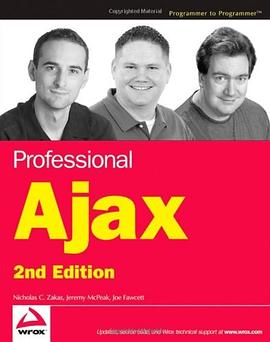
Professional Ajax 2nd Edition provides a developer-level tutorial of Ajax techniques, patterns, and use cases. The book begins by exploring the roots of Ajax, covering how the evolution of the web and new technologies directly led to the development of Ajax techniques. A detailed discussion of how frames, JavaScript, cookies, XML, and XMLHttp requests (XHR) related to Ajax is included. After this introduction, the book moves on to cover the implementation of specific Ajax techniques. Request brokers such as hidden frames, dynamic iframes, and XHR are compared and contrasted, explaining when one method should be used over another. To make this discussion clearer, a brief overview of HTTP requests and responses is included. Once a basic understanding of the various request types is discussed, the book moves on to provide in-depth examples of how and when to use Ajax in a web site or web application. Different data transmission formats, including plain text, HTML, XML, and JSON are discussed for their advantages and disadvantages. Also included is a discussion on web services and how they may be used to perform Ajax techniques. Next, more complex topics are covered. A chapter introducing a request management framework explores how to manage all of the requests inside of an Ajax application. Ajax debugging techniques are also discussed. The last part of the book walks through the creation of two full-fledged Ajax web applications. The first, FooReader.NET, is an Ajax-powered RSS reader. The second, called AjaxMail, is an Ajax-enabled email system. Both of these applications incorporate many of the techniques discussed throughout the book. Professional Ajax 2nd edition is written for Web application developers looking to enhance the usability of their web sites and web applications and intermediate JavaScript developers looking to further understand the language. Readers should have familiarity with XML, XSLT, Web Services, PHP or C#, HTML, CSS. This book is not aimed at beginners without a basic understanding of the aforementioned technologies. Also, a good understanding of JavaScript is vitally important to understanding this book. Those readers without such knowledge should instead refer to books such as Beginning JavaScript, Second Edition (Wrox, 2004, ISBN: 978-0-7645-5587-9) and Professional JavaScript for Web Developers (Wrox, 2005, ISBN: 978-0-7645-7908-0). Professional Ajax 2nd edition adds nearly 200 pages of new and expanded coverage compared to the first edition. Some of the new topics covered here include: Ajax Libraries including the Yahoo! Connection Manager, Prototype, and jQuery Request Management with Priority Queues and the RequestManager Object Comet push-based web systems and HTTP streaming Maps and Mashups with Geocoding, Google Maps API and Yahoo! Maps API Ajax Debugging with FireBug and Microsoft Fiddler ASP.NET AJAX Extensions (formerly code-named "Atlas") And of course the Second Edition retains and updates the core first edition content including: the range of request brokers (including the hidden frame technique, iframes, and XMLHttp) and explains when one should be used over another different Ajax techniques and patterns for executing client-server communication Ajax patterns including predictive fetch, page preloading, submission throttling, incremental field and form validation, periodic refresh, multi-stage download and more Syndication with RSS, Atom, and XParser JSON and creating an autosuggest textbox example web site widgets for a news ticker, weather information, web search, and site search Ajax Frameworks JSpan, DWR, and Ajax.NET Professional A Web-based RSS/Atom aggregator case study An AjaxMail case study This book is also available as part of the 4-book JavaScript and Ajax Wrox Box (ISBN: 0470227818). This 4-book set includes: Professional JavaScript for Web Developers (ISBN: 0764579088) Professional Ajax 2nd edition (ISBN: 0470109491) Professional Web 2.0 Programming (ISBN: 0470087889) Professional Rich Internet Applications: Ajax and Beyond (ISBN: 0470082801)
作者简介
Nicholas C. Zakas has a BS in Computer Science from Merrimack College and an MBA from Endicott
College. He is the author of Professional JavaScript for Web Developers (Wiley 2005) as well as several
online articles. Nicholas works for Yahoo! as a frontend engineer and has worked in web development
for more than 6 years, during which time he has helped develop web solutions in use at some of the
largest companies in the world. Nicholas can be reached through his web site at www.nczonline.net.
Jeremy McPeak began tinkering with web development as a hobby in 1998. Currently working in the IT
department of a school district, Jeremy has experience developing web solutions with JavaScript, PHP,
and C#. He has written several online articles covering topics such as XSLT, WebForms, and C#. He is
also co-author of Beginning JavaScript, 3rd Edition (Wiley 2007). Jeremy can be reached through his web
site at www.wdonline.com.
Joe Fawcett started programming in the 1970s and briefly worked in IT upon leaving full-time educa-
tion. He then pursued a more checkered career before returning to software development in 1994. In
2003 he was awarded the title of Microsoft Most Valuable Professional in XML for community contribu-
tions and technical expertise. He currently works in London as a developer for FTC Kaplan, a leading
international provider of accountancy and business training, where he specializes in systems integration.
目录信息
读后感
我在网上书城购买的这本书,看内容很不错!买回来时可高兴了。但是自己看起来很吃力,想找同学教教自己,但是大家都在学习,抽不出时间教我。后来隔壁宿舍的一个同学偶然提起说:他学计算机是在一个叫猎豹网校上面学的。我赶紧百度搜一下,呵,真的是琳琅满目啊,好多计算机课...
我在网上书城购买的这本书,看内容很不错!买回来时可高兴了。但是自己看起来很吃力,想找同学教教自己,但是大家都在学习,抽不出时间教我。后来隔壁宿舍的一个同学偶然提起说:他学计算机是在一个叫猎豹网校上面学的。我赶紧百度搜一下,呵,真的是琳琅满目啊,好多计算机课...
逻辑混乱,章节编排混乱。 最重要的是,对于一些我们关心的例如跨域问题,没有详细讲解。 更极端的是,书中居然说js闭包在大部分浏览器中会造成内存泄漏,让大家最好别用……
逻辑混乱,章节编排混乱。 最重要的是,对于一些我们关心的例如跨域问题,没有详细讲解。 更极端的是,书中居然说js闭包在大部分浏览器中会造成内存泄漏,让大家最好别用……
我在网上书城购买的这本书,看内容很不错!买回来时可高兴了。但是自己看起来很吃力,想找同学教教自己,但是大家都在学习,抽不出时间教我。后来隔壁宿舍的一个同学偶然提起说:他学计算机是在一个叫猎豹网校上面学的。我赶紧百度搜一下,呵,真的是琳琅满目啊,好多计算机课...
用户评价
这本书的语言风格非常独特,它既有学术研究的严谨性,又充满了实践者的幽默感和洞察力。作者似乎深谙技术书籍容易变得枯燥乏味的“陷阱”,所以在关键的技术点讲解之后,总会穿插一些非常接地气的比喻或者作者自己踩过的“坑”。这种亦师亦友的叙述方式,极大地降低了学习曲线的陡峭程度。比如,在讲解状态管理那部分,作者用了一个关于“连锁反应的咖啡订单”的比喻,瞬间就把复杂的订阅/发布模式的弊端阐释得淋漓尽致。而且,书中对不同技术路线的优劣势分析极其客观公正,没有明显的偏向性,这对于希望建立全面技术观的读者来说,是极其宝贵的财富。它不会告诉你“只有这个方法是正确的”,而是会引导你根据项目需求和团队背景做出最合适的权衡。这种成熟、中立的分析视角,让人感觉自己不是在学习一个单一的工具,而是在学习一套完整的工程化思维体系。
这本书的封面设计简直是复古与现代的完美结合,那种带着磨损感的纸张纹理和简洁的字体排版,一下子就让人回想起那个技术快速迭代的年代。我拿到书的时候,首先被它厚实的质感吸引住了,这可不是那种轻飘飘的速成指南,而是一本真正愿意沉下心来深入探讨的宝典。内页的纸张选择也十分考究,阅读起来不刺眼,即便是长时间盯着那些代码块和图表,眼睛也不会感到疲劳。排版上,作者似乎非常注重读者的阅读体验,关键概念的强调和代码示例的布局都经过了深思熟虑,使得复杂的逻辑流也能被清晰地梳理出来。特别是章节之间的过渡设计,非常平滑自然,不会让人感到阅读节奏被打断。如果你是一个注重工具质感和阅读沉浸感的开发者,光是拿起这本书放在桌面上,那种满足感就足以值回票价了。它散发出来的是一种老派匠人对作品的执着,那种“我把最好的东西都塞进去了”的诚意,是冰冷的电子文档永远无法比拟的。这本书的物理形态本身,就是对“专业”二字最好的诠释。
那些附带的实践项目和代码示例,设计得极具代表性和挑战性。它们不是那种简单到可以复制粘贴就能跑起来的“玩具代码”,而是真正模拟了工业级应用中会遇到的复杂交互场景。我花了大量时间去重构和扩展书中的案例,每一次深入挖掘,都能发现新的优化点或者设计模式的精妙之处。更棒的是,这些代码的组织结构非常清晰,注释详尽且富有条理,即便是时隔一段时间再回头看,也能迅速定位到核心逻辑。这种高质量的示例代码,其价值甚至超过了文字本身,因为它们是理论知识的活化石。对我来说,这本书更像是一个高级代码库的“使用说明书”,它教会的不仅仅是“怎么做”,更是“为什么用这种方式做会更好”。我甚至尝试将书中的一些高级特性应用到我正在维护的遗留系统中,效果立竿见影,解决了长期存在的性能瓶颈问题。
这本书的内容组织逻辑,简直像一位经验丰富的导师在为你铺设通往精通之路的阶梯。它没有急于展示那些光鲜亮丽的最新框架,而是从最底层的原理开始,一步步搭建起我们对现代前端交互模式的深刻理解。我尤其欣赏作者在解释异步操作的那些章节,那种深入到事件循环和浏览器渲染机制的剖析,简直是醍醐灌顶。很多市面上的书籍只是停留在“如何使用API”,但这本书却在追问“API为什么是这样设计的”。例如,它对性能优化方面的探讨,绝不是简单的列举几个技巧,而是将理论与实际场景紧密结合,让你明白在何种上下文下,选择哪种策略才能达到最佳效果。对我来说,它强迫我跳出了仅仅停留在“实现功能”的思维定式,而是开始思考如何构建健壮、可维护、高性能的交互系统。读完这部分,感觉自己的技术视野一下子被拓宽了,不再是被动地接受既成事实,而是开始主动地去理解和驾驭底层的运行机制。
这本书的深度和广度让人印象深刻,它真正做到了“百科全书”式的覆盖,但又没有陷入信息过载的泥潭。它涵盖了从基础的DOM操作到服务端渲染策略的方方面面,内容之全面,让我不得不惊叹于作者对整个技术栈的精深掌握。特别是关于未来趋势的探讨,那些章节的远见卓识,让我对未来几年的技术演进有了一个清晰的预判,这对于制定技术路线图至关重要。对于一个已经在行业内摸爬滚打多年的资深开发者来说,这本书更像是一面镜子,它能帮你审视自己知识体系中的薄弱环节,并提供了一条系统性的补强路径。它没有迎合那些追逐短期热点的浮躁心态,而是坚定地站在长期主义的角度,构建一套稳定可靠的技术基石。可以说,这本书的价值是跨越版本的,它传授的底层思维模式,是任何新框架都无法轻易取代的。