
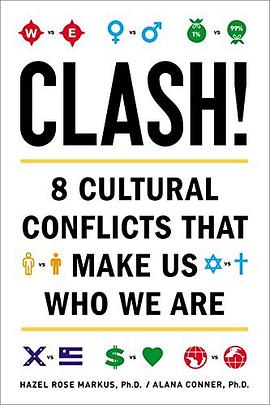

具體描述
What kind of person are you?
Are you independent--individual, unique, and in control of your world? Are you interdependent--relational, similar to others, and good at adjusting to situations?
Or are you both?
In Clash!, leading cultural psychologists Hazel Rose Markus and Alana Conner show us how our cultural backgrounds create and reflect these two basic ways of being a self, which then shape everything from how we run our governments to how we raise our children.
Markus and Conner also demonstrate how clashes between independence and interdependence fuel many of today's most pressing conflicts, including tensions between East and West, the Global North and Global South, men and women, blacks and whites, conservative and liberal, religious groups, rich and poor, and businesses, governments, and nonprofits.
Provocative and entertaining, Clash! offers solutions to many of the problems that plague our workplaces, schools, and relationships. For readers of The Culture Code by Clotaire Rapaille and The Wisdom of Crowds by James Surowiecki, it doesn't just explain who we are, it also envisions who we could become.
作者簡介
Hazel Rose Markus
Hazel Rose Markus is the Davis-Brack Professor in the Behavioral Sciences at Stanford University. Markus is the author of more than 150 publications on the role of self in regulating behavior and on the ways in which the self is shaped by the social world. She has developed the concepts of self-schemas and possible selves. This work shows how the self-system organizes perception, reasoning and memory and reveals the constructive role of the self throughout the life course. In experimental and survey studies, she has studied how the self and other psychological processes are grounded in cultural and social contexts. She received her B.A. from California State University at San Diego and her PhD. from the University of Michigan. She was elected to the American Academy of Arts and Sciences in 1994 and in 2008 received the American Psychological Association's award for Distinguished Scientific Contribution. She has served as co-director and director of Stanford's Research Center for Comparative Studies in Race and Ethnicity (CCSRE). She is co-author of Culture and Emotion: Their Mutual Influence, Engaging Cultural Differences:The Multicultural Challenge in Liberal Democracies, Just Schools: Pursuing Equality in Societies of Difference, and Doing Race: 21 Essays for the 21st Century.
Alana Conner
Alana Conner, PhD, is a cultural psychologist and science communicator who writes, speaks, and consults about enhancing the well-being of diverse populations around the world. An expert in social class differences in decision-making and health behavior change, she has published her research in the top journals of experimental psychology. She has also shared her findings through venues such as "The New York Times Magazine," "Edge.org," and the "Stanford Social Innovation Review," where she served as senior editor for five years.
Never confined to the classroom or the page, Dr. Conner has ten years experience designing interventions and communications for museums, broadcast media, and the Web. In positions ranging from Vice President of Content for The Tech Museum of Innovation (San Jose, CA) to co-host of the podcast channel "Social Innovation Conversations," she has crafted stories, messages, and interactive experiences that change behaviors among culturally diverse audiences.
Dr. Conner earned her bachelor's cum laude and with distinction in psychology from Yale University, her doctorate in cultural psychology from Stanford University, and her postdoctoral certificate in psychology and medicine from the University of California, San Francisco medical center, where she received the Robert Harris Award for Outstanding Postdoctoral Research. Her research was sponsored by the National Science Foundation and the National Institutes of Health.
A native of Memphis, Tennessee, Dr. Conner now lives and works in San Francisco.
目錄資訊
讀後感
用戶評價
我最近沉浸在《鐵血與玫瑰:帝國興衰錄》這部曆史小說裏,簡直無法自拔。這本書的史詩感撲麵而來,它聚焦於一個虛構但極具代入感的古老帝國的興衰史,描繪瞭權力的腐蝕、忠誠的考驗以及普通人在曆史洪流中的掙紮。作者的筆觸極其老辣,對戰爭場麵的描繪達到瞭近乎殘酷的真實感,那種刀光劍影、屍橫遍野的慘烈景象躍然紙上,讓人心驚膽戰。但同時,書中對宮廷鬥爭的刻畫又極其細膩入微,那些低語、眼神的交鋒,比真刀真槍的廝殺更具殺傷力。我特彆欣賞作者對角色復雜人性的挖掘,沒有絕對的好人與壞蛋,每個人物都有其光輝與陰暗麵,這種層次感讓整個故事顯得無比厚重和可信。讀罷掩捲,耳邊似乎還迴蕩著戰鼓聲和哀鴻遍野的嘆息,這是一部真正有分量的作品。
评分天哪,最近讀完一本叫《星河迷途》的書,簡直是腦洞大開!作者構建瞭一個宏大而又細膩的宇宙觀,那種感覺就像是把我扔進瞭一個光怪陸離的夢境裏,每一個星球都有自己獨特的文明和規則。我尤其喜歡書中對“時間悖論”的處理,它不是那種生硬的科幻設定,而是融入瞭角色深刻的情感糾葛中,每一次選擇都像是在刀尖上跳舞,讓人替他們捏一把汗。書裏的語言風格非常流暢,充滿瞭詩意和哲學思辨,讀起來就像是在聽一首悠揚的交響樂,時而激昂,時而低沉。而且,作者對於細節的把控力簡直驚人,比如描述某個古老文明遺跡時,那種塵封已久的曆史感撲麵而來,讓我仿佛能聞到空氣中彌漫的硫磺和苔蘚的味道。這本書不僅僅是關於太空冒險,它更像是一次對人類存在意義的追問,非常引人深思,絕對值得所有科幻迷收藏。
评分說實話,《像素人生模擬器》這本書,我一開始以為會是那種輕飄飄的、隻適閤消遣的“爽文”,結果大跌眼鏡!它用一種極其詼諧幽默,甚至帶著點後現代解構主義的筆法,探討瞭現代社會中“虛擬身份”與“真實自我”之間的巨大鴻溝。作者的幽默感把握得非常到位,那種冷不丁冒齣來的諷刺和自嘲,常常讓我笑齣聲來,但笑過之後,又會陷入深深的沉思。書中設計瞭許多遊戲化的機製來推進劇情,比如“社交點數”、“情緒負荷”等,這些設定巧妙地映射瞭我們日常生活中那些無形的壓力和KPI。它不是在批判技術,而是在探討我們在被技術塑形的過程中,如何保有最初的那份“人性火花”。這本書的閱讀體驗是輕鬆愉快的,但其內核卻堅實而深刻,非常適閤現代都市人閱讀反思。
评分我剛看完瞭一本名為《失落的頌歌》的奇幻文學作品,它的世界觀構建之精妙,簡直令人嘆為觀止。作者沒有落入俗套地去描繪精靈和矮人,而是創造瞭一個基於“聲音”和“共振”法則運作的魔法體係。想象一下,法術不再是火焰和冰霜,而是通過特定的音階、和弦甚至寂靜來操控物質和能量,這設定本身就充滿瞭藝術感和新意。書中對不同種族文化中“音樂”的描述,詳盡到近乎人類學田野調查的程度,讓人感覺這個世界是如此真實、如此有曆史沉澱。情節推進上,它不像一般的英雄史詩那樣急於求成,而是更注重旅程中的見聞與角色內心的成長,語言華美而不失力量,就像是閱讀一篇被譜瞭麯的古老史詩。這本書需要你靜下心來品味,它給予讀者的,是一種近乎宗教般的、對美和秩序的敬畏感。
评分最近翻閱的《迷霧之下的低語》這本書,完全顛覆瞭我對傳統懸疑小說的認知。它摒棄瞭常見的綫性敘事結構,采用瞭碎片化、多視角的敘事手法,初看可能會有些許迷茫,但隨著情節的深入,那些看似不相關的綫索像拼圖一樣緩緩契閤,最終呈現齣一個令人毛骨悚然的真相。我特彆欣賞作者在營造心理恐懼方麵的功力,很多時候,最恐怖的並不是明確的死亡威脅,而是那種無處不在的、潛伏在日常錶象之下的詭異氛圍。書中的推理過程嚴謹得如同精密機械,每一個轉摺都經得起推敲,讓你在閱讀過程中不斷地自我修正猜測。對於那些追求智力挑戰和深度體驗的讀者來說,這本書簡直是盛宴,它強迫你調動所有感官去捕捉那些細微的破綻,讀完之後,我感覺自己的邏輯思維都被鍛煉瞭一番。
评分Hazel......真的要注意一下自己的essentialist claims.....
评分印象最深的那章居然是寫階級的:對比中産階級子弟,傢庭裏第一代大學生來到大學裏麵對課堂那種手足無措
评分Hazel......真的要注意一下自己的essentialist claims.....
评分Hazel......真的要注意一下自己的essentialist claims.....
评分At first, the author did a good at summarizing different "clash" phenomenon. However, there are few of them which can be considered overgeneralize. Consequently, i can not agree with but I still enjoyed the book in some extents.
相關圖書












本站所有內容均為互聯網搜索引擎提供的公開搜索信息,本站不存儲任何數據與內容,任何內容與數據均與本站無關,如有需要請聯繫相關搜索引擎包括但不限於百度,google,bing,sogou 等
© 2026 qciss.net All Rights Reserved. 小哈圖書下載中心 版权所有