
具体描述
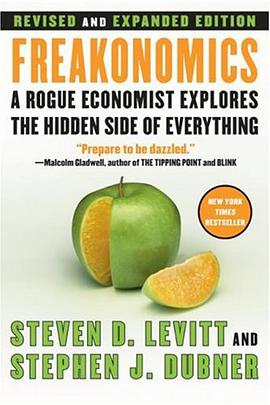
Which is more dangerous, a gun or a swimming pool? What do schoolteachers and sumo wrestlers have in common? Why do drug dealers still live with their moms? How much do parents really matter? How did the legalization of abortion affect the rate of violent crime? These may not sound like typical questions for an econo-mist to ask. But Steven D. Levitt is not a typical economist. He is a much-heralded scholar who studies the riddles of everyday life—from cheating and crime to sports and child-rearing—and whose conclusions turn conventional wisdom on its head. Freakonomics is a groundbreaking collaboration between Levitt and Stephen J. Dubner, an award-winning author and journalist. They usually begin with a mountain of data and a simple question. Some of these questions concern life-and-death issues; others have an admittedly freakish quality. Thus the new field of study contained in this book: freakonomics. Through forceful storytelling and wry insight, Levitt and Dubner show that economics is, at root, the study of incentives—how people get what they want, or need, especially when other people want or need the same thing. In Freakonomics , they explore the hidden side of . . . well, everything. The inner workings of a crack gang. The truth about real-estate agents. The myths of campaign finance. The telltale marks of a cheating schoolteacher. The secrets of the Klu Klux Klan. What unites all these stories is a belief that the modern world, despite a great deal of complexity and downright deceit, is not impenetrable, is not unknowable, and—if the right questions are asked—is even more intriguing than we think. All it takes is a new way of looking. Freakonomics establishes this unconventional premise: If morality represents how we would like the world to work, then economics represents how it actually does work. It is true that readers of this book will be armed with enough riddles and stories to last a thousand cocktail parties. But Freakonomics can provide more than that. It will literally redefine the way we view the modern world.
作者简介
史蒂芬·列维特,1994年在麻省理工大学取得经济学博士学位。1997年进入芝加哥大学执教短短两年时间列维特就成为芝加哥大学经济学院终身教授。2002年列维特被选为美国科学院经济学部委员。列维特还担任《政治经济学杂志》(JPE)的编辑和《经济学季刊》(OJE)的编辑。
史蒂芬·都伯纳,《纽约时报》和《纽约客》长期撰稿人,著有畅销书《骚动的灵魂》和《一个英雄崇拜者的自白》。
目录信息
读后感
很多经典的经济学的前提假设,都把人看成是完全理性,然后依据此假设,建立许多的数学模型。 当然经过长期的数据积累是可以看出未来趋势,但是所有的经济现象都是依据人的行为来完成,而人所完成的行为总是依据个人的动机来进行自己的行动。 博弈论是经济学界正式把人的微观动...
经济学是个非常骗人的东西。 如果你是经济学科班,大学里第一门专业课应该是经济学原理,你发现这门课里充满了简单有趣却对你思维产生革命意义的天才智慧,于是你对你将来的学习充满了憧憬和希望。 可是快乐的时光总是短暂的,在这第一门专业课结束之后,你突然发现好日子走到...
魔由心生 人的动机决定了人的选择。 几年前,一个很久以前辞职的同事找到我,商量大家一起创业。刚好他手上有一笔业务,做完后,可用做启动的资金。开始大家都构想得很好,项目进展得很顺利,客户的款也付得爽快。终于有时间大家坐下来,讨论一些关于新公司的问题...
周末,天一直闷着,阴阴的,周六下了一夜的雨。这样的天气躲在家中偷看《魔鬼经济学》 是再惬意不过了。 需要承认,人们很容易从别人的议论中得到暗示,这样,在评价一件事物之前,内心会有些倾向性,但往往这是偏见。这次也不例外,我同时订阅了《弗里德曼的生活经济学》和...