
具体描述
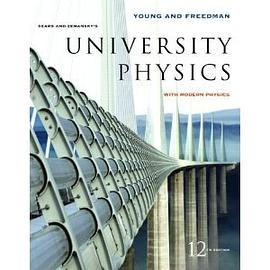
Refining the most widely adopted and enduring physics text available, University Physics with Modern Physics, Twelfth Edition continues an unmatched history of innovation and careful execution that was established by the best selling Eleventh Edition. Assimilating the best ideas from education research, this new edition provides enhanced problem-solving instruction, pioneering visual and conceptual pedagogy, the first systematically enhanced problems, and the most pedagogically proven and widely used homework and tutorial system available. Mechanics, Waves/Acoustics, Thermodynamics, Electromagnetism, Optics, Modern Physics. For all readers interested in university physics.
作者简介
Hugh D. Young is Emeritus Professor of Physics at Carnegie Mellon University in Pittsburgh, PA. He attended Carnegie Mellon for both undergraduate and graduate study and earned his Ph.D. in fundamental particle theory under the direction of the late Richard Cutkosky. He joined the faculty of Carnegie Mellon in 1956 and has also spent two years as a Visiting Professor at the University of California at Berkeley.
Prof. Young’s career has centered entirely around undergraduate education. He has written several undergraduate-level textbooks, and in 1973 he became a co-author with Francis Sears and Mark Zemansky for their well-known introductory texts. With their deaths, he assumed full responsibility for new editions of these books until joined by Prof. Freedman for University Physics.
Prof. Young is an enthusiastic skier, climber, and hiker. He also served for several years as Associate Organist at St. Paul’s Cathedral in Pittsburgh, and has played numerous organ recitals in the Pittsburgh area. Prof. Young and his wife Alice usually travel extensively in the summer, especially in Europe and in the desert canyon country of southern Utah.
Roger A. Freedman is a Lecturer in Physics at the University of California, Santa Barbara. Dr. Freedman was an undergraduate at the University of California campuses in San Diego and Los Angeles, and did his doctoral research in nuclear theory at Stanford University under the direction of Professor J. Dirk Walecka. He came to UCSB in 1981 after three years teaching and doing research at the University of Washington.
At UCSB, Dr. Freedman has taught in both the Department of Physics and the College of Creative Studies, a branch of the university intended for highly gifted and motivated undergraduates. He has published research in nuclear physics, elementary particle physics, and laser physics. In recent years, he has helped to develop computer-based tools for learning introductory physics and astronomy. When not in the classroom or slaving over a computer, Dr. Freedman can be found either flying (he holds a commercial pilot’s license) or driving with his wife, Caroline, in their 1960 Nash Metropolitan convertible.
A. Lewis Ford is Professor of Physics at Texas A&M University. He received a B.A. from Rice University in 1968 and a Ph.D. in chemical physics from the University of Texas at Austin in 1972. After a one-year postdoc at Harvard University, he joined the Texas A&M physics faculty in 1973 and has been there ever since. Professor Ford’s research area is theoretical atomic physics, with a specialization in atomic collisions. At Texas A&M he has taught a variety of undergraduate and graduate courses, but primarily introductory physics.
目录信息
读后感
用户评价
如果说它是一本工具书,那么它无疑是瑞士军刀级别的存在,几乎涵盖了大学物理本科阶段所有需要掌握的核心知识点。从电磁学的麦克斯韦方程组的严谨推导,到量子力学初步概念的引入,它几乎没有留下明显的“知识盲区”。然而,这种百科全书式的全面性也带来了另一个问题:在某些它认为属于“非核心”的领域,比如现代物理的某些前沿探索,它只是蜻蜓点水般地提及。例如,在谈到相对论时,虽然爱因斯坦的原理阐述得非常到位,但在处理引力场在特定边界条件下的应用时,内容相对简略,似乎是为了保持全书的篇幅和平衡性而有所取舍。对于我这种希望在特定方向上深挖的用户来说,这本书更像是一个高质量的“地图”,它指明了方向,但对于通往更深处的具体路径,我还需要借助其他更专业的地图集。因此,我常常将它作为我学习旅程中的“主线任务指南”,一旦遇到需要深入探究的“支线任务”,我就需要转向其他更具针对性的资料。它的价值在于奠定基础,而非提供终极答案。
阅读这本教材的过程,简直就是一场对思维清晰度的极限测试。在光学部分,作者对波动理论的几何光学和物理光学之间的过渡处理得极为精妙,这正是我在其他一些偏重应用的参考书里从未见过的深入分析。他不仅仅展示了如何用斯涅尔定律计算折射角,而是深入探究了光的波动性如何从根本上决定了这些宏观现象的发生机制。特别是关于干涉和衍射的章节,作者构建了一个非常清晰的层次结构:先从最简单的单缝衍射入手,逐步引入双缝,再过渡到更复杂的阵列光栅,每一步的理论深化都建立在前一步坚实的基础上,很少出现概念上的跳跃。我特别喜欢它穿插的一些历史注释,简短地提到了惠更斯、菲涅尔等先驱在这些理论建立过程中的挣扎与突破,这为冰冷的公式增添了一层人文色彩,让我更能理解这些定律是如何在历史长河中被“打磨”出来的。虽然某些章节依然需要反复阅读才能完全消化,但这种由浅入深、层层递进的叙述方式,极大地增强了学习的成就感。
这套“大学物理”教材,初捧在手时,那种厚重感和知识的密度就让人心生敬畏。我花了很长时间才真正开始深入研读,但一旦沉浸其中,便发现它不仅仅是教科书,更像是一扇通往自然界深层逻辑的窗口。书中对经典力学部分的阐述极其详尽,从最基础的运动学定义到复杂的刚体转动和振动,作者的逻辑链条构建得非常严谨,很少有含糊不清的地方。尤其欣赏它在引入微积分工具时,并没有将数学知识当作一个孤立的模块来讲解,而是巧妙地将微积分的应用场景融入到物理问题的求解过程中,这对于我们这些初学者来说至关重要,它让我们明白了“学数学是为了更好地理解物理”这个核心理念。每章后的习题设计也十分巧妙,难度梯度设置合理,从基础概念的检验到需要综合运用多个定律的复杂应用题,覆盖面广,让人感觉每解决一道题,自己的物理直觉和解题能力都在稳步提升。我尤其喜欢它在解释一些抽象概念时,会辅以大量的实例和类比,比如对电磁场中矢量场的描绘,虽然是二维文字描述,但通过那些精妙的比喻,脑海中似乎真的能“看到”电荷周围的力线分布。这本书的阅读体验,可以说是扎实、严谨,让人踏实。
这本书的排版和插图设计,是其在众多物理教材中脱颖而出的一个重要原因,这一点必须单独提及。对于涉及三维空间概念的物理问题,比如磁场中的洛伦兹力或者电场中的高斯定律,清晰的图示是理解的生命线。这套书的插图质量非常高,线条简洁有力,三维透视图的透视感和轴线标注都做得非常专业,极大地减少了我在脑海中构建立体模型时产生的认知负荷。更值得称赞的是,很多关键公式旁边都会附带一个精炼的文字总结,用大白话解释了这个公式的物理意义和应用限制,这对于我这种更偏爱直觉理解而非纯粹符号操作的学习者来说,简直是福音。虽然印刷质量上乘,但由于纸张较厚,整本书的重量确实是一个挑战,每次带着它去图书馆都像进行一次负重训练。总而言之,这是一本设计精良、内容详实的经典教材,它的目标读者群非常明确:那些准备认真对待物理学科、并希望获得最扎实基础训练的学生。
坦白讲,我对这本“大学物理”的体验是相当复杂和充满挑战的。它无疑是一部权威性的著作,其内容的广度和深度毋庸置疑,但正是这份“全面”和“深入”,使得它对于自学者而言,门槛高得令人望而却步。当我试图啃下热力学和统计物理那几章时,我深刻体会到了什么是真正的“学术壁垒”。书中的推导过程往往省略了一些中间步骤,可能对于已经有扎实数学基础的物理系高年级学生来说是“显而易见”的,但对我而言,每每看到 $sum$ 符号变成 $int$ 符号的那一瞬间,我就得停下来,翻回好几章去重新梳理相关的微积分背景,才能勉强跟上作者的思路。更让我感到吃力的是,它对实验现象的描述总是非常精确和理想化,虽然这保证了理论的纯粹性,但在实际的物理世界中,那些被忽略的阻尼、非线性效应或环境噪声,往往才是决定最终结果的关键。这本书更像是一位经验极其丰富的教授,在课堂上给最优秀的学生讲授最前沿的知识,语速快、信息密度极大,让人在兴奋之余,更多的是一种追赶不上的焦虑感。它考验的不仅仅是智力,更是阅读的耐心和毅力。