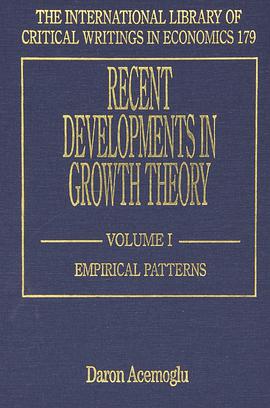

具体描述
This two-volume collection examines the major developments in growth theory over the past decade. Key papers by leading scholars cover new trends in theoretical and empirical research. The first volume shows how new research has improved our understanding of the empirical patterns of economic growth and has posed new challenges for theory. The second volume contains articles which have pushed the theory of economic growth in new directions and work which has responded to the challenges raised by empirical research.
作者简介
Daron Acemoglu is the Killian Professor of Economics at MIT. In 2005 he received the John Bates Clark Medal awarded to economists under forty judged to have made the most significant contribution to economic thought and knowledge. (Photo by Peter Tenzer.)
目录信息
Acknowledgements
Introduction Daron Acemoglu
PART I INCOME DIFFERENCES: CONVERGENCE, DIVERGENCE, STABILITY AND REVERSAL
1. Lant Pritchett (1997), ‘Divergence, Big Time’
2. Charles I. Jones (1997), ‘On the Evolution of the World Income Distribution’
3. Danny T. Quah (1997), ‘Empirics for Growth and Distribution: Stratification, Polarization, and Convergence Clubs’
4. Francesco Caselli, Gerardo Esquivel and Fernando Lefort (1996), ‘Reopening the Convergence Debate: A New Look at Cross-Country Growth Empirics’
5. Daron Acemoglu, Simon Johnson and James A. Robinson (2002), ‘Reversal of Fortune: Geography and Institutions in the Making of the Modern World Income Distribution’
PART II PROXIMATE CAUSES OF INCOME DIFFERENCES
6. N. Gregory Mankiw, David Romer and David N. Weil (1992), ‘A Contribution to the Empirics of Economic Growth’
7. Alwyn Young (1995), ‘The Tyranny of Numbers: Confronting the Statistical Realities of the East Asian Growth Experience’
8. Peter J. Klenow and Andrés Rodríguez-Clare (1997), ‘The Neoclassical Revival in Growth Economics: Has It Gone Too Far?’
9. Robert E. Hall and Charles I. Jones (1999), ‘Why Do Some Countries Produce So Much More Output per Worker Than Others?’
PART III FINANCIAL CONSTRAINTS ON INVESTMENT AND GROWTH
10. Jayaratne Jith and Philip Strahan (1996), ‘The Finance-Growth Nexus: Evidence from Bank Branch Deregulation’
11. Raghuram G. Rajan and Luigi Zingales (1998), ‘Financial Dependence and Growth’
PART IV SCHOOLING AND GROWTH
12. Mark Bils and Peter J. Klenow (2000), ‘Does Schooling Cause Growth?’
13. Daron Acemoglu and Joshua Angrist (2000), ‘How Large Are Human-Capital Externalities? Evidence from Compulsory Schooling Laws’
14. Lutz Hendricks (2002), ‘How Important Is Human Capital for Development? Evidence from Immigrant Earnings’
PART V TECHNOLOGY AND SPILLOVERS
15. Adam B. Jaffe, Manuel Trajtenberg and Rebecca Henderson (1993), ‘Geographic Localization of Knowledge Spillovers as Evidenced by Patent Citations’
16. Douglas A. Irwin and Peter J. Klenow (1994), ‘Learning-by-Doing Spillovers in the Semiconductor Industry’
PART VI FUNDAMENTAL CAUSES OF INCOME DIFFERENCES
17. William Easterly and Ross Levine (1997), ‘Africa’s Growth Tragedy: Policies and Ethnic Divisions’
18. Steven Knack and Philip Keefer (1995), ‘Institutions and Economic Performance: Cross-Country Tests Using Alternative Institutional Measures’
19. Daron Acemoglu, Simon Johnson and James A. Robinson (2001), ‘The Colonial Origins of Comparative Development: An Empirical Investigation’
Name Index
Volume II: Theory
Acknowledgements
An introduction by the editor to both volumes appears in Volume I
PART I ENDOGENOUS TECHNICAL CHANGE WITHOUT SCALE EFFECTS
1. Charles I. Jones (1995), ‘R & D-Based Models of Economic Growth’
2. Alwyn Young (1998), ‘Growth without Scale Effect’
PART II DIRECTED TECHNICAL CHANGE
3. Daron Acemoglu (2002), ‘Directed Technical Change’
4. Daron Acemoglu (2003), ‘Labor- and Capital-Augmenting Technical Change’
PART III DIFFUSION, ADOPTION AND APPROPRIATE TECHNOLOGY
5. Stephen L. Parente and Edward C. Prescott (1994), ‘Barriers to Technology Adoption and Development’
6. Elhanan Helpman and Manuel Trajtenberg (1998), ‘A Time to Sow and a Time to Reap: Growth Based on General Purpose Technologies’
7. Susanto Basu and David N. Weil (1998), ‘Appropriate Technology and Growth’
8. Daron Acemoglu and Fabrizio Zilibotti (2001), ‘Productivity Differences’
9. Peter Howitt (2000), ‘Endogenous Growth and Cross-Country Income Differences’
PART IV MARKET STRUCTURE AND GROWTH
10. Daron Acemoglu and Fabrizio Zilibotti (1997), ‘Was Prometheus Unbound by Chance? Risk, Diversification, and Growth’
11. Philippe Aghion, Christopher Harris, Peter Howitt and John Vickers (2001), ‘Competition, Imitation and Growth with Step-by-Step Innovation’
PART V TRADE, LOCATION OF PRODUCTION AND GROWTH
12. Paul Krugman and Anthony J. Venables (1995), ‘Globalization and the Inequality of Nations’
13. Jaume Ventura (1997), ‘Growth and Interdependence’
14. Daron Acemoglu and Jaume Ventura (2002), ‘The World Income Distribution’
PART VI TECHNOLOGY AND INEQUALITY
15. Daron Acemoglu (1998), ‘Why Do New Technologies Complement Skills? Directed Technical Change and Wage Inequality’
16. Oded Galor and Omer Maov (2000), ‘Ability-Biased Technological Transition, Wage Inequality, and Economic Growth’
17. Per Krusell, Lee E. Ohanian, José-Víctor Ríos-Rull and Giovanni L. Violante (2000), ‘Capital-Skill Complementarity and Inequality: A Macroeconomic Analysis’
PART VII UNDERSTANDING POLICY AND INSTITUTIONS
18. Per Krusell and José-Víctor Ríos-Rull (1996), ‘Vested Interests in a Positive Theory of Stagnation and Growth’
19. Philip R. Lane and Aaron Tornell (1996), ‘Power, Growth, and the Voracity Effect’
20. Roland Bénabou (2000), ‘Unequal Societies: Income Distribution and the Social Contract’
21. Daron Acemoglu and James A. Robinson (2000), ‘Political Losers as a Barrier to Economic Development’
22. Daron Acemoglu and James A. Robinson (2000), ‘Why Did the West Extend the Franchise? Democracy, Inequality, and Growth in Historical Perspective’
23. François Bourguignon and Thierry Verdier (2000), ‘Oligarchy, Democracy, Inequality and Growth’
Name Index
· · · · · · (收起)
读后感
用户评价
我必须承认,这本书的阅读体验是渐进式的,它要求读者保持高度的专注力。它不是那种可以让你在通勤路上随便翻翻的书,更适合在安静的书房里,手边备着草稿纸和计算器。我发现,当我试着在脑海中重构某个关键模型的推导过程时,才能真正领会到作者对细节的把握。特别是在关于“知识创造”和“知识扩散”机制的探讨部分,它提供了一套非常精妙的分析工具,去理解为什么在信息时代,那些能够高效整合和利用知识的实体会获得指数级的增长优势。这本书为我提供了一个坚实的基础,去批判性地评估当前关于发展中国家如何实现可持续增长的政策建议,因为它直指问题的核心——那些看不见的、内生的动力。
坦率地讲,这本书的深度超出了我的初步预期,它并非是那种提供快速答案的“快餐式”阅读材料,而是要求读者投入时间和精力去消化的学术精品。我尤其欣赏它对不同学派观点的平衡处理。例如,在讨论资本积累与技术进步的作用时,它并没有偏袒任何一方,而是并列展示了它们各自的优势和局限性,引导读者自己去权衡。这种严谨的学术态度让我在阅读时感觉非常可靠,因为你知道你正在接触的是经过时间检验的、被同行广泛讨论的核心思想。如果你想从根本上理解为什么“创新”在现代经济学中占据了如此核心的地位,这本书无疑会是你的首选参考书之一。它对计量经济学在验证这些理论中的应用也有涉及,虽然不是重点,但足以让你意识到理论与实证之间的紧密联系。
总而言之,这是一部份量十足的著作,它成功地将过去几十年经济增长理论领域最富争议性、最富有洞察力的观点汇集一堂。对于任何希望在经济学领域深耕下去的人来说,这本书提供的理论深度和广度是不可替代的。它不仅仅是回顾历史,更重要的是,它为未来研究指明了方向,特别是那些关于长期结构性变革和制度作用的讨论,至今仍具有强大的现实指导意义。阅读完后,我感觉我对“发展”这个概念的理解不再停留在简单的GDP数字上,而是触及到了更深层次的、由人类创新和社会结构决定的复杂系统。这本书绝对值得被放在经济学家的案头,作为思考和研究的基石。
这本书简直是经济学爱好者的一本宝典,尤其是对于那些痴迷于理解经济增长驱动力的读者来说,它提供了一个绝佳的视角。我不得不说,作者在梳理和呈现这些复杂理论方面的功力令人印象深刻。你不会觉得自己在啃一本枯燥的教科书,而更像是进行一场深入的学术对话。它不仅仅是罗列了不同的增长模型,更重要的是,它深入挖掘了这些模型背后的哲学基础和历史演变。比如,早期的新古典增长模型是如何被后来的内生增长理论所挑战和补充的,这些转变是如何反映了经济学家对技术进步和人力资本作用认知的深化,书里都有非常清晰的脉络。那些关于技术溢出效应、知识积累机制的讨论,对于理解为什么有些国家能够持续高速增长而另一些则陷入停滞,提供了至关重要的理论框架。
这本书的结构编排堪称艺术,它将宏大的理论体系拆解成了易于理解的模块。对于我这种非全职研究人员来说,能够清晰地把握住从索洛模型到内生增长模型再到更前沿的动态随机一般均衡(DSGE)模型中的关键差异点,是极其宝贵的。作者在叙述中使用的语言,虽然保持了学术的精确性,但又避免了过度晦涩的行话堆砌,这使得即便是初次接触这些复杂模型的读者也能找到切入点。阅读它就像是攀登一座思想的高峰,每上一层,视野就开阔一分,你开始能看到不同理论是如何相互联系、相互促进的。那些关于人力资本回报递增的论证,以及知识作为非竞争性公共物品的特性,都被剖析得淋漓尽致,让人茅塞顿开。