
具体描述
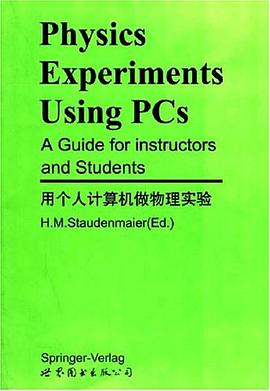
In many fields of physics the use of on-line computers in research experiments is daily routine and without computers scientific progress is often unthinkable in our times .Computer-aided experimentation and measurement hqve become important aspects in professional life in research as well as in industry.Nevertheless these subjects are not really covered in the physics curricula of most universities and we believe it to be an important task for professors and teaching staff to familiarize students with computer applications in their own and neighbouring fields.In general it is desirable that students also learn some of the useful concepts of the nes science called "informatics"or"computer science".Successful attempts have already been made in the field of computer applications in theoretical physics and various universities now offer elaborate courses;excellent textbooks are also available.
本书为英文版。
作者简介
目录信息
1 Fourier Analysis of Some Simple Periodic Signals
1.1 Apparatus
1.2 Programs
1.3 Experiments
1.3.1 Simple Harmonic Wave
1.3.2 Beats
1.3.3 Amplitude Modulation
1.3.4 Rectangles
1.4 Didactic and Pedagogical Aspects
References
Appendix l.A
2 Point Mechanics by Experiments -Direct Access to Motion Data
2.1 Introduction
2.2 ORVICO
2.2.1 Principle
2.2.2 Hardware
2.2.3 Software
2.3 Examples
2.3.1 Ballistic Motion
2.3.2 The Rigid Pendulum
2.3.3 Frame of Reference
2.3.4 Statistical Motion on an Air Table
2.3.5 Spheric Pendulum
2.3.6 Two Point Masses Observed
2.4 Conclusion
References
Part Ⅱ Thermodynamics
3.Application of PID Control to a Thermal Evaporation Source
3.1 Introduction
3.2 The System to be Controlled:An Inert-Gas-Aggregation Source
3.2.1 Background
3.2.2 The Inert-Gas-Aggregation Technique
3.2.3 A Description of a Real Inert-Gas-Aggregation Source
3.3 Description of the PID Control Algorithm
3.3.1 The PID Control Algorithm
3.4 I mplementing the PID Algorithm on a Computer
3.4.1 Program Structure and the Use of Interrupts
3.5 Adjusting the PID
3.5.1 The Ziegler-Nichols' Methods
3.6 Possibilities Offered by the Leman Source
3.7 Conclusions
Acknowledgements
References
4.Computer Control of the Measurement of Thermal Conductivity
4.1 Thermal Conductivity
4.1.1 Measurement of Thermal Conductivity with Parallel Heat Flow
4.1.2 Measurement of Thermal Conductivity with Non-Parallel Heat Flow
4.2 Experimental Considerations
4.2.1 The Thermocouple as a Temperature Measuring Device
4.2.2. The AD595 Thermocouple Amplifier Integrated Circuit
4.2.3 Thermocouple Accuracy
4.2.4 Calibration of the Thermocouples
4.2.5 Thermocouple Selection Multiplexing Circuit
4.2.6 Multiplexor Control
4.2.7 The IEEE-488 Bus Interface Unit
4.2.8 The Control and Measurement Software
4.2.9 Discussion of the Experiment
4.3 The Computer Simulation
References
Appendix 4.A.
Appendix 4.B
Part Ⅲ Solid State Physics
5.Experiments with High-Tc Superconductivity
5.1 Experimental Setup
5.1.1 The Apparatus
5.1.2 Electronics
5.1.3 Computer, Interface and Software
5.2 Measurements
5.2.1 Resistance Measurement
5.2.2 Tunnel Diode Oscillator Measurernent
5.3 Results
5.3.1 Detailed Analysis of the Resistance and TDO Measurements
5.3.2 Thermodynamic and Calorimentric Results
5.3.3 Experience Within the Laboratory Course
References
Appendix 5.A: Electric Circuit Diagrams
Appendix 5.B: Spline Fit Program SPLFIT
6.Computer Control of Low Temperature Specific Heat Measurement
6.1 Basic Physics
6.1.1 Specific Heat
6.1.2 Low Temperature Specific Heat
6.1.3 The Debye Model for the Specific Heat
6.1.4 Specific Heat Anomalies
6.2 Experimental Setup
6.2.1 Specimen
6.2.2 Apparatus
6.2.3 Electronics
6.2.4 Microputer Control
6.3 Measurements and Results
6.3.1 Measurement Principles
6.3.2 Using the Computer Program
6.3.3 Typical Results
6.4 Discussion
References
Appendix 6.A: Circuit Diagrams
Appendix 6.B: Program Listing
7. Computer-Controlled Observations of Surface Plasmon-Polaritons
7.1 Introduction
7.2 A Computer-Controlled ATR Experiment
7.2.1 Prism Geometry
7.2.2 Computer Control of ATR Measurements
7.3 Comments on the Mechanics Design and the Computer Interface
7.4 Conclusion
References
Part IV Optics and Atomic Physics
8. Molecular Spectroscopy of 12
9. Optical Transfer Functions
Part V Nuclear Physics
10. Nuclear Spectrometry Using a PC Converted to a Multichannel Analyser
11. Parity Violation in the Weak Interaction
12. Receiving and Interpreting Orbital Satellite Data.A Computer Experiment for Educational Purposes
Subject Index
· · · · · · (收起)
读后感
用户评价
这本书简直是一位物理实验的“魔术师”,它把冰冷的计算机变成了通往奇妙物理世界的钥匙。我一直对物理实验充满好奇,但对复杂仪器的操作和昂贵的设备感到有些畏惧。然而,这本书完全打消了我的顾虑。作者的笔触非常亲切,仿佛一位老朋友在娓娓道来,将原本可能枯燥的科学知识变得生动有趣。书中介绍的很多实验,都只需要一台个人电脑和一些随处可见的小配件,这让我感到非常惊喜。我尝试跟着书中的步骤,用电脑测量了电流和电压的关系,发现原来如此简单就能理解欧姆定律的精髓。这本书不仅仅教会了我如何做实验,更重要的是它让我体会到了科学的魅力,激发了我对未知世界的好奇心。
这本书让我对计算机在物理实验中的应用有了全新的认识!我一直对物理实验很感兴趣,但总觉得实验器材昂贵,操作繁琐。这本书的出现,简直是打开了我新世界的大门。作者用非常生动形象的语言,介绍了如何利用我们日常生活中随处可见的个人电脑,搭建出各种各样的物理实验平台。我尤其被书中关于“数据采集与分析”的部分深深吸引。以前总觉得数据分析是件很专业、很枯燥的事情,但这本书却把复杂的算法和统计方法,通过简单的编程和图表展示,变得既直观又有趣。我尝试跟着书中的例子,用电脑测量了落体运动的速度,并将其与理论值进行对比,结果出乎意料地准确!这让我深刻体会到,原来物理的奥秘,离我们如此之近,也并非难以触及。这本书不仅仅是关于如何做实验,更重要的是它教会了我一种思维方式,一种利用科技解决问题的能力。它让我不再害怕复杂的概念,而是充满好奇地去探索和验证。
这本书实在是太棒了!我一直对物理充满热爱,但现实条件总是限制了我深入实践。这本书的出现,简直是为我量身打造的。它让我看到了利用个人电脑进行物理实验的巨大潜力。作者的讲解非常细致,从基础的电路连接到复杂的数据处理,都娓娓道来,毫不费力。我最喜欢的部分是关于“光学实验”的介绍,通过简单的软件和一些常见的材料,我就能模拟出光的干涉和衍射现象,这在以前是我想都不敢想的。这本书让我明白了,原来物理的奥秘并非高不可攀,只要掌握了正确的方法,即使是普通人也能在个人电脑上进行有趣的物理探索。它不仅增长了我的知识,更重要的是激发了我动手实践的勇气和热情,让我觉得科学离我越来越近。
当我翻开这本书,脑海中浮现的不是实验室里琳琅满目的仪器,而是自己熟悉的电脑屏幕。我一直以为物理实验是属于专业人士的领域,需要耗费大量的财力和精力。然而,《用个人计算机做物理实验》这本书彻底颠覆了我的认知。它就像一位耐心而睿智的向导,一步步引领我走进一个充满无限可能的世界。书中没有晦涩难懂的术语,也没有令人望而却步的理论公式,取而代之的是清晰易懂的步骤和生动有趣的案例。我印象最深刻的是关于“声波测量”的章节,作者巧妙地利用电脑的麦克风和音频处理软件,就能够模拟出复杂的声音实验,让我对声波的传播特性有了直观的感受。这本书的魅力在于,它将科学的严谨性与实践的可行性完美结合,让我在家中也能享受到探索物理世界的乐趣。它不仅仅是一本书,更是一个激发我求知欲和创造力的宝库。
一直以来,我对物理世界的运作充满着朦胧的好奇,总觉得那些定律和现象遥不可及,仿佛只能在书本和实验室里窥见一斑。直到我读了《用个人计算机做物理实验》,我的看法被彻底颠覆了。这本书不仅仅是一本关于如何操作电脑进行物理实验的书,它更像是一本打开物理世界大门的说明书,而那把钥匙,就是我们随处可见的个人电脑。作者用一种极其生动且易于理解的方式,拆解了许多复杂的物理概念,并将其与电脑的强大功能相结合。我尤其被书中关于“力学测量”的章节所震撼,利用电脑的摄像头和简单的算法,我竟然能够精确地测量出物体的运动轨迹和速度,这种亲手验证科学原理的体验,是任何教科书都无法比拟的。它让我深刻地体会到,科学的探索不再是少数人的专利,而是人人都能参与其中的奇妙旅程。