
具体描述
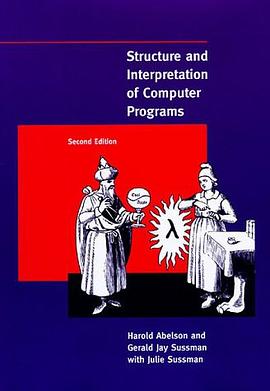
Structure and Interpretation of Computer Programs has had a dramatic impact on computer science curricula over the past decade. This long-awaited revision contains changes throughout the text.
There are new implementations of most of the major programming systems in the book, including the interpreters and compilers, and the authors have incorporated many small changes that reflect their experience teaching the course at MIT since the first edition was published.
A new theme has been introduced that emphasizes the central role played by different approaches to dealing with time in computational models: objects with state, concurrent programming, functional programming and lazy evaluation, and nondeterministic programming. There are new example sections on higher-order procedures in graphics and on applications of stream processing in numerical programming, and many new exercises.
In addition, all the programs have been reworked to run in any Scheme implementation that adheres to the IEEE standard.
作者简介
Hal Abelson is Class of 1922 Professor of Computer Science and Engineering at Massachusetts Institute of Technology and a fellow of the IEEE. He is a founding director of Creative Commons, Public Knowledge, and the Free Software Foundation. Additionally, he serves as co-chair for the MIT Council on Educational Technology.
Gerald Jay Sussman is the Matsushita Professor of Electrical Engineering in the Department of Electrical Engineering and Computer Science, Massachusetts Institute of Technology. He is also the coauthor of Structure and Interpretation of Computer Programs (MIT Press, second edition, 1996).
目录信息
Preface to the Second Edition
Preface to the First Edition
Acknowledgments
1 Building Abstractions with Procedures
1.1 The Elements of Programming
1.1.1 Expressions
1.1.2 Naming and the Environment
1.1.3 Evaluating Combinations
1.1.4 Compound Procedures
1.1.5 The Substitution Model for Procedure Application
1.1.6 Conditional Expressions and Predicates
1.1.7 Example: Square Roots by Newton's Method
1.1.8 Procedures as Black-Box Abstractions
1.2 Procedures and the Processes They Generate
1.2.1 Linear Recursion and Iteration
1.2.2 Tree Recursion
1.2.3 Orders of Growth
1.2.4 Exponentiation
1.2.5 Greatest Common Divisors
1.2.6 Example: Testing for Primality
1.3 Formulating Abstractions with Higher-Order Procedures
1.3.1 Procedures as Arguments
1.3.2 Constructing Procedures Using Lambda
1.3.3 Procedures as General Methods
1.3.4 Procedures as Returned Values
2 Building Abstractions with Data
2.1 Introduction to Data Abstraction
2.1.1 Example: Arithmetic Operations for Rational Numbers
2.1.2 Abstraction Barriers
2.1.3 What Is Meant by Data?
2.1.4 Extended Exercise: Interval Arithmetic
2.2 Hierarchical Data and the Closure Property
2.2.1 Representing Sequences
2.2.2 Hierarchical Structures
2.2.3 Sequences as Conventional Interfaces
2.2.4 Example: A Picture Language
2.3 Symbolic Data
2.3.1 Quotation
2.3.2 Example: Symbolic Differentiation
2.3.3 Example: Representing Sets
2.3.4 Example: Huffman Encoding Trees
2.4 Multiple Representations for Abstract Data
2.4.1 Representations for Complex Numbers
2.4.2 Tagged data
2.4.3 Data-Directed Programming and Additivity
2.5 Systems with Generic Operations
2.5.1 Generic Arithmetic Operations
2.5.2 Combining Data of Different Types
2.5.3 Example: Symbolic Algebra
3 Modularity, Objects, and State
3.1 Assignment and Local State
3.1.1 Local State Variables
3.1.2 The Benefits of Introducing Assignment
3.1.3 The Costs of Introducing Assignment
3.2 The Environment Model of Evaluation
3.2.1 The Rules for Evaluation
3.2.2 Applying Simple Procedures
3.2.3 Frames as the Repository of Local State
3.2.4 Internal Definitions
3.3 Modeling with Mutable Data
3.3.1 Mutable List Structure
3.3.2 Representing Queues
3.3.3 Representing Tables
3.3.4 A Simulator for Digital Circuits
3.3.5 Propagation of Constraints
3.4 Concurrency: Time Is of the Essence
3.4.1 The Nature of Time in Concurrent Systems
3.4.2 Mechanisms for Controlling Concurrency
3.5 Streams
3.5.1 Streams Are Delayed Lists
3.5.2 Infinite Streams
3.5.3 Exploiting the Stream Paradigm
3.5.4 Streams and Delayed Evaluation
3.5.5 Modularity of Functional Programs and Modularity of Objects
4 Metalinguistic Abstraction
4.1 The Metacircular Evaluator
4.1.1 The Core of the Evaluator
4.1.2 Representing Expressions
4.1.3 Evaluator Data Structures
4.1.4 Running the Evaluator as a Program
4.1.5 Data as Programs
4.1.6 Internal Definitions
4.1.7 Separating Syntactic Analysis from Execution
4.2 Variations on a Scheme -- Lazy Evaluation
4.2.1 Normal Order and Applicative Order
4.2.2 An Interpreter with Lazy Evaluation
4.2.3 Streams as Lazy Lists
4.3 Variations on a Scheme -- Nondeterministic Computing
4.3.1 Amb and Search
4.3.2 Examples of Nondeterministic Programs
4.3.3 Implementing the Amb Evaluator
4.4 Logic Programming
4.4.1 Deductive Information Retrieval
4.4.2 How the Query System Works
4.4.3 Is Logic Programming Mathematical Logic?
4.4.4 Implementing the Query System
5 Computing with Register Machines
5.1 Designing Register Machines
5.1.1 A Language for Describing Register Machines
5.1.2 Abstraction in Machine Design
5.1.3 Subroutines
5.1.4 Using a Stack to Implement Recursion
5.1.5 Instruction Summary
5.2 A Register-Machine Simulator
5.2.1 The Machine Model
5.2.2 The Assembler
5.2.3 Generating Execution Procedures for Instructions
5.2.4 Monitoring Machine Performance
5.3 Storage Allocation and Garbage Collection
5.3.1 Memory as Vectors
5.3.2 Maintaining the Illusion of Infinite Memory
5.4 The Explicit-Control Evaluator
5.4.1 The Core of the Explicit-Control Evaluator
5.4.2 Sequence Evaluation and Tail Recursion
5.4.3 Conditionals, Assignments, and Definitions
5.4.4 Running the Evaluator
5.5 Compilation
5.5.1 Structure of the Compiler
5.5.2 Compiling Expressions
5.5.3 Compiling Combinations
5.5.4 Combining Instruction Sequences
5.5.5 An Example of Compiled Code
5.5.6 Lexical Addressing
5.5.7 Interfacing Compiled Code to the Evaluator
References
List of Exercises
Index
· · · · · · (收起)
读后感
第四章scheme做個小小的interpreter, 學過compiler的人一定覺得還不如看dragon book比較實際. 但是他精彩就是在於用很簡潔的方式(scheme的特性)去解釋複雜的interpreter原理. 但是interpreter不是最重要的, 精彩的還是看他如何在精心設計之下可以順利的拓展他需要的功能. 又...
上帝是魔法師,魔法師是無神論者。 圣經灌輸教義,魔法書揭示魔力。 這本書使胡言亂語的癡迷者硬起來。 這本書讓魔法師重拾一切元素盡在掌握的驕傲。 這本書寫給那些制定規則的人。
Underlying our approach to this subject is our conviction that 'computer science' is not a science and that its significance has little to do with computers. The computer revolution is a revolution in the way we think and in the way we express what we think...
这个学期花了大量的时间在这本书上,同时旁听了裘宗燕老师(本书译者)以本书为教材开的课“程序设计技术和方法”,到学期末,总算是把这本书看完了。 豆瓣上关于本书的评论大多是形而上的,都说这本书怎样怎样好,但很少说明为什么好。我读这本书之前看了很多豆瓣上的评论,...
1. 涵盖面很广。从数据抽象、过程抽象、迭代、高阶函数等编程和控制系统复杂性的思想,到数据结构和算法,到编译器/解释器、编程语言设计。MIT这门课的课程讲义(在MIT OCW里可找到)里还增加了面向对象编程的内容。虽然很多内容涉及并不深入,但是这是MIT EECS(电子工程与计...
用户评价
我对《计算机程序的构造与解释》(第二版,MIT)的感受,简直是“相见恨晚”。在这之前,我曾以为自己已经掌握了编程的精髓,但这本书却让我看到了自己的渺小和无知。它以一种极其严谨和系统的方式,将计算机科学的核心概念一一展现,从最基础的表达式求值,到复杂的元语言抽象,无不涉及。书中所倡导的“思想先行,代码跟随”的理念,深深地影响了我此后的学习和工作。它让我明白,编写出能够运行的代码固然重要,但更重要的是理解代码背后所蕴含的思想和原则。书中关于“自举”和“语言设计”的讨论,更是让我大开眼界,让我看到了编程语言本身是如何被构造和解释的。我曾多次尝试将书中的一些概念应用到我实际的项目中,每一次都收效显著,让我对代码的掌控力有了质的飞跃。这本书,不仅仅是知识的传授,更是一种思维模式的塑造,它让我成为了一个更加深刻、更加有条理的程序员。
《计算机程序的构造与解释》(第二版,MIT)这本书,对我而言,更像是一场与智慧的对话,而不是一次简单的阅读。它没有枯燥的技术堆砌,而是用一种极其精炼和富有启发性的方式,带领读者深入计算机科学的腹地。书中所探讨的“函数式编程”、“过程抽象”等概念,如同打开了一扇扇新世界的大门,让我看到了编程的另一种可能性。它鼓励我用更加宏观的视角去理解程序,去关注数据的流动和结构的演变,而不是仅仅停留在表面的语法操作。我曾经无数次地在书中寻找答案,当我遇到编程难题时,我都会回过头来翻阅这本书,总能从中找到解决问题的灵感和思路。这本书,不仅仅是教授我如何编程,更是教会我如何思考,如何去构建出那些能够自我理解、自我改进的系统。它让我对编程这件事,产生了一种近乎“痴迷”的热情,因为我知道,我正在学习的是计算机科学的“真谛”。
《计算机程序的构造与解释》(第二版,MIT)这本书,对我来说,与其说是一本教材,不如说是一次思想的启蒙。我至今还记得第一次读到书中关于“递归”的章节时,那种又敬又畏的感觉。它不是简单地给出递归的定义和例子,而是层层剥茧,展示了递归在解决复杂问题时的优雅和强大。书中对“求值策略”、“环境模型”的深入剖析,让我对程序的执行过程有了全新的认识,不再是黑箱操作,而是能够清晰地追踪每一个计算步骤。它教会我如何构建出能够自我引用的结构,如何让程序拥有“生命”,能够根据指令做出复杂的决策。每一次翻阅,都能从中发现新的洞见,就如同寻宝一般,总能挖掘出之前未曾察觉的宝藏。它鼓励我质疑现有的编程范式,去探索那些更具创新性和颠覆性的方法。我经常会花很多时间去思考书中的每一个例子,尝试用不同的方式去实现,去感受不同设计选择所带来的影响。这本书,真正地让我理解了“构造”和“解释”这两个词的深刻含义,它们不仅仅是技术术语,更是指引我们前进的哲学方向。
这本《计算机程序的构造与解释》(第二版,MIT)在我计算机科学的求学之路上,扮演了如同灯塔般的角色。初次翻开它,便被其深邃的思想和精巧的结构所震撼。书中对计算本质的剖析,远超我以往任何一本教科书的认知。它不只是教授你如何编写代码,更是引领你理解“为何”要这样编写,以及“如何”才能写出更优雅、更高效、更具表达力的程序。那些lambda演算、递归的深邃魅力,以及对各种抽象机制的细致阐述,每一次阅读都像是在进行一次心灵的洗礼。它教会我如何从根本上思考问题,如何构建出能够自我演进的系统。我常常在深夜里,一边品味着书中的例子,一边陷入沉思,试图将其中的思想融会贯通,应用到我自己的学习和实践中。这本书的价值,在于它给予了我一套思考问题和解决问题的哲学,而非仅仅是一堆技术技巧。它像是一位睿智的长者,循循善诱,引导我走向计算机科学的殿堂,让我对这个领域产生了前所未有的敬畏和热爱。我几乎可以肯定,这本书的每一个字,都在潜移默化地改变着我的思维方式,让我在面对复杂的编程挑战时,能够更加从容和自信。
接触《计算机程序的构造与解释》(第二版,MIT)这本书,对我而言,是一次彻底颠覆过往认知的体验。在此之前,我习惯于将编程视为一种工具,一种解决具体问题的手段。但这本书,让我意识到编程本身可以是一种艺术,一种能够探索思想深度的媒介。它关于“抽象”的论述,简直是点石成金,让我看到了隐藏在代码之下的模式和结构。那些关于过程、数据抽象、模块化的讲解,至今仍在我脑海中回响,如同精妙的乐章,层层递进,引人入胜。书中引入的Scheme语言,虽然起初有些陌生,但很快就成为了我理解那些复杂概念的绝佳载体。它简洁的语法,使得我们可以更专注于思想的表达,而无需被繁琐的细节所困扰。我曾经花了数个周末,沉浸在书中关于“状态”和“并发”的讨论中,那种豁然开朗的感觉,至今记忆犹新。这本书不仅仅是技术书籍,更是一部关于计算思想的哲学著作,它教会我如何用更宏观的视角去审视程序,如何构建出既强大又易于理解的系统。我感觉自己像是打开了一个新的世界,看到了编程背后更广阔的可能性。
不论学不学 scheme ,都非常值得一读的好书!
cs61a,你值得拥有。
读的是UCB的Python版,可谓高屋建瓴。一遍不够,还要重读。
囫囵读完。。。真要读完只有在校生才能了
编程课的教材。老师把这本书中原本用scheme写的程序都翻译成javascript了。