
具体描述
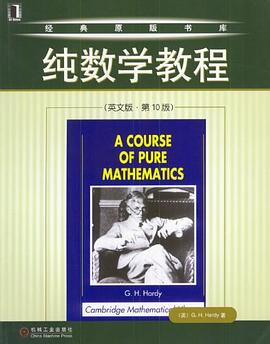
自从1908年出版以来,这本书已经成为一部经典之著。一代又一代崭露头角的数学家正是通过这本书的指引,步入了数学的殿堂。
在本书中,作者怀着对教育工作的无限热忱,以一种严格的纯粹学者的态度,揭示了微积分的基本思想、无穷级数的性质以及包括极限概念在内的其他题材。
作者简介
G. H.Hardy英国数学家(1877—1947)。1896年考入剑桥三一学院,并子1900年在剑桥获得史密斯奖。之后,在英国牛津大学。剑桥大学任教,是20世纪初著名的数学分析家之一。
他的贡献包括数论中的丢番图逼近、堆垒数论、素数分布理论与黎曼函数,调和分析中的三角级数理论。发散级数求和与陶伯定理。不等式、积分变换与积分方程等方面,对分析学的发展有深刻的影响。以他的名字命名的Hp空间(哈代空间),至今仍是数学研究中十分活跃的领域。
除本书外,他还著有《不等式》、《发散级数》等10多部书籍与300多篇文章。
目录信息
REAL VARIABLES
SECT.
1-2. Rational numbers
3-7. Irrational numbers
8. Real numbers
9. Relations of magnitude between real numbers
10-11. Algebraical operations with real numbers
12. The number 2
13-14. Quadratic surds
15. The continum
16. The continuous real variable
17. Sections of the real numbers. Dedekind's theorem
18. Points of accumulation
19. Weierstrass's theorem .
Miscellaneous examples
CHAPTER II
FUNCTIONS OF REAL VARIABLES
20. The idea of a function
21. The graphical representation of functions. Coordinates
22. Polar coordinates
23. Polynomias
24-25. Rational functions
26-27. Aigebraical functious
28-29. Transcendental functions
30. Graphical solution of equations
31. Functions of two variables and their graphical repre-
sentation
32. Curves in a plane
33. Loci in space
Miscellaneous examples
CHAPTER III
COMPLEX NUMBERS
SECT.
34-38. Displacements
39-42. Complex numbers
43. The quadratic equation with real coefficients
44. Argand's diagram
45. De Moivre's theorem
46. Rational functions of a complex variable
47-49. Roots of complex numbers
Miscellaneous examples
CHAPTER IV
LIMITS OF FUNCTIONS OF A POSITIVE INTEGRAL VARIABLE
50. Functions of a positive integral variable
51. Interpolation
52. Finite and infinite classes
53-57. Properties possessed by a function of n for large values
of n
58-61. Definition of a limit and other definitions
62. Oscillating functions
63-68. General theorems concerning limits
69-70. Steadily increasing or decreasing functions
71. Alternative proof of Weierstrass's theorem
72. The limit of xn
73. The limit of(1+
74. Some algebraical lemmas
75. The limit of n(nX-1)
76-77. Infinite series
78. The infinite geometrical series
79. The representation of functions of a continuous real
variable by means of limits
80. The bounds of a bounded aggregate
81. The bounds of a bounded function
82. The limits of indetermination of a bounded function
83-84. The general principle of convergence
85-86. Limits of complex functions and series of complex terms
87-88. Applications to zn and the geometrical series
89. The symbols O, o,
Miscellaneous examples
CHAPTER V
LIMITS OF FUNCTIONS OF A CONTINUOUS VARIABLE. CONTINUOUS
AND DISCONTINUOUS FUNCTIONS
90-92. Limits as x-- or x---
93-97. Limits as z-, a
98. The symbols O, o,~: orders of smallness and greatness
99-100. Continuous functions of a real variable
101-105. Properties of continuous functions. Bounded functions.
The oscillation of a function in an interval
106-107. Sets of intervals on a line. The Heine-Borel theorem
108. Continuous functions of several variables
109-110. Implicit and inverse functions
Miscellaneous examples
CHAPTER VI
DERIVATIVES AND INTEGRALS
111-113. Derivatives
114. General rules for differentiation
115. Derivatives of complex functions
116. The notation of the differential calculus
117. Differentiation of polynomials
118. Differentiation of rational functions
119. Differentiation of algebraical functions
120. Differentiation of transcendental functions
121. Repeated differentiation
122. General theorems concerning derivatives, Rolle's
theorem
123-125. Maxima and minima
126-127. The mean value theorem
128. Cauchy's mean value theorem
SECT.
129. A theorem of Darboux
130-131. Integration. The logarithmic function
132. Integration of polynomials
133-134. Integration of rational functions
135-142. Integration of algebraical functions. Integration by
rationalisation. Integration by parts
143-147. Integration of transcendental functions
148. Areas of plane curves
149. Lengths of plane curves
Miscellaneous examples
CHAPTER VII
ADDITIONAL THEOREMS IN THE DIFFERENTIAL AND INTEGRAL CALCULUS
150-151. Taylor's theorem
152. Taylor's series
153. Applications of Taylor's theorem to maxima and
minima
154. The calculation of certain limits
155. The contact of plane curves
156-158. Differentiation of functions of several variables
159. The mean value theorem for functions of two variables
160. Differentials
161-162. Definite integrals
163. The circular functions
164. Calculation of the definite integral as the limit of a sum
165. General properties of the definite integral
166. Integration by parts and by substitution
167. Alternative proof of Taylor's theorem
168. Application to the binomial series
169. Approximate formulae for definite integrals. Simpson's
rule
170. Integrals of complex functions
Miscellaneous examples
CHAPTER VIII
THE CONVERGENCE OF INFINITE SERIES AND INFINITE INTEGRALS
SECT. PAGE
171-174. Series of positive terms. Cauchy's and d'Alembert's
tests of convergence
175. Ratio tests
176. Dirichlet's theorem
177. Multiplication of series of positive terms
178-180. Further tests for convergence. Abel's theorem. Mac-
laurin's integral test
181. The series n-s
182. Cauchy's condensation test
183. Further ratio tests
184-189. Infinite integrals
190. Series of positive and negative terms
191-192. Absolutely convergent series
193-194. Conditionally convergent series
195. Alternating series
196. Abel's and Dirichlet's tests of convergence
197. Series of complex terms
198-201. Power series
202. Multiplication of series
203. Absolutely and conditionally convergent infinite
integrals
Miscellaneous examples
CHAPTER IX
THE LOGARITHMIC, EXPONENTIAL, AND CIRCULAR FUNCTIONS
OF A REAL VARIABLE
204-205. The logarithmic function
206. The functional equation satisfied by log x
207-209. The behaviour of log x as x tends to infinity or to zero
210. The logarithmic scale of infinity
211. The number e
212-213. The exponential function
214. The general power ax
215. The exponential limit
216. The logarithmic limit
SECT.
217. Common logarithms
218. Logarithmic tests of convergence
219. The exponential series
220. The logarithmic series
221. The series for arc tan x
222. The binomial series
223. Alternative development of the theory
224-226. The analytical theory of the circular functions
Miscellaneous examples
CHAPTER X
THE GENERAL THEORY OF THE LOGARITHMIC, EXPONENTIAL,
AND CIRCULAR FUNCTIONS
227-228. Functions of a complex variable
229. Curvilinear integrals
230. Definition of the logarithmic function
231. The values of the logarithmic function
232-234. The exponential function
235-236. The general power a
237-240. The trigonometrical and hyperbolic functions
241. The connection between the logarithmic and inverse
trigonometrical functions
242. The exponential series
243. The series for cos z and sin z
244-245. The logarithmic series
246. The exponential limit
247. The binomial series
Miscellaneous examples
The functional equation satisfied by Log z, 454. The function e, 460.
Logarithms to any base, 461. The inverse cosine, sine, and tangent of a
complex number, 464. Trigonometrical series, 470, 472-474, 484, 485.
Roots of transcendental equations, 479, 480. Transformations, 480-483.
Stereographic projection, 482. Mercator's projection, 482. Level curves,
484-485. Definite integrals, 486.
APPENDIX I. The proof that every equation has a root
APPENDIX II. A note on double limit problems
APPENDIX III. The infinite in analysis and geometry
APPENDIX IV. The infinite in analysis and geometry
INDEX
· · · · · · (收起)
读后感
书名是A Course of Pure Mathematics, 实际上名不副实,因为书里只讲了基本的分析学原理,没有其他的数学内容(除了那几个附录讲了些别的主题,比如怎么证明代数基本定理)。 哈代是个优秀的数学家。在哈代之前,剑桥大学拥有许多杰出的应用数学家,比如Green,Stokes还有Max...
书名是A Course of Pure Mathematics, 实际上名不副实,因为书里只讲了基本的分析学原理,没有其他的数学内容(除了那几个附录讲了些别的主题,比如怎么证明代数基本定理)。 哈代是个优秀的数学家。在哈代之前,剑桥大学拥有许多杰出的应用数学家,比如Green,Stokes还有Max...
书名是A Course of Pure Mathematics, 实际上名不副实,因为书里只讲了基本的分析学原理,没有其他的数学内容(除了那几个附录讲了些别的主题,比如怎么证明代数基本定理)。 哈代是个优秀的数学家。在哈代之前,剑桥大学拥有许多杰出的应用数学家,比如Green,Stokes还有Max...
书名是A Course of Pure Mathematics, 实际上名不副实,因为书里只讲了基本的分析学原理,没有其他的数学内容(除了那几个附录讲了些别的主题,比如怎么证明代数基本定理)。 哈代是个优秀的数学家。在哈代之前,剑桥大学拥有许多杰出的应用数学家,比如Green,Stokes还有Max...
书名是A Course of Pure Mathematics, 实际上名不副实,因为书里只讲了基本的分析学原理,没有其他的数学内容(除了那几个附录讲了些别的主题,比如怎么证明代数基本定理)。 哈代是个优秀的数学家。在哈代之前,剑桥大学拥有许多杰出的应用数学家,比如Green,Stokes还有Max...
用户评价
经典 但过时了
: O13
《素数之恋》作者John Derbyshire推崇的微积分教材
很差的一本书
《素数之恋》作者John Derbyshire推崇的微积分教材